

124
Y. Ge and Z. Ye
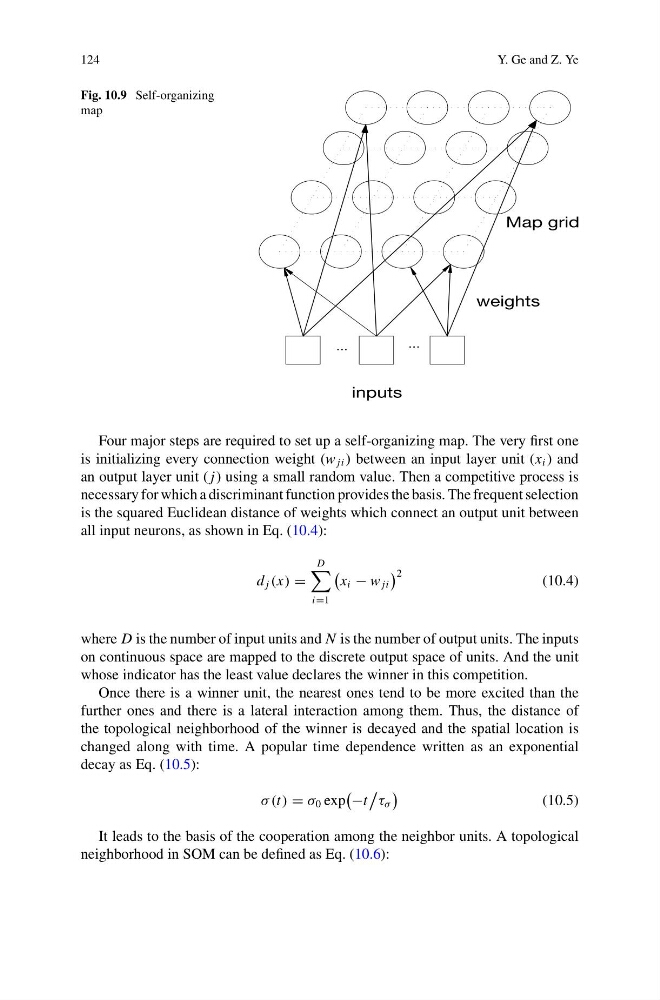
Fig. 10.9 Self-organizing
map
Four major steps are required to set up a self-organizing map. The very first one
is initializing every connection weight (w ji ) between an input layer unit (x i ) and
an output layer unit ( j) using a small random value. Then a competitive process is
necessary for which a discriminant function provides the basis. The frequent selection
is the squared Euclidean distance of weights which connect an output unit between
all input neurons, as shown in Eq. (10.4):
d j (x) =
D
i=1
x i − w ji
2
(10.4)
where D is the number of input units and N is the number of output units. The inputs
on continuous space are mapped to the discrete output space of units. And the unit
whose indicator has the least value declares the winner in this competition.
Once there is a winner unit, the nearest ones tend to be more excited than the
further ones and there is a lateral interaction among them. Thus, the distance of
the topological neighborhood of the winner is decayed and the spatial location is
changed along with time. A popular time dependence written as an exponential
decay as Eq. (10.5):
σ (t) = σ 0 exp
−t
τ σ
(10.5)
It leads to the basis of the cooperation among the neighbor units. A topological
neighborhood in SOM can be defined as Eq. (10.6):
Y. Ge and Z. Ye
Fig. 10.9 Self-organizing
map
Four major steps are required to set up a self-organizing map. The very first one
is initializing every connection weight (w ji ) between an input layer unit (x i ) and
an output layer unit ( j) using a small random value. Then a competitive process is
necessary for which a discriminant function provides the basis. The frequent selection
is the squared Euclidean distance of weights which connect an output unit between
all input neurons, as shown in Eq. (10.4):
d j (x) =
D
i=1
x i − w ji
2
(10.4)
where D is the number of input units and N is the number of output units. The inputs
on continuous space are mapped to the discrete output space of units. And the unit
whose indicator has the least value declares the winner in this competition.
Once there is a winner unit, the nearest ones tend to be more excited than the
further ones and there is a lateral interaction among them. Thus, the distance of
the topological neighborhood of the winner is decayed and the spatial location is
changed along with time. A popular time dependence written as an exponential
decay as Eq. (10.5):
σ (t) = σ 0 exp
−t
τ σ
(10.5)
It leads to the basis of the cooperation among the neighbor units. A topological
neighborhood in SOM can be defined as Eq. (10.6):