

6.3 Classical Solutions in Nonlocal Gravity Models
61
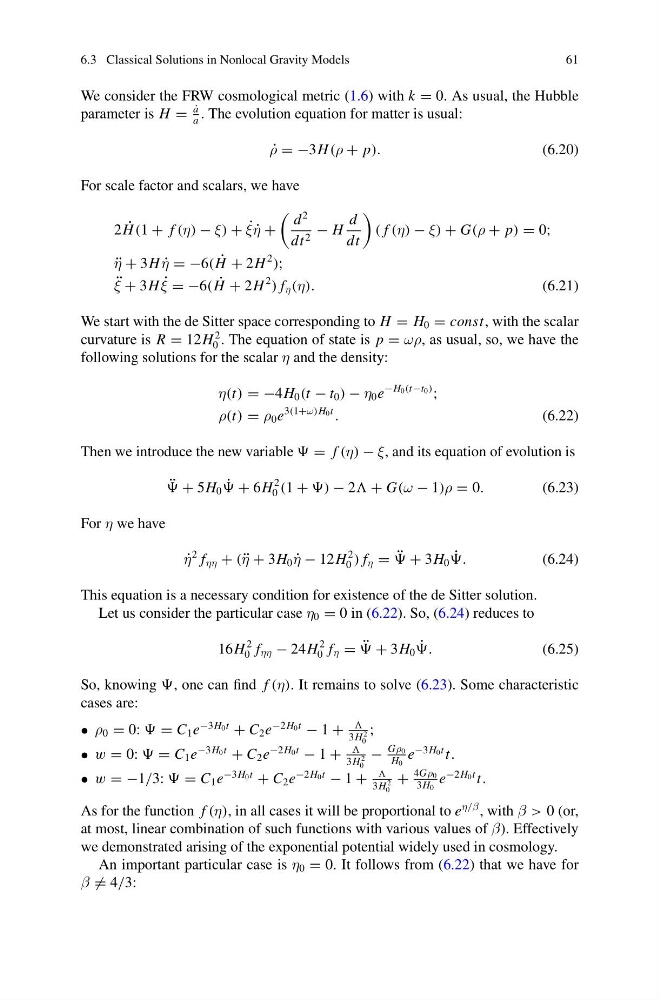
We consider the FRW cosmological metric (1.6) with k = 0. As usual, the Hubble
parameter is H =
˙
a
a
. The evolution equation for matter is usual:
˙
ρ = −3H (ρ + p).
(6.20)
For scale factor and scalars, we have
2 ˙
H (1 + f (η) − ξ) + ˙
ξ ˙
η +
d
2
dt 2 − H
d
dt
( f (η) − ξ) + G(ρ + p) = 0;
¨
η + 3H ˙
η = −6( ˙
H + 2H
2
);
¨
ξ + 3H ˙
ξ = −6( ˙
H + 2H
2
) f η (η).
(6.21)
We start with the de Sitter space corresponding to H = H 0 = const, with the scalar
curvature is R = 12H
2
0 . The equation of state is p = ωρ, as usual, so, we have the
following solutions for the scalar η and the density:
η(t) = −4H 0 (t − t 0 ) − η 0 e
−H 0 (t−t 0 )
;
ρ(t) = ρ 0 e
3(1+ω)H 0 t
.
(6.22)
Then we introduce the new variable = f (η) − ξ, and its equation of evolution is
¨
+ 5H 0 ˙
+ 6H
2
0 (1 + ) − 2 + G(ω − 1)ρ = 0.
(6.23)
For η we have
˙
η
2 f ηη + ( ¨
η + 3H 0 ˙
η − 12H
2
0 ) f η = ¨
+ 3H 0 ˙
.
(6.24)
This equation is a necessary condition for existence of the de Sitter solution.
Let us consider the particular case η 0 = 0 in (6.22). So, (6.24) reduces to
16H
2
0 f ηη − 24H
2
0 f η = ¨
+ 3H 0 ˙
.
(6.25)
So, knowing , one can find f (η). It remains to solve (6.23). Some characteristic
cases are:
• ρ 0 = 0: = C 1 e
−3H 0 t
+ C 2 e
−2H 0 t
− 1 +
3H
2
0
;
• w = 0: = C 1 e
−3H 0 t
+ C 2 e
−2H 0 t
− 1 +
3H
2
0
−
Gρ 0
H 0
e
−3H 0 t t.
• w = −1/3: = C 1 e
−3H 0 t
+ C 2 e
−2H 0 t
− 1 +
3H
2
0
+
4Gρ 0
3H 0
e
−2H 0 t t.
As for the function f (η), in all cases it will be proportional to e
η/β , with β > 0 (or,
at most, linear combination of such functions with various values of β). Effectively
we demonstrated arising of the exponential potential widely used in cosmology.
An important particular case is η 0 = 0. It follows from (6.22) that we have for
β = 4/3:
61
We consider the FRW cosmological metric (1.6) with k = 0. As usual, the Hubble
parameter is H =
˙
a
a
. The evolution equation for matter is usual:
˙
ρ = −3H (ρ + p).
(6.20)
For scale factor and scalars, we have
2 ˙
H (1 + f (η) − ξ) + ˙
ξ ˙
η +
d
2
dt 2 − H
d
dt
( f (η) − ξ) + G(ρ + p) = 0;
¨
η + 3H ˙
η = −6( ˙
H + 2H
2
);
¨
ξ + 3H ˙
ξ = −6( ˙
H + 2H
2
) f η (η).
(6.21)
We start with the de Sitter space corresponding to H = H 0 = const, with the scalar
curvature is R = 12H
2
0 . The equation of state is p = ωρ, as usual, so, we have the
following solutions for the scalar η and the density:
η(t) = −4H 0 (t − t 0 ) − η 0 e
−H 0 (t−t 0 )
;
ρ(t) = ρ 0 e
3(1+ω)H 0 t
.
(6.22)
Then we introduce the new variable = f (η) − ξ, and its equation of evolution is
¨
+ 5H 0 ˙
+ 6H
2
0 (1 + ) − 2 + G(ω − 1)ρ = 0.
(6.23)
For η we have
˙
η
2 f ηη + ( ¨
η + 3H 0 ˙
η − 12H
2
0 ) f η = ¨
+ 3H 0 ˙
.
(6.24)
This equation is a necessary condition for existence of the de Sitter solution.
Let us consider the particular case η 0 = 0 in (6.22). So, (6.24) reduces to
16H
2
0 f ηη − 24H
2
0 f η = ¨
+ 3H 0 ˙
.
(6.25)
So, knowing , one can find f (η). It remains to solve (6.23). Some characteristic
cases are:
• ρ 0 = 0: = C 1 e
−3H 0 t
+ C 2 e
−2H 0 t
− 1 +
3H
2
0
;
• w = 0: = C 1 e
−3H 0 t
+ C 2 e
−2H 0 t
− 1 +
3H
2
0
−
Gρ 0
H 0
e
−3H 0 t t.
• w = −1/3: = C 1 e
−3H 0 t
+ C 2 e
−2H 0 t
− 1 +
3H
2
0
+
4Gρ 0
3H 0
e
−2H 0 t t.
As for the function f (η), in all cases it will be proportional to e
η/β , with β > 0 (or,
at most, linear combination of such functions with various values of β). Effectively
we demonstrated arising of the exponential potential widely used in cosmology.
An important particular case is η 0 = 0. It follows from (6.22) that we have for
β = 4/3: