

62
6 Nonlocal Gravity
ξ = −
3 f 0 β
3β − 4
e
−H 0 (t−t 0 )/β
+
c 0
3H 0
e
−3H 0 (t−t 0 )
− ξ 0 ;
η = −4H 0 (t − t 0 ); ω =
4
3β
− 1, , = 3H
2
0 (1 + ξ 0 );
ρ 0 =
6(β − 2)H
2
0 f 0
βG
,
(6.26)
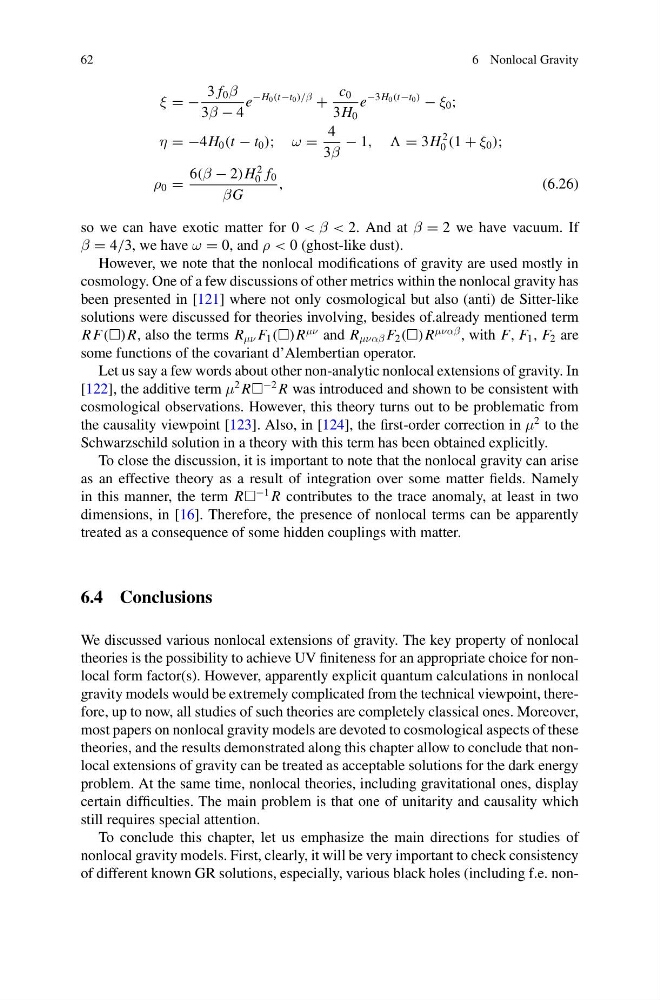
so we can have exotic matter for 0 < β < 2. And at β = 2 we have vacuum. If
β = 4/3, we have ω = 0, and ρ < 0 (ghost-like dust).
However, we note that the nonlocal modifications of gravity are used mostly in
cosmology. One of a few discussions of other metrics within the nonlocal gravity has
been presented in [121] where not only cosmological but also (anti) de Sitter-like
solutions were discussed for theories involving, besides of.already mentioned term
R F()R, also the terms R μν F 1 ()R
μν and R μναβ F 2 ()R
μναβ , with F, F 1 , F 2 are
some functions of the covariant d’Alembertian operator.
Let us say a few words about other non-analytic nonlocal extensions of gravity. In
[122], the additive term μ
2 R
−2 R was introduced and shown to be consistent with
cosmological observations. However, this theory turns out to be problematic from
the causality viewpoint [123]. Also, in [124], the first-order correction in μ
2 to the
Schwarzschild solution in a theory with this term has been obtained explicitly.
To close the discussion, it is important to note that the nonlocal gravity can arise
as an effective theory as a result of integration over some matter fields. Namely
in this manner, the term R
−1 R contributes to the trace anomaly, at least in two
dimensions, in [16]. Therefore, the presence of nonlocal terms can be apparently
treated as a consequence of some hidden couplings with matter.
6.4 Conclusions
We discussed various nonlocal extensions of gravity. The key property of nonlocal
theories is the possibility to achieve UV finiteness for an appropriate choice for nonlocal form factor(s). However, apparently explicit quantum calculations in nonlocal
gravity models would be extremely complicated from the technical viewpoint, therefore, up to now, all studies of such theories are completely classical ones. Moreover,
most papers on nonlocal gravity models are devoted to cosmological aspects of these
theories, and the results demonstrated along this chapter allow to conclude that nonlocal extensions of gravity can be treated as acceptable solutions for the dark energy
problem. At the same time, nonlocal theories, including gravitational ones, display
certain difficulties. The main problem is that one of unitarity and causality which
still requires special attention.
To conclude this chapter, let us emphasize the main directions for studies of
nonlocal gravity models. First, clearly, it will be very important to check consistency
of different known GR solutions, especially, various black holes (including f.e. non-
6 Nonlocal Gravity
ξ = −
3 f 0 β
3β − 4
e
−H 0 (t−t 0 )/β
+
c 0
3H 0
e
−3H 0 (t−t 0 )
− ξ 0 ;
η = −4H 0 (t − t 0 ); ω =
4
3β
− 1, , = 3H
2
0 (1 + ξ 0 );
ρ 0 =
6(β − 2)H
2
0 f 0
βG
,
(6.26)
so we can have exotic matter for 0 < β < 2. And at β = 2 we have vacuum. If
β = 4/3, we have ω = 0, and ρ < 0 (ghost-like dust).
However, we note that the nonlocal modifications of gravity are used mostly in
cosmology. One of a few discussions of other metrics within the nonlocal gravity has
been presented in [121] where not only cosmological but also (anti) de Sitter-like
solutions were discussed for theories involving, besides of.already mentioned term
R F()R, also the terms R μν F 1 ()R
μν and R μναβ F 2 ()R
μναβ , with F, F 1 , F 2 are
some functions of the covariant d’Alembertian operator.
Let us say a few words about other non-analytic nonlocal extensions of gravity. In
[122], the additive term μ
2 R
−2 R was introduced and shown to be consistent with
cosmological observations. However, this theory turns out to be problematic from
the causality viewpoint [123]. Also, in [124], the first-order correction in μ
2 to the
Schwarzschild solution in a theory with this term has been obtained explicitly.
To close the discussion, it is important to note that the nonlocal gravity can arise
as an effective theory as a result of integration over some matter fields. Namely
in this manner, the term R
−1 R contributes to the trace anomaly, at least in two
dimensions, in [16]. Therefore, the presence of nonlocal terms can be apparently
treated as a consequence of some hidden couplings with matter.
6.4 Conclusions
We discussed various nonlocal extensions of gravity. The key property of nonlocal
theories is the possibility to achieve UV finiteness for an appropriate choice for nonlocal form factor(s). However, apparently explicit quantum calculations in nonlocal
gravity models would be extremely complicated from the technical viewpoint, therefore, up to now, all studies of such theories are completely classical ones. Moreover,
most papers on nonlocal gravity models are devoted to cosmological aspects of these
theories, and the results demonstrated along this chapter allow to conclude that nonlocal extensions of gravity can be treated as acceptable solutions for the dark energy
problem. At the same time, nonlocal theories, including gravitational ones, display
certain difficulties. The main problem is that one of unitarity and causality which
still requires special attention.
To conclude this chapter, let us emphasize the main directions for studies of
nonlocal gravity models. First, clearly, it will be very important to check consistency
of different known GR solutions, especially, various black holes (including f.e. non-