

5.2 Basic Definitions
49
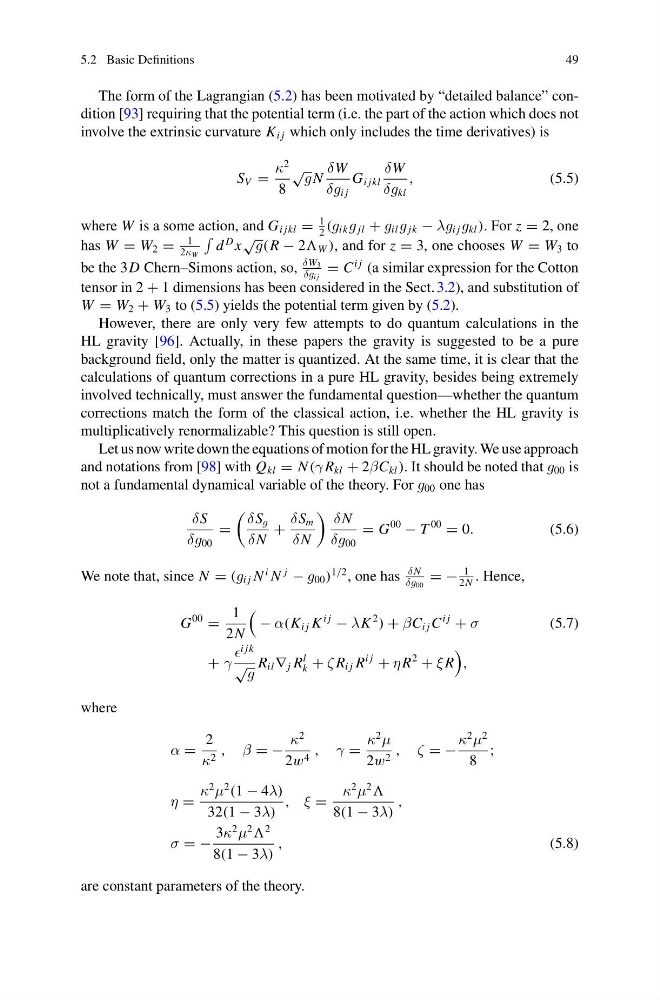
The form of the Lagrangian (5.2) has been motivated by “detailed balance” condition [93] requiring that the potential term (i.e. the part of the action which does not
involve the extrinsic curvature K i j which only includes the time derivatives) is
S V =
κ
2
8
√ g N
δW
δg i j
G i jkl
δW
δg kl
,
(5.5)
where W is a some action, and G i jkl =
1
2
(g ik g jl + g il g jk − λg i j g kl ). For z = 2, one
has W = W 2 =
1
2κ W
d
D x
√ g(R − 2 W ), and for z = 3, one chooses W = W 3 to
be the 3D Chern–Simons action, so,
δW 3
δg i j
= C
i j (a similar expression for the Cotton
tensor in 2 + 1 dimensions has been considered in the Sect. 3.2), and substitution of
W = W 2 + W 3 to (5.5) yields the potential term given by (5.2).
However, there are only very few attempts to do quantum calculations in the
HL gravity [96]. Actually, in these papers the gravity is suggested to be a pure
background field, only the matter is quantized. At the same time, it is clear that the
calculations of quantum corrections in a pure HL gravity, besides being extremely
involved technically, must answer the fundamental question—whether the quantum
corrections match the form of the classical action, i.e. whether the HL gravity is
multiplicatively renormalizable? This question is still open.
Let us now write down the equations of motion for the HL gravity. We use approach
and notations from [98] with Q kl = N (γ R kl + 2βC kl ). It should be noted that g 00 is
not a fundamental dynamical variable of the theory. For g 00 one has
δS
δg 00
=
δS g
δ N
+
δS m
δ N
δ N
δg 00
= G
00
− T
00
= 0.
(5.6)
We note that, since N = (g i j N
i N
j
− g 00 )
1/2 , one has
δ N
δg 00
= −
1
2N
. Hence,
G
00
=
1
2N
− α(K i j K
i j
− λK
2
) + βC i j C
i j
+ σ
(5.7)
+ γ
i jk
√
g
R il ∇ j R
l
k + ζ R i j R
i j
+ η R
2
+ ξ R
,
where
α =
2
κ 2 , β = −
κ
2
2w 4 , γ =
κ
2
μ
2w 2 , ζ = −
κ
2
μ
2
8
;
η =
κ
2
μ
2
(1 − 4λ)
32(1 − 3λ)
, ξ =
κ
2
μ
2
8(1 − 3λ)
,
σ = −
3κ
2
μ
2
2
8(1 − 3λ)
,
(5.8)
are constant parameters of the theory.
49
The form of the Lagrangian (5.2) has been motivated by “detailed balance” condition [93] requiring that the potential term (i.e. the part of the action which does not
involve the extrinsic curvature K i j which only includes the time derivatives) is
S V =
κ
2
8
√ g N
δW
δg i j
G i jkl
δW
δg kl
,
(5.5)
where W is a some action, and G i jkl =
1
2
(g ik g jl + g il g jk − λg i j g kl ). For z = 2, one
has W = W 2 =
1
2κ W
d
D x
√ g(R − 2 W ), and for z = 3, one chooses W = W 3 to
be the 3D Chern–Simons action, so,
δW 3
δg i j
= C
i j (a similar expression for the Cotton
tensor in 2 + 1 dimensions has been considered in the Sect. 3.2), and substitution of
W = W 2 + W 3 to (5.5) yields the potential term given by (5.2).
However, there are only very few attempts to do quantum calculations in the
HL gravity [96]. Actually, in these papers the gravity is suggested to be a pure
background field, only the matter is quantized. At the same time, it is clear that the
calculations of quantum corrections in a pure HL gravity, besides being extremely
involved technically, must answer the fundamental question—whether the quantum
corrections match the form of the classical action, i.e. whether the HL gravity is
multiplicatively renormalizable? This question is still open.
Let us now write down the equations of motion for the HL gravity. We use approach
and notations from [98] with Q kl = N (γ R kl + 2βC kl ). It should be noted that g 00 is
not a fundamental dynamical variable of the theory. For g 00 one has
δS
δg 00
=
δS g
δ N
+
δS m
δ N
δ N
δg 00
= G
00
− T
00
= 0.
(5.6)
We note that, since N = (g i j N
i N
j
− g 00 )
1/2 , one has
δ N
δg 00
= −
1
2N
. Hence,
G
00
=
1
2N
− α(K i j K
i j
− λK
2
) + βC i j C
i j
+ σ
(5.7)
+ γ
i jk
√
g
R il ∇ j R
l
k + ζ R i j R
i j
+ η R
2
+ ξ R
,
where
α =
2
κ 2 , β = −
κ
2
2w 4 , γ =
κ
2
μ
2w 2 , ζ = −
κ
2
μ
2
8
;
η =
κ
2
μ
2
(1 − 4λ)
32(1 − 3λ)
, ξ =
κ
2
μ
2
8(1 − 3λ)
,
σ = −
3κ
2
μ
2
2
8(1 − 3λ)
,
(5.8)
are constant parameters of the theory.