

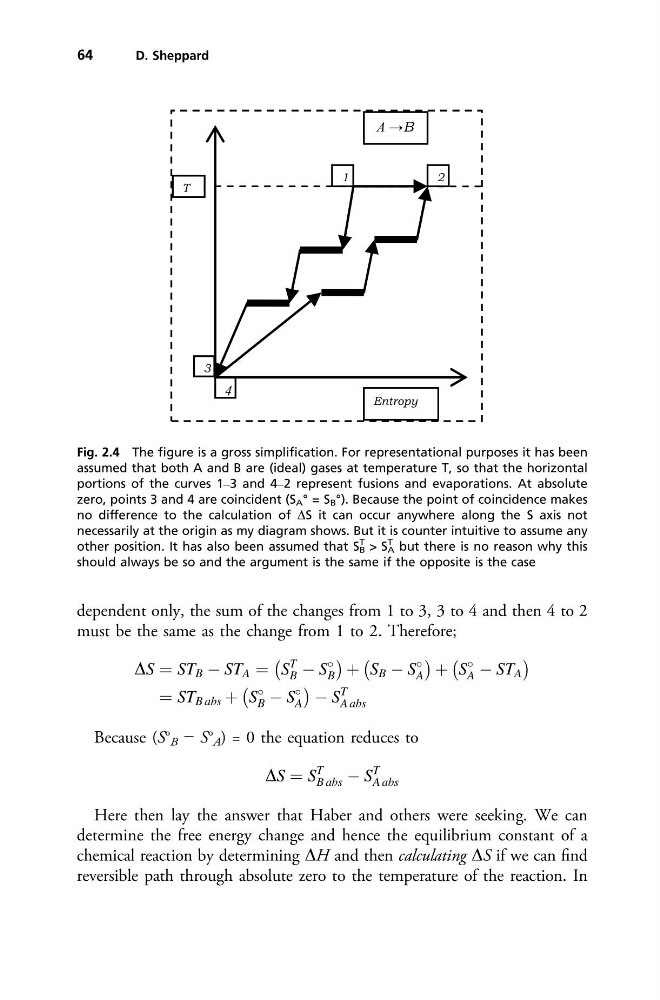
dependent only, the sum of the changes from 1 to 3, 3 to 4 and then 4 to 2
must be the same as the change from 1 to 2. Therefore;
DS ¼ ST B À ST A ¼ S
T
B À S
B
À
Á þ S B À S
A
À
Á þ S
A À ST A
À
Á
¼ ST B abs þ S
B À S
A
À
Á À S
T
A abs
Because (S° B − S° A ) = 0 the equation reduces to
DS ¼ S
T
B abs À S
T
A abs
Here then lay the answer that Haber and others were seeking. We can
determine the free energy change and hence the equilibrium constant of a
chemical reaction by determining DH and then calculating DS if we can find
reversible path through absolute zero to the temperature of the reaction. In
T
Entropy
1
2
3
4
A →B
Fig. 2.4 The figure is a gross simplification. For representational purposes it has been
assumed that both A and B are (ideal) gases at temperature T, so that the horizontal
portions of the curves 1–3 and 4–2 represent fusions and evaporations. At absolute
zero, points 3 and 4 are coincident (S A ° = S B °). Because the point of coincidence makes
no difference to the calculation of DS it can occur anywhere along the S axis not
necessarily at the origin as my diagram shows. But it is counter intuitive to assume any
other position. It has also been assumed that S B
T > S A
T but there is no reason why this
should always be so and the argument is the same if the opposite is the case
64
D. Sheppard
must be the same as the change from 1 to 2. Therefore;
DS ¼ ST B À ST A ¼ S
T
B À S
B
À
Á þ S B À S
A
À
Á þ S
A À ST A
À
Á
¼ ST B abs þ S
B À S
A
À
Á À S
T
A abs
Because (S° B − S° A ) = 0 the equation reduces to
DS ¼ S
T
B abs À S
T
A abs
Here then lay the answer that Haber and others were seeking. We can
determine the free energy change and hence the equilibrium constant of a
chemical reaction by determining DH and then calculating DS if we can find
reversible path through absolute zero to the temperature of the reaction. In
T
Entropy
1
2
3
4
A →B
Fig. 2.4 The figure is a gross simplification. For representational purposes it has been
assumed that both A and B are (ideal) gases at temperature T, so that the horizontal
portions of the curves 1–3 and 4–2 represent fusions and evaporations. At absolute
zero, points 3 and 4 are coincident (S A ° = S B °). Because the point of coincidence makes
no difference to the calculation of DS it can occur anywhere along the S axis not
necessarily at the origin as my diagram shows. But it is counter intuitive to assume any
other position. It has also been assumed that S B
T > S A
T but there is no reason why this
should always be so and the argument is the same if the opposite is the case
64
D. Sheppard