

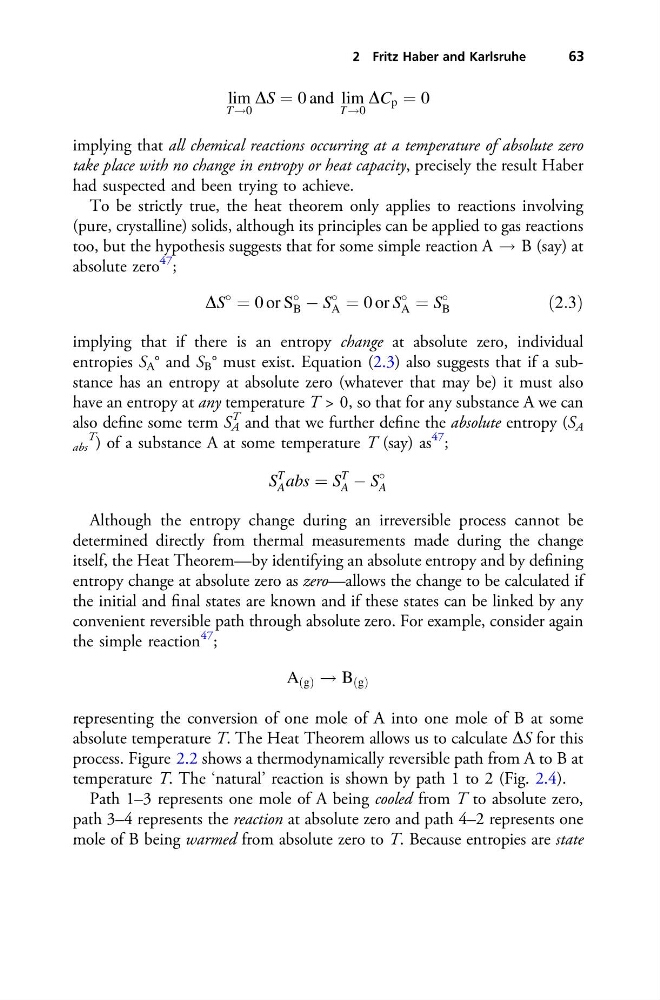
lim
T!0
DS ¼ 0 and lim
T!0
DC p ¼ 0
implying that all chemical reactions occurring at a temperature of absolute zero
take place with no change in entropy or heat capacity, precisely the result Haber
had suspected and been trying to achieve.
To be strictly true, the heat theorem only applies to reactions involving
(pure, crystalline) solids, although its principles can be applied to gas reactions
too, but the hypothesis suggests that for some simple reaction A ! B (say) at
absolute zero
47
;
DS
¼ 0 or S
B À S
A ¼ 0 or S
A ¼ S
B
ð2:3Þ
implying that if there is an entropy change at absolute zero, individual
entropies S A ° and S B ° must exist. Equation (2.3) also suggests that if a substance has an entropy at absolute zero (whatever that may be) it must also
have an entropy at any temperature T > 0, so that for any substance A we can
also define some term S A
T and that we further define the absolute entropy (S A
abs
T ) of a substance A at some temperature T (say) as
47 ;
S
T
A abs ¼ S
T
A À S
A
Although the entropy change during an irreversible process cannot be
determined directly from thermal measurements made during the change
itself, the Heat Theorem—by identifying an absolute entropy and by defining
entropy change at absolute zero as zero—allows the change to be calculated if
the initial and final states are known and if these states can be linked by any
convenient reversible path through absolute zero. For example, consider again
the simple reaction
47
;
A ðgÞ ! B ðgÞ
representing the conversion of one mole of A into one mole of B at some
absolute temperature T. The Heat Theorem allows us to calculate DS for this
process. Figure 2.2 shows a thermodynamically reversible path from A to B at
temperature T. The ‘natural’ reaction is shown by path 1 to 2 (Fig. 2.4).
Path 1–3 represents one mole of A being cooled from T to absolute zero,
path 3–4 represents the reaction at absolute zero and path 4–2 represents one
mole of B being warmed from absolute zero to T. Because entropies are state
2 Fritz Haber and Karlsruhe
63
T!0
DS ¼ 0 and lim
T!0
DC p ¼ 0
implying that all chemical reactions occurring at a temperature of absolute zero
take place with no change in entropy or heat capacity, precisely the result Haber
had suspected and been trying to achieve.
To be strictly true, the heat theorem only applies to reactions involving
(pure, crystalline) solids, although its principles can be applied to gas reactions
too, but the hypothesis suggests that for some simple reaction A ! B (say) at
absolute zero
47
;
DS
¼ 0 or S
B À S
A ¼ 0 or S
A ¼ S
B
ð2:3Þ
implying that if there is an entropy change at absolute zero, individual
entropies S A ° and S B ° must exist. Equation (2.3) also suggests that if a substance has an entropy at absolute zero (whatever that may be) it must also
have an entropy at any temperature T > 0, so that for any substance A we can
also define some term S A
T and that we further define the absolute entropy (S A
abs
T ) of a substance A at some temperature T (say) as
47 ;
S
T
A abs ¼ S
T
A À S
A
Although the entropy change during an irreversible process cannot be
determined directly from thermal measurements made during the change
itself, the Heat Theorem—by identifying an absolute entropy and by defining
entropy change at absolute zero as zero—allows the change to be calculated if
the initial and final states are known and if these states can be linked by any
convenient reversible path through absolute zero. For example, consider again
the simple reaction
47
;
A ðgÞ ! B ðgÞ
representing the conversion of one mole of A into one mole of B at some
absolute temperature T. The Heat Theorem allows us to calculate DS for this
process. Figure 2.2 shows a thermodynamically reversible path from A to B at
temperature T. The ‘natural’ reaction is shown by path 1 to 2 (Fig. 2.4).
Path 1–3 represents one mole of A being cooled from T to absolute zero,
path 3–4 represents the reaction at absolute zero and path 4–2 represents one
mole of B being warmed from absolute zero to T. Because entropies are state
2 Fritz Haber and Karlsruhe
63