

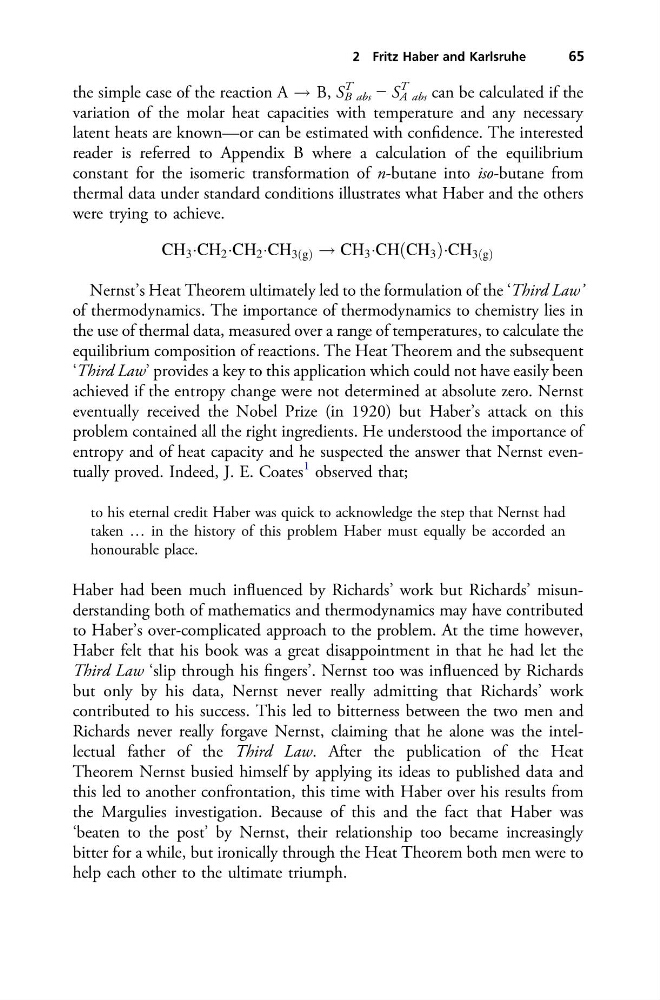
the simple case of the reaction A ! B, S B abs
T
− S A abs
T
can be calculated if the
variation of the molar heat capacities with temperature and any necessary
latent heats are known—or can be estimated with confidence. The interested
reader is referred to Appendix B where a calculation of the equilibrium
constant for the isomeric transformation of n-butane into iso-butane from
thermal data under standard conditions illustrates what Haber and the others
were trying to achieve.
CH 3 ÁCH 2 ÁCH 2 ÁCH 3ðgÞ ! CH 3 ÁCH CH 3
ð
ÞÁCH 3ðgÞ
Nernst’s Heat Theorem ultimately led to the formulation of the ‘Third Law’
of thermodynamics. The importance of thermodynamics to chemistry lies in
the use of thermal data, measured over a range of temperatures, to calculate the
equilibrium composition of reactions. The Heat Theorem and the subsequent
‘Third Law’ provides a key to this application which could not have easily been
achieved if the entropy change were not determined at absolute zero. Nernst
eventually received the Nobel Prize (in 1920) but Haber’s attack on this
problem contained all the right ingredients. He understood the importance of
entropy and of heat capacity and he suspected the answer that Nernst eventually proved. Indeed, J. E. Coates
1 observed that;
to his eternal credit Haber was quick to acknowledge the step that Nernst had
taken … in the history of this problem Haber must equally be accorded an
honourable place.
Haber had been much influenced by Richards’ work but Richards’ misunderstanding both of mathematics and thermodynamics may have contributed
to Haber’s over-complicated approach to the problem. At the time however,
Haber felt that his book was a great disappointment in that he had let the
Third Law ‘slip through his fingers’. Nernst too was influenced by Richards
but only by his data, Nernst never really admitting that Richards’ work
contributed to his success. This led to bitterness between the two men and
Richards never really forgave Nernst, claiming that he alone was the intellectual father of the Third Law. After the publication of the Heat
Theorem Nernst busied himself by applying its ideas to published data and
this led to another confrontation, this time with Haber over his results from
the Margulies investigation. Because of this and the fact that Haber was
‘beaten to the post’ by Nernst, their relationship too became increasingly
bitter for a while, but ironically through the Heat Theorem both men were to
help each other to the ultimate triumph.
2 Fritz Haber and Karlsruhe
65
T
− S A abs
T
can be calculated if the
variation of the molar heat capacities with temperature and any necessary
latent heats are known—or can be estimated with confidence. The interested
reader is referred to Appendix B where a calculation of the equilibrium
constant for the isomeric transformation of n-butane into iso-butane from
thermal data under standard conditions illustrates what Haber and the others
were trying to achieve.
CH 3 ÁCH 2 ÁCH 2 ÁCH 3ðgÞ ! CH 3 ÁCH CH 3
ð
ÞÁCH 3ðgÞ
Nernst’s Heat Theorem ultimately led to the formulation of the ‘Third Law’
of thermodynamics. The importance of thermodynamics to chemistry lies in
the use of thermal data, measured over a range of temperatures, to calculate the
equilibrium composition of reactions. The Heat Theorem and the subsequent
‘Third Law’ provides a key to this application which could not have easily been
achieved if the entropy change were not determined at absolute zero. Nernst
eventually received the Nobel Prize (in 1920) but Haber’s attack on this
problem contained all the right ingredients. He understood the importance of
entropy and of heat capacity and he suspected the answer that Nernst eventually proved. Indeed, J. E. Coates
1 observed that;
to his eternal credit Haber was quick to acknowledge the step that Nernst had
taken … in the history of this problem Haber must equally be accorded an
honourable place.
Haber had been much influenced by Richards’ work but Richards’ misunderstanding both of mathematics and thermodynamics may have contributed
to Haber’s over-complicated approach to the problem. At the time however,
Haber felt that his book was a great disappointment in that he had let the
Third Law ‘slip through his fingers’. Nernst too was influenced by Richards
but only by his data, Nernst never really admitting that Richards’ work
contributed to his success. This led to bitterness between the two men and
Richards never really forgave Nernst, claiming that he alone was the intellectual father of the Third Law. After the publication of the Heat
Theorem Nernst busied himself by applying its ideas to published data and
this led to another confrontation, this time with Haber over his results from
the Margulies investigation. Because of this and the fact that Haber was
‘beaten to the post’ by Nernst, their relationship too became increasingly
bitter for a while, but ironically through the Heat Theorem both men were to
help each other to the ultimate triumph.
2 Fritz Haber and Karlsruhe
65