

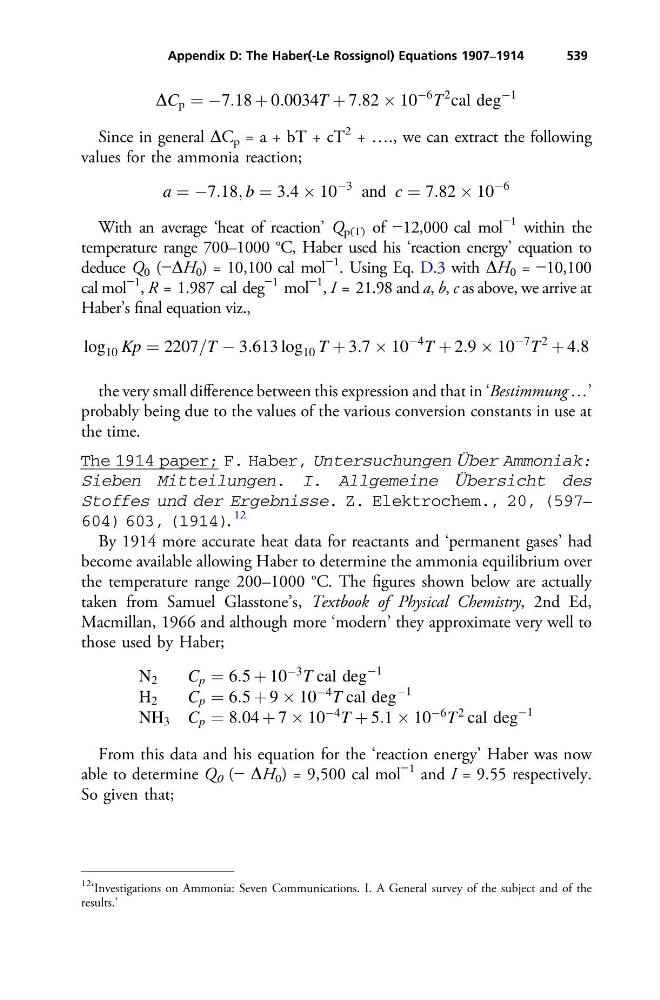
DC p ¼ À7:18 þ 0:0034T þ 7:82 Â 10
À6
T
2 cal deg
À1
Since in general DC p = a + bT + cT
2 + …., we can extract the following
values for the ammonia reaction;
a ¼ À7:18; b ¼ 3:4 Â 10
À3 and c ¼ 7:82 Â 10
À6
With an average ‘heat of reaction’ Q p(T) of −12,000 cal mol
−1 within the
temperature range 700–1000 °C, Haber used his ‘reaction energy’ equation to
deduce Q 0 (−DH 0 ) = 10,100 cal mol
−1
. Using Eq. D.3 with DH 0 = −10,100
cal mol
−1
, R = 1.987 cal deg
−1 mol
−1
, I = 21.98 and a, b, c as above, we arrive at
Haber’s final equation viz.,
log 10 Kp ¼ 2207=T À 3:613 log 10 T þ 3:7 Â 10
À4
T þ 2:9 Â 10
À7
T
2
þ 4:8
the very small difference between this expression and that in ‘Bestimmung …’
probably being due to the values of the various conversion constants in use at
the time.
The 1914 paper; F. Haber, Untersuchungen Über Ammoniak:
Sieben Mitteilungen. I. Allgemeine Übersicht des
Stoffes und der Ergebnisse. Z. Elektrochem., 20, (597–
604) 603, (1914).
12
By 1914 more accurate heat data for reactants and ‘permanent gases’ had
become available allowing Haber to determine the ammonia equilibrium over
the temperature range 200–1000 °C. The figures shown below are actually
taken from Samuel Glasstone’s, Textbook of Physical Chemistry, 2nd Ed,
Macmillan, 1966 and although more ‘modern’ they approximate very well to
those used by Haber;
N 2
C p ¼ 6:5 þ 10
À3
T cal deg
À1
H 2
C p ¼ 6:5 þ 9 Â 10
À4
T cal deg
À1
NH 3 C p ¼ 8:04 þ 7 Â 10
À4
T þ 5:1 Â 10
À6
T
2 cal deg
À1
From this data and his equation for the ‘reaction energy’ Haber was now
able to determine Q 0 (− DH 0 ) = 9,500 cal mol
−1 and I = 9.55 respectively.
So given that;
12 ‘Investigations on Ammonia: Seven Communications. I. A General survey of the subject and of the
results.’
Appendix D: The Haber(-Le Rossignol) Equations 1907–1914
539
À6
T
2 cal deg
À1
Since in general DC p = a + bT + cT
2 + …., we can extract the following
values for the ammonia reaction;
a ¼ À7:18; b ¼ 3:4 Â 10
À3 and c ¼ 7:82 Â 10
À6
With an average ‘heat of reaction’ Q p(T) of −12,000 cal mol
−1 within the
temperature range 700–1000 °C, Haber used his ‘reaction energy’ equation to
deduce Q 0 (−DH 0 ) = 10,100 cal mol
−1
. Using Eq. D.3 with DH 0 = −10,100
cal mol
−1
, R = 1.987 cal deg
−1 mol
−1
, I = 21.98 and a, b, c as above, we arrive at
Haber’s final equation viz.,
log 10 Kp ¼ 2207=T À 3:613 log 10 T þ 3:7 Â 10
À4
T þ 2:9 Â 10
À7
T
2
þ 4:8
the very small difference between this expression and that in ‘Bestimmung …’
probably being due to the values of the various conversion constants in use at
the time.
The 1914 paper; F. Haber, Untersuchungen Über Ammoniak:
Sieben Mitteilungen. I. Allgemeine Übersicht des
Stoffes und der Ergebnisse. Z. Elektrochem., 20, (597–
604) 603, (1914).
12
By 1914 more accurate heat data for reactants and ‘permanent gases’ had
become available allowing Haber to determine the ammonia equilibrium over
the temperature range 200–1000 °C. The figures shown below are actually
taken from Samuel Glasstone’s, Textbook of Physical Chemistry, 2nd Ed,
Macmillan, 1966 and although more ‘modern’ they approximate very well to
those used by Haber;
N 2
C p ¼ 6:5 þ 10
À3
T cal deg
À1
H 2
C p ¼ 6:5 þ 9 Â 10
À4
T cal deg
À1
NH 3 C p ¼ 8:04 þ 7 Â 10
À4
T þ 5:1 Â 10
À6
T
2 cal deg
À1
From this data and his equation for the ‘reaction energy’ Haber was now
able to determine Q 0 (− DH 0 ) = 9,500 cal mol
−1 and I = 9.55 respectively.
So given that;
12 ‘Investigations on Ammonia: Seven Communications. I. A General survey of the subject and of the
results.’
Appendix D: The Haber(-Le Rossignol) Equations 1907–1914
539