

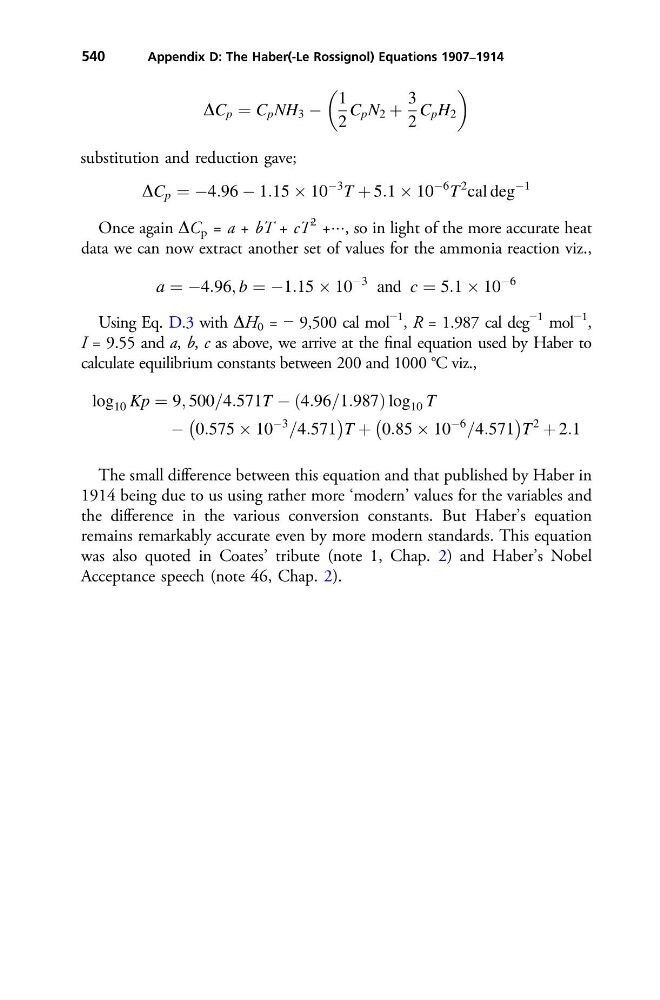
DC p ¼ C p NH 3 À
1
2
C p N 2 þ
3
2
C p H 2
substitution and reduction gave;
DC p ¼ À4:96 À 1:15 Â 10
À3
T þ 5:1 Â 10
À6
T
2 cal deg
À1
Once again DC p = a + bT + cT
2 +ÁÁÁ, so in light of the more accurate heat
data we can now extract another set of values for the ammonia reaction viz.,
a ¼ À4:96; b ¼ À1:15 Â 10
À3 and c ¼ 5:1 Â 10
À6
Using Eq. D.3 with DH 0 = − 9,500 cal mol
−1
, R = 1.987 cal deg
−1 mol
−1
,
I = 9.55 and a, b, c as above, we arrive at the final equation used by Haber to
calculate equilibrium constants between 200 and 1000 °C viz.,
log 10 Kp ¼ 9; 500=4:571T À ð4:96=1:987Þ log 10 T
À 0:575 Â 10
À3
=4:571
À
Á T þ 0:85 Â 10
À6
=4:571
À
Á
T
2
þ 2:1
The small difference between this equation and that published by Haber in
1914 being due to us using rather more ‘modern’ values for the variables and
the difference in the various conversion constants. But Haber’s equation
remains remarkably accurate even by more modern standards. This equation
was also quoted in Coates’ tribute (note 1, Chap. 2) and Haber’s Nobel
Acceptance speech (note 46, Chap. 2).
540
Appendix D: The Haber(-Le Rossignol) Equations 1907–1914
1
2
C p N 2 þ
3
2
C p H 2
substitution and reduction gave;
DC p ¼ À4:96 À 1:15 Â 10
À3
T þ 5:1 Â 10
À6
T
2 cal deg
À1
Once again DC p = a + bT + cT
2 +ÁÁÁ, so in light of the more accurate heat
data we can now extract another set of values for the ammonia reaction viz.,
a ¼ À4:96; b ¼ À1:15 Â 10
À3 and c ¼ 5:1 Â 10
À6
Using Eq. D.3 with DH 0 = − 9,500 cal mol
−1
, R = 1.987 cal deg
−1 mol
−1
,
I = 9.55 and a, b, c as above, we arrive at the final equation used by Haber to
calculate equilibrium constants between 200 and 1000 °C viz.,
log 10 Kp ¼ 9; 500=4:571T À ð4:96=1:987Þ log 10 T
À 0:575 Â 10
À3
=4:571
À
Á T þ 0:85 Â 10
À6
=4:571
À
Á
T
2
þ 2:1
The small difference between this equation and that published by Haber in
1914 being due to us using rather more ‘modern’ values for the variables and
the difference in the various conversion constants. But Haber’s equation
remains remarkably accurate even by more modern standards. This equation
was also quoted in Coates’ tribute (note 1, Chap. 2) and Haber’s Nobel
Acceptance speech (note 46, Chap. 2).
540
Appendix D: The Haber(-Le Rossignol) Equations 1907–1914