

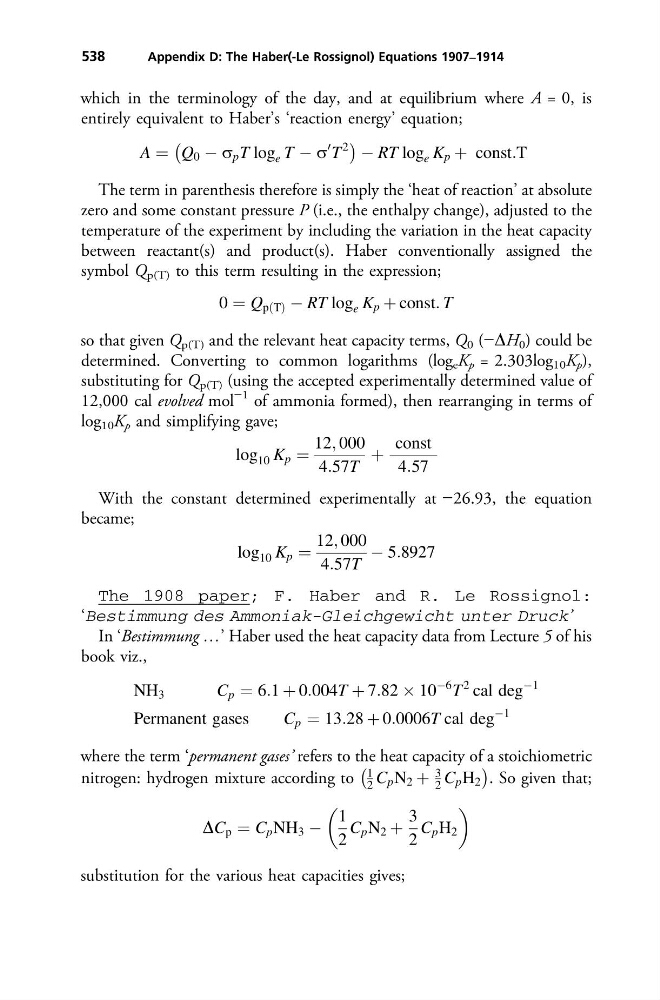
which in the terminology of the day, and at equilibrium where A = 0, is
entirely equivalent to Haber’s ‘reaction energy’ equation;
A ¼ Q 0 À r p T log e T À r
0
T
2
À
Á À RT log e K p þ const:T
The term in parenthesis therefore is simply the ‘heat of reaction’ at absolute
zero and some constant pressure P (i.e., the enthalpy change), adjusted to the
temperature of the experiment by including the variation in the heat capacity
between reactant(s) and product(s). Haber conventionally assigned the
symbol Q p(T) to this term resulting in the expression;
0 ¼ Q pðTÞ À RT log e K p þ const: T
so that given Q p(T) and the relevant heat capacity terms, Q 0 (−DH 0 ) could be
determined. Converting to common logarithms (log e K p = 2.303log 10 K p ),
substituting for Q p(T) (using the accepted experimentally determined value of
12,000 cal evolved mol
−1 of ammonia formed), then rearranging in terms of
log 10 K p and simplifying gave;
log 10 K p ¼
12; 000
4:57T
þ
const
4:57
With the constant determined experimentally at −26.93, the equation
became;
log 10 K p ¼
12; 000
4:57T
À 5:8927
The 1908 paper; F. Haber and R. Le Rossignol:
‘Bestimmung des Ammoniak-Gleichgewicht unter Druck’
In ‘Bestimmung …’ Haber used the heat capacity data from Lecture 5 of his
book viz.,
NH 3
C p ¼ 6:1 þ 0:004T þ 7:82 Â 10
À6
T
2 cal deg
À1
Permanent gases
C p ¼ 13:28 þ 0:0006T cal deg
À1
where the term ‘permanent gases’ refers to the heat capacity of a stoichiometric
nitrogen: hydrogen mixture according to
1
2 C p N 2 þ
3
2 C p H 2
À
Á
. So given that;
DC p ¼ C p NH 3 À
1
2
C p N 2 þ
3
2
C p H 2
substitution for the various heat capacities gives;
538
Appendix D: The Haber(-Le Rossignol) Equations 1907–1914
entirely equivalent to Haber’s ‘reaction energy’ equation;
A ¼ Q 0 À r p T log e T À r
0
T
2
À
Á À RT log e K p þ const:T
The term in parenthesis therefore is simply the ‘heat of reaction’ at absolute
zero and some constant pressure P (i.e., the enthalpy change), adjusted to the
temperature of the experiment by including the variation in the heat capacity
between reactant(s) and product(s). Haber conventionally assigned the
symbol Q p(T) to this term resulting in the expression;
0 ¼ Q pðTÞ À RT log e K p þ const: T
so that given Q p(T) and the relevant heat capacity terms, Q 0 (−DH 0 ) could be
determined. Converting to common logarithms (log e K p = 2.303log 10 K p ),
substituting for Q p(T) (using the accepted experimentally determined value of
12,000 cal evolved mol
−1 of ammonia formed), then rearranging in terms of
log 10 K p and simplifying gave;
log 10 K p ¼
12; 000
4:57T
þ
const
4:57
With the constant determined experimentally at −26.93, the equation
became;
log 10 K p ¼
12; 000
4:57T
À 5:8927
The 1908 paper; F. Haber and R. Le Rossignol:
‘Bestimmung des Ammoniak-Gleichgewicht unter Druck’
In ‘Bestimmung …’ Haber used the heat capacity data from Lecture 5 of his
book viz.,
NH 3
C p ¼ 6:1 þ 0:004T þ 7:82 Â 10
À6
T
2 cal deg
À1
Permanent gases
C p ¼ 13:28 þ 0:0006T cal deg
À1
where the term ‘permanent gases’ refers to the heat capacity of a stoichiometric
nitrogen: hydrogen mixture according to
1
2 C p N 2 þ
3
2 C p H 2
À
Á
. So given that;
DC p ¼ C p NH 3 À
1
2
C p N 2 þ
3
2
C p H 2
substitution for the various heat capacities gives;
538
Appendix D: The Haber(-Le Rossignol) Equations 1907–1914