

where L s(0) is the heat of sublimation at absolute zero and a and b are constants for the substance, and then integrate we get,
log e p
0
¼ À L sð0Þ =RT
À
Á þ ða=RÞ ln T À ðb=RÞT þ i
ðC:11Þ
where i should be at least approximately equal to the ‘true chemical constant’
for the substance involved. Indeed, Eq. C.11 is an approximate form of
Eq. C.4. From measurements of the heat capacities of gases, Nernst concluded that the value 3.5 may be used for the constant a for all substances, so
that a/R is approximately 1.75 and converting to common logarithms
Eq. C.11 finally becomes;
log 10 p
0
¼ ÀL sð0Þ =4:57RT þ 1:75 log 10 T À ðb=4:57ÞT þ I
ðC:12Þ
which in turn represents a more applicable form of Eq. C.4.
Now, we might reasonably expect the constant I to be equal to i/2.303, but
because of the approximations involved it becomes a new empirical constant
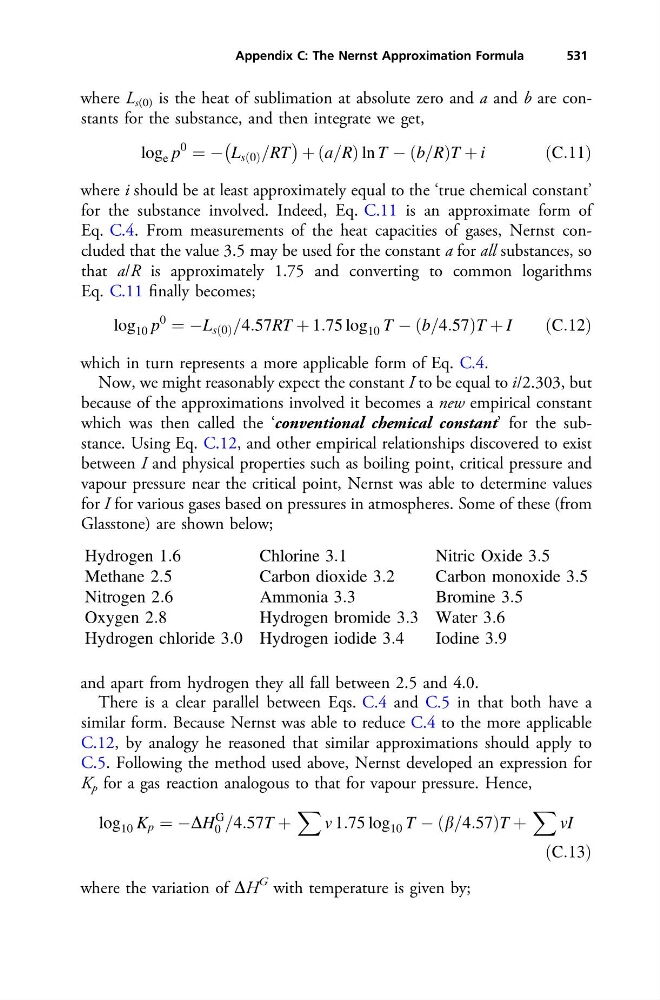
which was then called the ‘conventional chemical constant’ for the substance. Using Eq. C.12, and other empirical relationships discovered to exist
between I and physical properties such as boiling point, critical pressure and
vapour pressure near the critical point, Nernst was able to determine values
for I for various gases based on pressures in atmospheres. Some of these (from
Glasstone) are shown below;
Hydrogen 1:6
Chlorine 3:1
Nitric Oxide 3:5
Methane 2:5
Carbon dioxide 3:2
Carbon monoxide 3:5
Nitrogen 2:6
Ammonia 3:3
Bromine 3:5
Oxygen 2:8
Hydrogen bromide 3:3 Water 3:6
Hydrogen chloride 3:0 Hydrogen iodide 3:4
Iodine 3:9
and apart from hydrogen they all fall between 2.5 and 4.0.
There is a clear parallel between Eqs. C.4 and C.5 in that both have a
similar form. Because Nernst was able to reduce C.4 to the more applicable
C.12, by analogy he reasoned that similar approximations should apply to
C.5. Following the method used above, Nernst developed an expression for
K p for a gas reaction analogous to that for vapour pressure. Hence,
log 10 K p ¼ ÀDH
G
0 =4:57T þ
X v 1:75 log 10 T À ðb=4:57ÞT þ
X vI
ðC:13Þ
where the variation of DH
G with temperature is given by;
Appendix C: The Nernst Approximation Formula
531
log e p
0
¼ À L sð0Þ =RT
À
Á þ ða=RÞ ln T À ðb=RÞT þ i
ðC:11Þ
where i should be at least approximately equal to the ‘true chemical constant’
for the substance involved. Indeed, Eq. C.11 is an approximate form of
Eq. C.4. From measurements of the heat capacities of gases, Nernst concluded that the value 3.5 may be used for the constant a for all substances, so
that a/R is approximately 1.75 and converting to common logarithms
Eq. C.11 finally becomes;
log 10 p
0
¼ ÀL sð0Þ =4:57RT þ 1:75 log 10 T À ðb=4:57ÞT þ I
ðC:12Þ
which in turn represents a more applicable form of Eq. C.4.
Now, we might reasonably expect the constant I to be equal to i/2.303, but
because of the approximations involved it becomes a new empirical constant
which was then called the ‘conventional chemical constant’ for the substance. Using Eq. C.12, and other empirical relationships discovered to exist
between I and physical properties such as boiling point, critical pressure and
vapour pressure near the critical point, Nernst was able to determine values
for I for various gases based on pressures in atmospheres. Some of these (from
Glasstone) are shown below;
Hydrogen 1:6
Chlorine 3:1
Nitric Oxide 3:5
Methane 2:5
Carbon dioxide 3:2
Carbon monoxide 3:5
Nitrogen 2:6
Ammonia 3:3
Bromine 3:5
Oxygen 2:8
Hydrogen bromide 3:3 Water 3:6
Hydrogen chloride 3:0 Hydrogen iodide 3:4
Iodine 3:9
and apart from hydrogen they all fall between 2.5 and 4.0.
There is a clear parallel between Eqs. C.4 and C.5 in that both have a
similar form. Because Nernst was able to reduce C.4 to the more applicable
C.12, by analogy he reasoned that similar approximations should apply to
C.5. Following the method used above, Nernst developed an expression for
K p for a gas reaction analogous to that for vapour pressure. Hence,
log 10 K p ¼ ÀDH
G
0 =4:57T þ
X v 1:75 log 10 T À ðb=4:57ÞT þ
X vI
ðC:13Þ
where the variation of DH
G with temperature is given by;
Appendix C: The Nernst Approximation Formula
531