

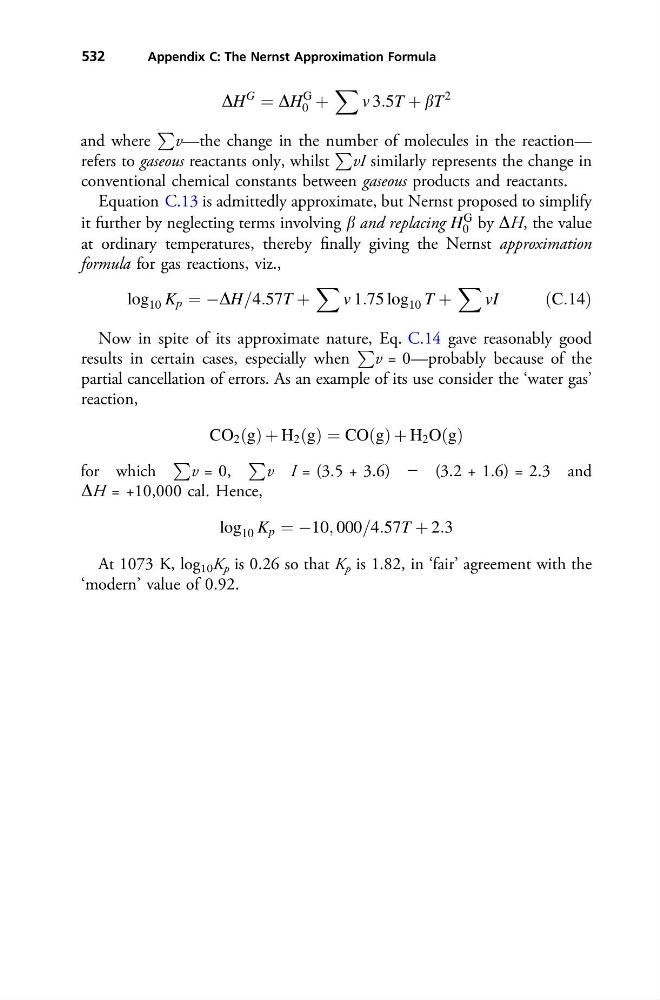
DH
G
¼ DH
G
0 þ
X
v 3:5T þ bT
2
and where
P
v—the change in the number of molecules in the reaction—
refers to gaseous reactants only, whilst
P
vI similarly represents the change in
conventional chemical constants between gaseous products and reactants.
Equation C.13 is admittedly approximate, but Nernst proposed to simplify
it further by neglecting terms involving b and replacing H
G
0 by DH, the value
at ordinary temperatures, thereby finally giving the Nernst approximation
formula for gas reactions, viz.,
log 10 K p ¼ ÀDH=4:57T þ
X v 1:75 log 10 T þ
X vI
ðC:14Þ
Now in spite of its approximate nature, Eq. C.14 gave reasonably good
results in certain cases, especially when
P
v = 0—probably because of the
partial cancellation of errors. As an example of its use consider the ‘water gas’
reaction,
CO 2 ðgÞ þ H 2 ðgÞ ¼ COðgÞ þ H 2 OðgÞ
for which
P
v = 0,
P
v I = (3.5 + 3.6) − (3.2 + 1.6) = 2.3 and
DH = +10,000 cal. Hence,
log 10 K p ¼ À10; 000=4:57T þ 2:3
At 1073 K, log 10 K p is 0.26 so that K p is 1.82, in ‘fair’ agreement with the
‘modern’ value of 0.92.
532
Appendix C: The Nernst Approximation Formula
G
¼ DH
G
0 þ
X
v 3:5T þ bT
2
and where
P
v—the change in the number of molecules in the reaction—
refers to gaseous reactants only, whilst
P
vI similarly represents the change in
conventional chemical constants between gaseous products and reactants.
Equation C.13 is admittedly approximate, but Nernst proposed to simplify
it further by neglecting terms involving b and replacing H
G
0 by DH, the value
at ordinary temperatures, thereby finally giving the Nernst approximation
formula for gas reactions, viz.,
log 10 K p ¼ ÀDH=4:57T þ
X v 1:75 log 10 T þ
X vI
ðC:14Þ
Now in spite of its approximate nature, Eq. C.14 gave reasonably good
results in certain cases, especially when
P
v = 0—probably because of the
partial cancellation of errors. As an example of its use consider the ‘water gas’
reaction,
CO 2 ðgÞ þ H 2 ðgÞ ¼ COðgÞ þ H 2 OðgÞ
for which
P
v = 0,
P
v I = (3.5 + 3.6) − (3.2 + 1.6) = 2.3 and
DH = +10,000 cal. Hence,
log 10 K p ¼ À10; 000=4:57T þ 2:3
At 1073 K, log 10 K p is 0.26 so that K p is 1.82, in ‘fair’ agreement with the
‘modern’ value of 0.92.
532
Appendix C: The Nernst Approximation Formula