

Now, the ‘true chemical constants’ involved may be determined from
vapour pressure and heat capacity measurements by means of Eq. C.4, and so
it became possible to evaluate K p (hence DG) for a gas reaction from thermal
and vapour pressure data alone. Although this result has been derived for a
very simple reaction, it holds in more complex cases. Indeed, the conclusions
hold even when the reaction is heterogeneous,
P vi only involving terms for
those reactants and products involving gases.
C.2 The Nernst Approximation Formula
The importance of Nernst’s ‘Heat Theorem’ when applied to gaseous systems
was that he was able to use it to deduce the integration constant(s) involved.
However, the application of eqn C.10 is obviously difficult since it requires
data on heat capacity and vapour pressure down to the absolute zero, Nernst
therefore developed a more applicable, but more approximate form for the
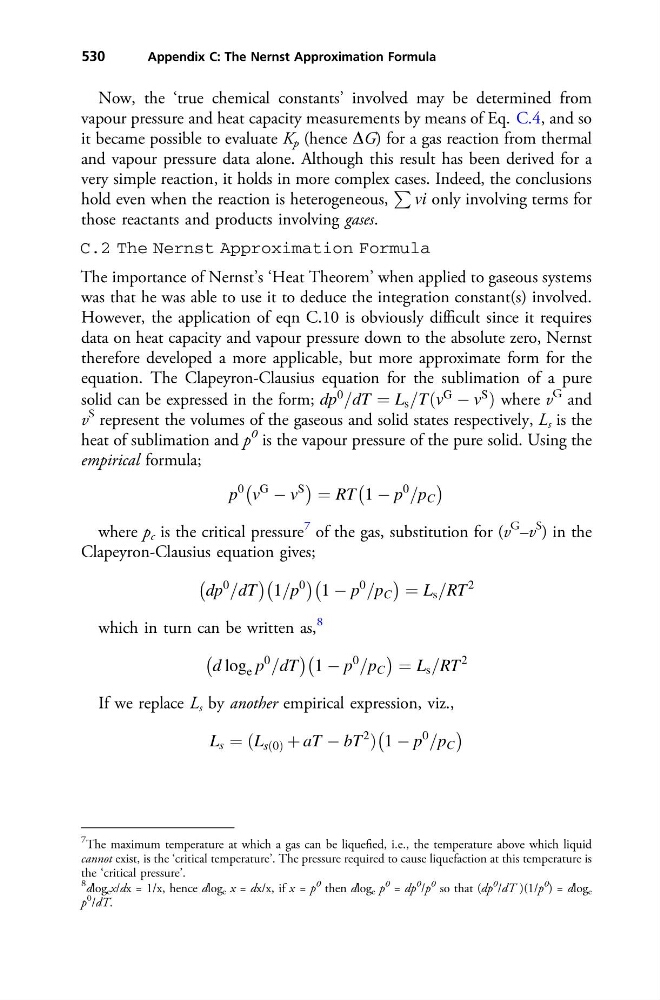
equation. The Clapeyron-Clausius equation for the sublimation of a pure
solid can be expressed in the form; dp
0
=dT ¼ L s =T v
G
À v
S
ð
Þwhere v
G and
v
S represent the volumes of the gaseous and solid states respectively, L s is the
heat of sublimation and p
0 is the vapour pressure of the pure solid. Using the
empirical formula;
p
0
v
G
À v
S
À
Á ¼ RT 1 À p
0
=p C
À
Á
where p c is the critical pressure
7 of the gas, substitution for (v
G
–v
S ) in the
Clapeyron-Clausius equation gives;
dp
0
=dT
À
Á
1=p
0
À
Á
1 À p
0
=p C
À
Á ¼ L s =RT
2
which in turn can be written as,
8
d log e p
0
=dT
À
Á
1 À p
0
=p C
À
Á ¼ L s =RT
2
If we replace L s by another empirical expression, viz.,
L s ¼ ðL sð0Þ þ aT À bT
2
Þ 1 À p
0
=p C
À
Á
7
The maximum temperature at which a gas can be liquefied, i.e., the temperature above which liquid
cannot exist, is the ‘critical temperature’. The pressure required to cause liquefaction at this temperature is
the ‘critical pressure’.
8
dlog e x/dx = 1/x, hence dlog e x = dx/x, if x = p
0 then dlog e p
0 = dp
0
/p
0 so that (dp
0
/dT )(1/p
0
) = dlog e
p
0
/dT.
530
Appendix C: The Nernst Approximation Formula
vapour pressure and heat capacity measurements by means of Eq. C.4, and so
it became possible to evaluate K p (hence DG) for a gas reaction from thermal
and vapour pressure data alone. Although this result has been derived for a
very simple reaction, it holds in more complex cases. Indeed, the conclusions
hold even when the reaction is heterogeneous,
P vi only involving terms for
those reactants and products involving gases.
C.2 The Nernst Approximation Formula
The importance of Nernst’s ‘Heat Theorem’ when applied to gaseous systems
was that he was able to use it to deduce the integration constant(s) involved.
However, the application of eqn C.10 is obviously difficult since it requires
data on heat capacity and vapour pressure down to the absolute zero, Nernst
therefore developed a more applicable, but more approximate form for the
equation. The Clapeyron-Clausius equation for the sublimation of a pure
solid can be expressed in the form; dp
0
=dT ¼ L s =T v
G
À v
S
ð
Þwhere v
G and
v
S represent the volumes of the gaseous and solid states respectively, L s is the
heat of sublimation and p
0 is the vapour pressure of the pure solid. Using the
empirical formula;
p
0
v
G
À v
S
À
Á ¼ RT 1 À p
0
=p C
À
Á
where p c is the critical pressure
7 of the gas, substitution for (v
G
–v
S ) in the
Clapeyron-Clausius equation gives;
dp
0
=dT
À
Á
1=p
0
À
Á
1 À p
0
=p C
À
Á ¼ L s =RT
2
which in turn can be written as,
8
d log e p
0
=dT
À
Á
1 À p
0
=p C
À
Á ¼ L s =RT
2
If we replace L s by another empirical expression, viz.,
L s ¼ ðL sð0Þ þ aT À bT
2
Þ 1 À p
0
=p C
À
Á
7
The maximum temperature at which a gas can be liquefied, i.e., the temperature above which liquid
cannot exist, is the ‘critical temperature’. The pressure required to cause liquefaction at this temperature is
the ‘critical pressure’.
8
dlog e x/dx = 1/x, hence dlog e x = dx/x, if x = p
0 then dlog e p
0 = dp
0
/p
0 so that (dp
0
/dT )(1/p
0
) = dlog e
p
0
/dT.
530
Appendix C: The Nernst Approximation Formula