

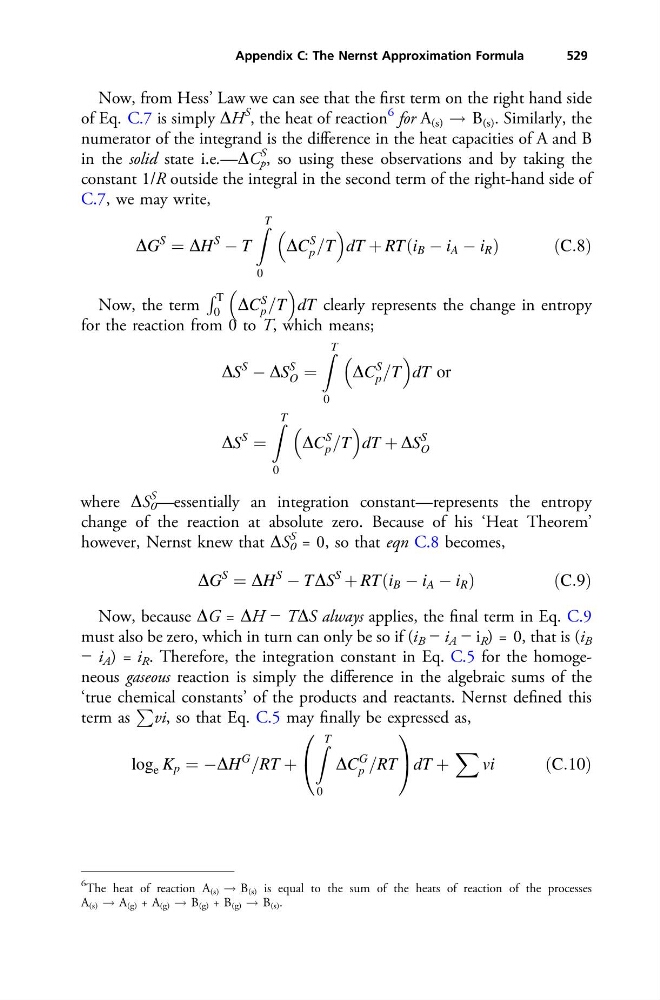
Now, from Hess’ Law we can see that the first term on the right hand side
of Eq. C.7 is simply DH
S , the heat of reaction
6 for A (s) ! B (s) . Similarly, the
numerator of the integrand is the difference in the heat capacities of A and B
in the solid state i.e.—DC p
S , so using these observations and by taking the
constant 1/R outside the integral in the second term of the right-hand side of
C.7, we may write,
DG
S
¼ DH
S
À T
Z T
0
DC
S
p =T
dT þ RT i B À i A À i R
ð
Þ
ð C:8Þ
Now, the term
R T
0 DC
S
p =T
dT clearly represents the change in entropy
for the reaction from 0 to T, which means;
DS
S
À DS
S
O ¼
Z T
0
DC
S
p =T
dT or
DS
S
¼
Z T
0
DC
S
p =T
dT þ DS
S
O
where DS 0
S
—essentially an integration constant—represents the entropy
change of the reaction at absolute zero. Because of his ‘Heat Theorem’
however, Nernst knew that DS 0
S = 0, so that eqn C.8 becomes,
DG
S
¼ DH
S
À TDS
S
þ RT i B À i A À i R
ð
Þ
ð C:9Þ
Now, because DG = DH − TDS always applies, the final term in Eq. C.9
must also be zero, which in turn can only be so if (i B − i A − i R ) = 0, that is (i B
− i A ) = i R . Therefore, the integration constant in Eq. C.5 for the homogeneous gaseous reaction is simply the difference in the algebraic sums of the
‘true chemical constants’ of the products and reactants. Nernst defined this
term as
P
vi, so that Eq. C.5 may finally be expressed as,
log e K p ¼ ÀDH
G
=RT þ
Z T
0
DC
G
p =RT
0
@
1
A dT þ
X vi
ðC:10Þ
6
The heat of reaction A (s) ! B (s) is equal to the sum of the heats of reaction of the processes
A (s) ! A (g) + A (g) ! B (g) + B (g) ! B (s) .
Appendix C: The Nernst Approximation Formula
529
of Eq. C.7 is simply DH
S , the heat of reaction
6 for A (s) ! B (s) . Similarly, the
numerator of the integrand is the difference in the heat capacities of A and B
in the solid state i.e.—DC p
S , so using these observations and by taking the
constant 1/R outside the integral in the second term of the right-hand side of
C.7, we may write,
DG
S
¼ DH
S
À T
Z T
0
DC
S
p =T
dT þ RT i B À i A À i R
ð
Þ
ð C:8Þ
Now, the term
R T
0 DC
S
p =T
dT clearly represents the change in entropy
for the reaction from 0 to T, which means;
DS
S
À DS
S
O ¼
Z T
0
DC
S
p =T
dT or
DS
S
¼
Z T
0
DC
S
p =T
dT þ DS
S
O
where DS 0
S
—essentially an integration constant—represents the entropy
change of the reaction at absolute zero. Because of his ‘Heat Theorem’
however, Nernst knew that DS 0
S = 0, so that eqn C.8 becomes,
DG
S
¼ DH
S
À TDS
S
þ RT i B À i A À i R
ð
Þ
ð C:9Þ
Now, because DG = DH − TDS always applies, the final term in Eq. C.9
must also be zero, which in turn can only be so if (i B − i A − i R ) = 0, that is (i B
− i A ) = i R . Therefore, the integration constant in Eq. C.5 for the homogeneous gaseous reaction is simply the difference in the algebraic sums of the
‘true chemical constants’ of the products and reactants. Nernst defined this
term as
P
vi, so that Eq. C.5 may finally be expressed as,
log e K p ¼ ÀDH
G
=RT þ
Z T
0
DC
G
p =RT
0
@
1
A dT þ
X vi
ðC:10Þ
6
The heat of reaction A (s) ! B (s) is equal to the sum of the heats of reaction of the processes
A (s) ! A (g) + A (g) ! B (g) + B (g) ! B (s) .
Appendix C: The Nernst Approximation Formula
529