

three boxes contain processes at equilibrium, DG is in each case equal to zero,
for no net work can be done by a system at equilibrium. The partial pressures
of the gaseous component are p A
0 in box one, p B
0 in box two then p A and p B in
box three. We now transfer one mole of gas A at p A
0 from box one to box three
via the permeable walls. The final pressure of the gas is p A and all equilibria
are maintained. The free energy change for this process is therefore,
DG ¼ RT log e ðp A =p
0
A Þ
Now transfer one mole of gas B at p B from box three to box two via the
permeable walls. The final pressure of the gas is p B
0 and all equilibria are
maintained. The free energy change for this process is therefore,
DG ¼ RT log e p
0
B =p B
À
Á
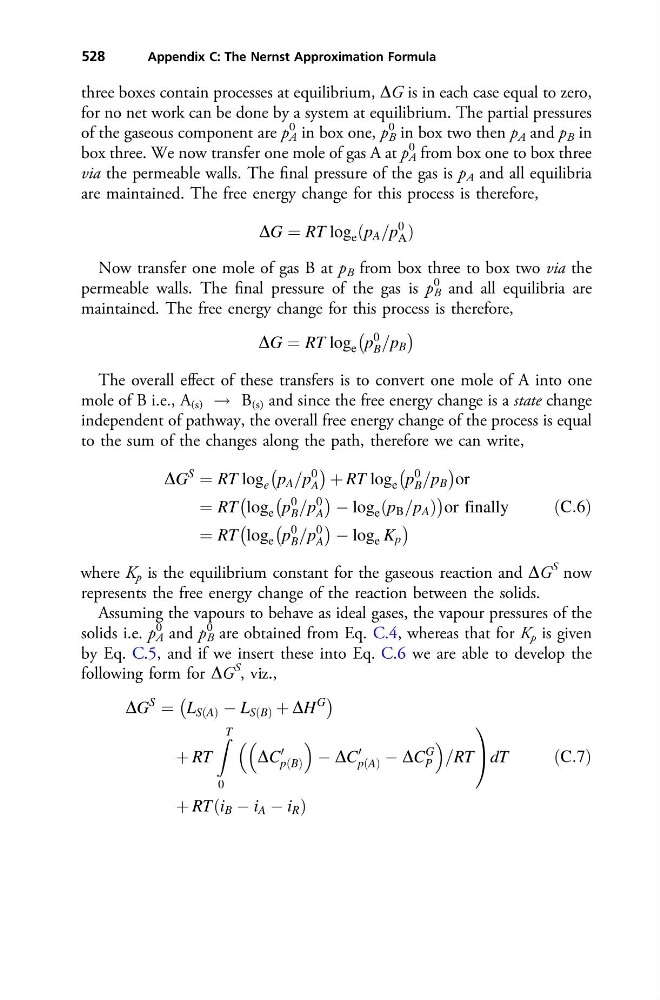
The overall effect of these transfers is to convert one mole of A into one
mole of B i.e., A (s) ! B (s) and since the free energy change is a state change
independent of pathway, the overall free energy change of the process is equal
to the sum of the changes along the path, therefore we can write,
DG
S
¼ RT log e p A =p
0
A
À
Á þ RT log e p
0
B =p B
À
Á
or
¼ RT log e p
0
B =p
0
A
À
Á À log e p B =p A
ð
Þ
À
Á
or finally
¼ RT log e p
0
B =p
0
A
À
Á À log e K p
À
Á
ðC:6Þ
where K p is the equilibrium constant for the gaseous reaction and DG
S now
represents the free energy change of the reaction between the solids.
Assuming the vapours to behave as ideal gases, the vapour pressures of the
solids i.e. p A
0 and p B
0 are obtained from Eq. C.4, whereas that for K p is given
by Eq. C.5, and if we insert these into Eq. C.6 we are able to develop the
following form for DG
S , viz.,
DG
S
¼ L SðAÞ À L SðBÞ þ DH
G
À
Á
þ RT
Z T
0
DC
0
pðBÞ
À DC
0
pðAÞ À DC
G
P
=RT
1
A dT
þ RT i B À i A À i R
ð
Þ
ðC:7Þ
528
Appendix C: The Nernst Approximation Formula
for no net work can be done by a system at equilibrium. The partial pressures
of the gaseous component are p A
0 in box one, p B
0 in box two then p A and p B in
box three. We now transfer one mole of gas A at p A
0 from box one to box three
via the permeable walls. The final pressure of the gas is p A and all equilibria
are maintained. The free energy change for this process is therefore,
DG ¼ RT log e ðp A =p
0
A Þ
Now transfer one mole of gas B at p B from box three to box two via the
permeable walls. The final pressure of the gas is p B
0 and all equilibria are
maintained. The free energy change for this process is therefore,
DG ¼ RT log e p
0
B =p B
À
Á
The overall effect of these transfers is to convert one mole of A into one
mole of B i.e., A (s) ! B (s) and since the free energy change is a state change
independent of pathway, the overall free energy change of the process is equal
to the sum of the changes along the path, therefore we can write,
DG
S
¼ RT log e p A =p
0
A
À
Á þ RT log e p
0
B =p B
À
Á
or
¼ RT log e p
0
B =p
0
A
À
Á À log e p B =p A
ð
Þ
À
Á
or finally
¼ RT log e p
0
B =p
0
A
À
Á À log e K p
À
Á
ðC:6Þ
where K p is the equilibrium constant for the gaseous reaction and DG
S now
represents the free energy change of the reaction between the solids.
Assuming the vapours to behave as ideal gases, the vapour pressures of the
solids i.e. p A
0 and p B
0 are obtained from Eq. C.4, whereas that for K p is given
by Eq. C.5, and if we insert these into Eq. C.6 we are able to develop the
following form for DG
S , viz.,
DG
S
¼ L SðAÞ À L SðBÞ þ DH
G
À
Á
þ RT
Z T
0
DC
0
pðBÞ
À DC
0
pðAÞ À DC
G
P
=RT
1
A dT
þ RT i B À i A À i R
ð
Þ
ðC:7Þ
528
Appendix C: The Nernst Approximation Formula