

A ðgÞ B ðgÞ
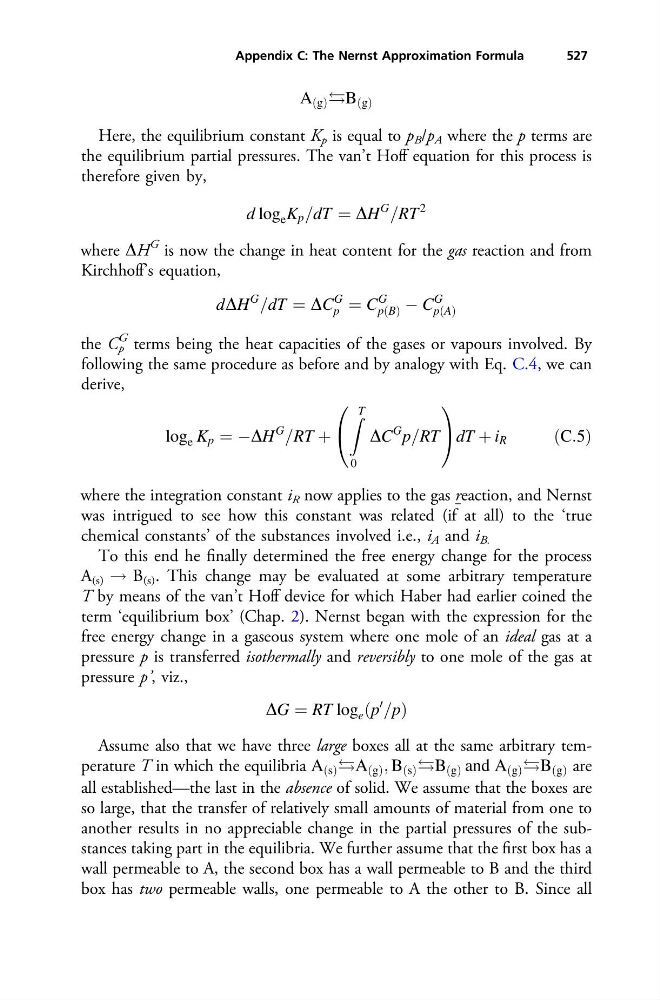
Here, the equilibrium constant K p is equal to p B /p A where the p terms are
the equilibrium partial pressures. The van’t Hoff equation for this process is
therefore given by,
d log e K p =dT ¼ DH
G
=RT
2
where DH
G is now the change in heat content for the gas reaction and from
Kirchhoff’s equation,
dDH
G
=dT ¼ DC
G
p ¼ C
G
pðBÞ À C
G
pðAÞ
the C p
G terms being the heat capacities of the gases or vapours involved. By
following the same procedure as before and by analogy with Eq. C.4, we can
derive,
log e K p ¼ ÀDH
G
=RT þ
Z T
0
DC
G
p=RT
0
@
1
A dT þ i R
ðC:5Þ
where the integration constant i R now applies to the gas reaction, and Nernst
was intrigued to see how this constant was related (if at all) to the ‘true
chemical constants’ of the substances involved i.e., i A and i B.
To this end he finally determined the free energy change for the process
A (s) ! B (s) . This change may be evaluated at some arbitrary temperature
T by means of the van’t Hoff device for which Haber had earlier coined the
term ‘equilibrium box’ (Chap. 2). Nernst began with the expression for the
free energy change in a gaseous system where one mole of an ideal gas at a
pressure p is transferred isothermally and reversibly to one mole of the gas at
pressure p’, viz.,
DG ¼ RT log e ðp
0
=pÞ
Assume also that we have three large boxes all at the same arbitrary temperature T in which the equilibria A ðsÞ A ðgÞ ; B ðsÞ B ðgÞ and A ðgÞ B ðgÞ are
all established—the last in the absence of solid. We assume that the boxes are
so large, that the transfer of relatively small amounts of material from one to
another results in no appreciable change in the partial pressures of the substances taking part in the equilibria. We further assume that the first box has a
wall permeable to A, the second box has a wall permeable to B and the third
box has two permeable walls, one permeable to A the other to B. Since all
Appendix C: The Nernst Approximation Formula
527
Here, the equilibrium constant K p is equal to p B /p A where the p terms are
the equilibrium partial pressures. The van’t Hoff equation for this process is
therefore given by,
d log e K p =dT ¼ DH
G
=RT
2
where DH
G is now the change in heat content for the gas reaction and from
Kirchhoff’s equation,
dDH
G
=dT ¼ DC
G
p ¼ C
G
pðBÞ À C
G
pðAÞ
the C p
G terms being the heat capacities of the gases or vapours involved. By
following the same procedure as before and by analogy with Eq. C.4, we can
derive,
log e K p ¼ ÀDH
G
=RT þ
Z T
0
DC
G
p=RT
0
@
1
A dT þ i R
ðC:5Þ
where the integration constant i R now applies to the gas reaction, and Nernst
was intrigued to see how this constant was related (if at all) to the ‘true
chemical constants’ of the substances involved i.e., i A and i B.
To this end he finally determined the free energy change for the process
A (s) ! B (s) . This change may be evaluated at some arbitrary temperature
T by means of the van’t Hoff device for which Haber had earlier coined the
term ‘equilibrium box’ (Chap. 2). Nernst began with the expression for the
free energy change in a gaseous system where one mole of an ideal gas at a
pressure p is transferred isothermally and reversibly to one mole of the gas at
pressure p’, viz.,
DG ¼ RT log e ðp
0
=pÞ
Assume also that we have three large boxes all at the same arbitrary temperature T in which the equilibria A ðsÞ A ðgÞ ; B ðsÞ B ðgÞ and A ðgÞ B ðgÞ are
all established—the last in the absence of solid. We assume that the boxes are
so large, that the transfer of relatively small amounts of material from one to
another results in no appreciable change in the partial pressures of the substances taking part in the equilibria. We further assume that the first box has a
wall permeable to A, the second box has a wall permeable to B and the third
box has two permeable walls, one permeable to A the other to B. Since all
Appendix C: The Nernst Approximation Formula
527