

d log e p
0
=dT ¼ L s =RT
2
ðC:1Þ
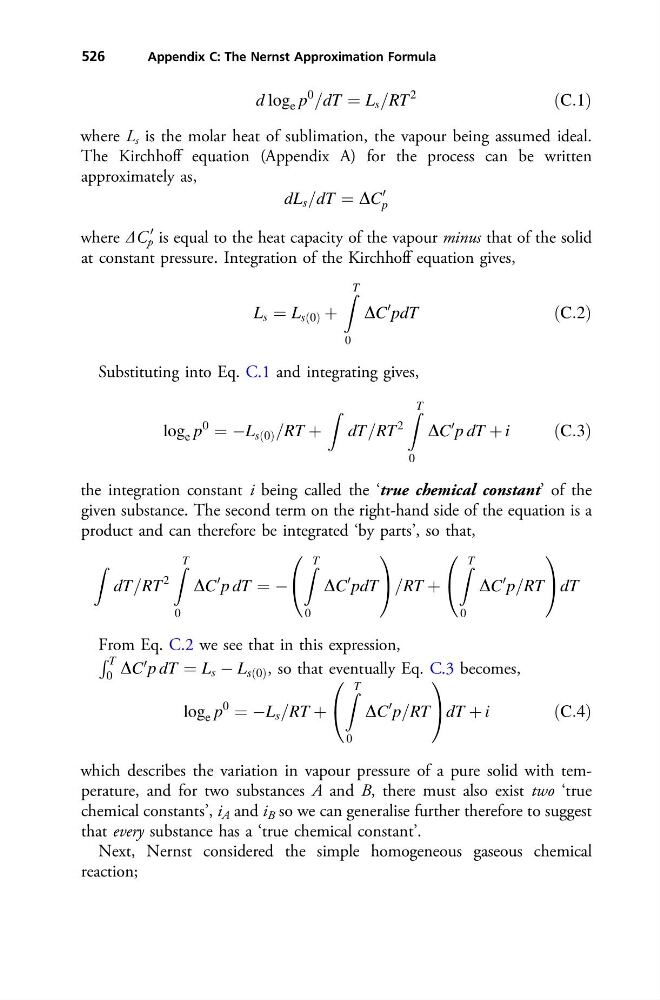
where L s is the molar heat of sublimation, the vapour being assumed ideal.
The Kirchhoff equation (Appendix A) for the process can be written
approximately as,
dL s =dT ¼ DC
0
p
where DC p
0 is equal to the heat capacity of the vapour minus that of the solid
at constant pressure. Integration of the Kirchhoff equation gives,
L s ¼ L sð0Þ þ
Z T
0
DC
0
pdT
ðC:2Þ
Substituting into Eq. C.1 and integrating gives,
log e p
0
¼ ÀL sð0Þ =RT þ
Z
dT=RT
2
Z T
0
DC
0
p dT þ i
ðC:3Þ
the integration constant i being called the ‘true chemical constant’ of the
given substance. The second term on the right-hand side of the equation is a
product and can therefore be integrated ‘by parts’, so that,
Z
dT=RT
2
Z T
0
DC
0
p dT ¼ À
Z T
0
DC
0
pdT
0
@
1
A =RT þ
Z T
0
DC
0
p=RT
0
@
1
A dT
From Eq. C.2 we see that in this expression,
R T
0 DC
0
p dT ¼ L s À L sð0Þ , so that eventually Eq. C.3 becomes,
log e p
0
¼ ÀL s =RT þ
Z T
0
DC
0
p=RT
0
@
1
A dT þ i
ðC:4Þ
which describes the variation in vapour pressure of a pure solid with temperature, and for two substances A and B, there must also exist two ‘true
chemical constants’, i A and i B so we can generalise further therefore to suggest
that every substance has a ‘true chemical constant’.
Next, Nernst considered the simple homogeneous gaseous chemical
reaction;
526
Appendix C: The Nernst Approximation Formula
0
=dT ¼ L s =RT
2
ðC:1Þ
where L s is the molar heat of sublimation, the vapour being assumed ideal.
The Kirchhoff equation (Appendix A) for the process can be written
approximately as,
dL s =dT ¼ DC
0
p
where DC p
0 is equal to the heat capacity of the vapour minus that of the solid
at constant pressure. Integration of the Kirchhoff equation gives,
L s ¼ L sð0Þ þ
Z T
0
DC
0
pdT
ðC:2Þ
Substituting into Eq. C.1 and integrating gives,
log e p
0
¼ ÀL sð0Þ =RT þ
Z
dT=RT
2
Z T
0
DC
0
p dT þ i
ðC:3Þ
the integration constant i being called the ‘true chemical constant’ of the
given substance. The second term on the right-hand side of the equation is a
product and can therefore be integrated ‘by parts’, so that,
Z
dT=RT
2
Z T
0
DC
0
p dT ¼ À
Z T
0
DC
0
pdT
0
@
1
A =RT þ
Z T
0
DC
0
p=RT
0
@
1
A dT
From Eq. C.2 we see that in this expression,
R T
0 DC
0
p dT ¼ L s À L sð0Þ , so that eventually Eq. C.3 becomes,
log e p
0
¼ ÀL s =RT þ
Z T
0
DC
0
p=RT
0
@
1
A dT þ i
ðC:4Þ
which describes the variation in vapour pressure of a pure solid with temperature, and for two substances A and B, there must also exist two ‘true
chemical constants’, i A and i B so we can generalise further therefore to suggest
that every substance has a ‘true chemical constant’.
Next, Nernst considered the simple homogeneous gaseous chemical
reaction;
526
Appendix C: The Nernst Approximation Formula