

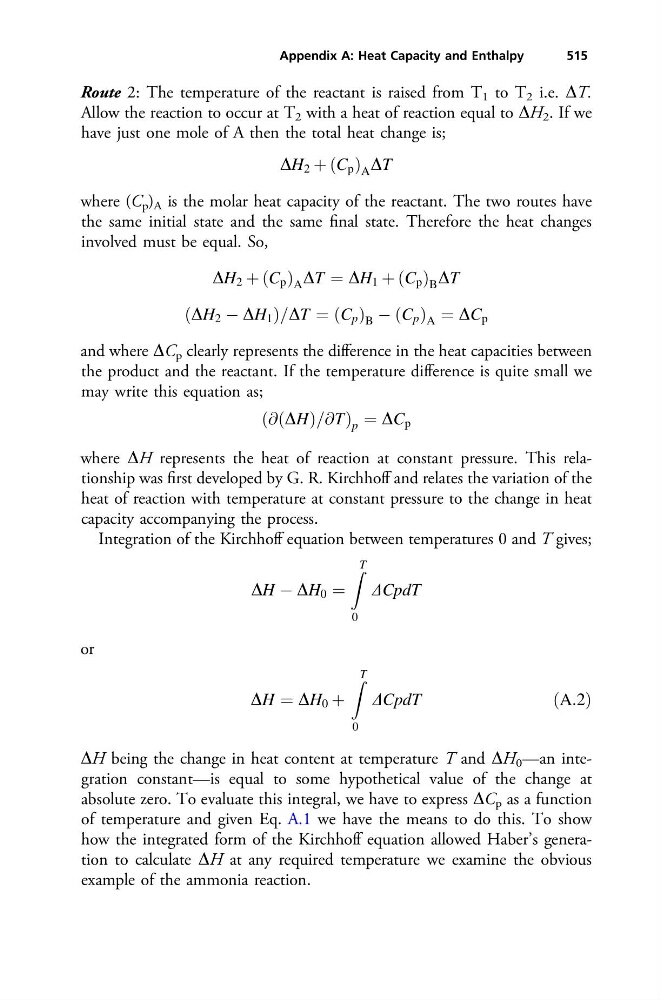
Route 2: The temperature of the reactant is raised from T 1 to T 2 i.e. DT.
Allow the reaction to occur at T 2 with a heat of reaction equal to DH 2 . If we
have just one mole of A then the total heat change is;
DH 2 þ ðC p Þ A DT
where (C p ) A is the molar heat capacity of the reactant. The two routes have
the same initial state and the same final state. Therefore the heat changes
involved must be equal. So,
DH 2 þ ðC p Þ A DT ¼ DH 1 þ ðC p Þ B DT
DH 2 À DH 1
ð
Þ =DT ¼ ðC p Þ B À ðC p Þ A ¼ DC p
and where DC p clearly represents the difference in the heat capacities between
the product and the reactant. If the temperature difference is quite small we
may write this equation as;
ð@ðDHÞ=@TÞ p ¼ DC p
where DH represents the heat of reaction at constant pressure. This relationship was first developed by G. R. Kirchhoff and relates the variation of the
heat of reaction with temperature at constant pressure to the change in heat
capacity accompanying the process.
Integration of the Kirchhoff equation between temperatures 0 and T gives;
DH À DH 0 ¼
Z T
0
DCpdT
or
DH ¼ DH 0 þ
Z T
0
DCpdT
ðA:2Þ
DH being the change in heat content at temperature T and DH 0 —an integration constant—is equal to some hypothetical value of the change at
absolute zero. To evaluate this integral, we have to express DC p as a function
of temperature and given Eq. A.1 we have the means to do this. To show
how the integrated form of the Kirchhoff equation allowed Haber’s generation to calculate DH at any required temperature we examine the obvious
example of the ammonia reaction.
Appendix A: Heat Capacity and Enthalpy
515
Allow the reaction to occur at T 2 with a heat of reaction equal to DH 2 . If we
have just one mole of A then the total heat change is;
DH 2 þ ðC p Þ A DT
where (C p ) A is the molar heat capacity of the reactant. The two routes have
the same initial state and the same final state. Therefore the heat changes
involved must be equal. So,
DH 2 þ ðC p Þ A DT ¼ DH 1 þ ðC p Þ B DT
DH 2 À DH 1
ð
Þ =DT ¼ ðC p Þ B À ðC p Þ A ¼ DC p
and where DC p clearly represents the difference in the heat capacities between
the product and the reactant. If the temperature difference is quite small we
may write this equation as;
ð@ðDHÞ=@TÞ p ¼ DC p
where DH represents the heat of reaction at constant pressure. This relationship was first developed by G. R. Kirchhoff and relates the variation of the
heat of reaction with temperature at constant pressure to the change in heat
capacity accompanying the process.
Integration of the Kirchhoff equation between temperatures 0 and T gives;
DH À DH 0 ¼
Z T
0
DCpdT
or
DH ¼ DH 0 þ
Z T
0
DCpdT
ðA:2Þ
DH being the change in heat content at temperature T and DH 0 —an integration constant—is equal to some hypothetical value of the change at
absolute zero. To evaluate this integral, we have to express DC p as a function
of temperature and given Eq. A.1 we have the means to do this. To show
how the integrated form of the Kirchhoff equation allowed Haber’s generation to calculate DH at any required temperature we examine the obvious
example of the ammonia reaction.
Appendix A: Heat Capacity and Enthalpy
515