

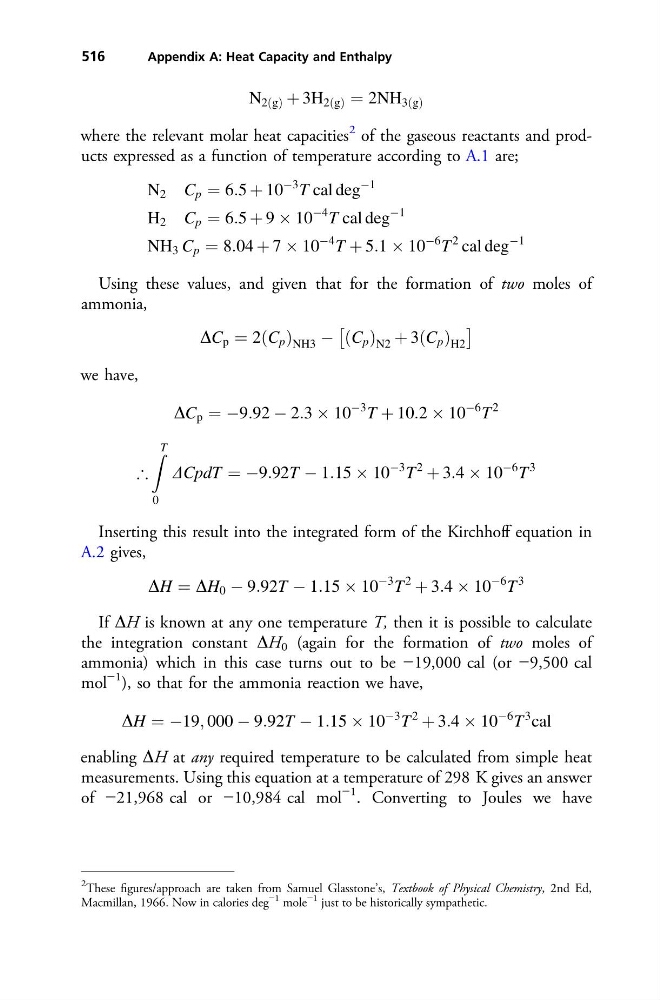
N 2ðgÞ þ 3H 2ðgÞ ¼ 2NH 3ðgÞ
where the relevant molar heat capacities
2 of the gaseous reactants and products expressed as a function of temperature according to A.1 are;
N 2 C p ¼ 6:5 þ 10
À3
T cal deg
À1
H 2 C p ¼ 6:5 þ 9 Â 10
À4
T cal deg
À1
NH 3 C p ¼ 8:04 þ 7 Â 10
À4
T þ 5:1 Â 10
À6
T
2 cal deg
À1
Using these values, and given that for the formation of two moles of
ammonia,
DC p ¼ 2ðC p Þ NH3 À ðC p Þ N2 þ 3ðC p Þ H2
Â
Ã
we have,
DC p ¼ À9:92 À 2:3 Â 10
À3
T þ 10:2 Â 10
À6
T
2
)
Z T
0
DCpdT ¼ À9:92T À 1:15 Â 10
À3
T
2
þ 3:4 Â 10
À6
T
3
Inserting this result into the integrated form of the Kirchhoff equation in
A.2 gives,
DH ¼ DH 0 À 9:92T À 1:15 Â 10
À3
T
2
þ 3:4 Â 10
À6
T
3
If DH is known at any one temperature T, then it is possible to calculate
the integration constant DH 0 (again for the formation of two moles of
ammonia) which in this case turns out to be −19,000 cal (or −9,500 cal
mol
−1
), so that for the ammonia reaction we have,
DH ¼ À19; 000 À 9:92T À 1:15 Â 10
À3
T
2
þ 3:4 Â 10
À6
T
3 cal
enabling DH at any required temperature to be calculated from simple heat
measurements. Using this equation at a temperature of 298 K gives an answer
of −21,968 cal or −10,984 cal mol
−1 . Converting to Joules we have
2
These figures/approach are taken from Samuel Glasstone’s, Textbook of Physical Chemistry, 2nd Ed,
Macmillan, 1966. Now in calories deg
−1 mole
−1 just to be historically sympathetic.
516
Appendix A: Heat Capacity and Enthalpy
where the relevant molar heat capacities
2 of the gaseous reactants and products expressed as a function of temperature according to A.1 are;
N 2 C p ¼ 6:5 þ 10
À3
T cal deg
À1
H 2 C p ¼ 6:5 þ 9 Â 10
À4
T cal deg
À1
NH 3 C p ¼ 8:04 þ 7 Â 10
À4
T þ 5:1 Â 10
À6
T
2 cal deg
À1
Using these values, and given that for the formation of two moles of
ammonia,
DC p ¼ 2ðC p Þ NH3 À ðC p Þ N2 þ 3ðC p Þ H2
Â
Ã
we have,
DC p ¼ À9:92 À 2:3 Â 10
À3
T þ 10:2 Â 10
À6
T
2
)
Z T
0
DCpdT ¼ À9:92T À 1:15 Â 10
À3
T
2
þ 3:4 Â 10
À6
T
3
Inserting this result into the integrated form of the Kirchhoff equation in
A.2 gives,
DH ¼ DH 0 À 9:92T À 1:15 Â 10
À3
T
2
þ 3:4 Â 10
À6
T
3
If DH is known at any one temperature T, then it is possible to calculate
the integration constant DH 0 (again for the formation of two moles of
ammonia) which in this case turns out to be −19,000 cal (or −9,500 cal
mol
−1
), so that for the ammonia reaction we have,
DH ¼ À19; 000 À 9:92T À 1:15 Â 10
À3
T
2
þ 3:4 Â 10
À6
T
3 cal
enabling DH at any required temperature to be calculated from simple heat
measurements. Using this equation at a temperature of 298 K gives an answer
of −21,968 cal or −10,984 cal mol
−1 . Converting to Joules we have
2
These figures/approach are taken from Samuel Glasstone’s, Textbook of Physical Chemistry, 2nd Ed,
Macmillan, 1966. Now in calories deg
−1 mole
−1 just to be historically sympathetic.
516
Appendix A: Heat Capacity and Enthalpy