

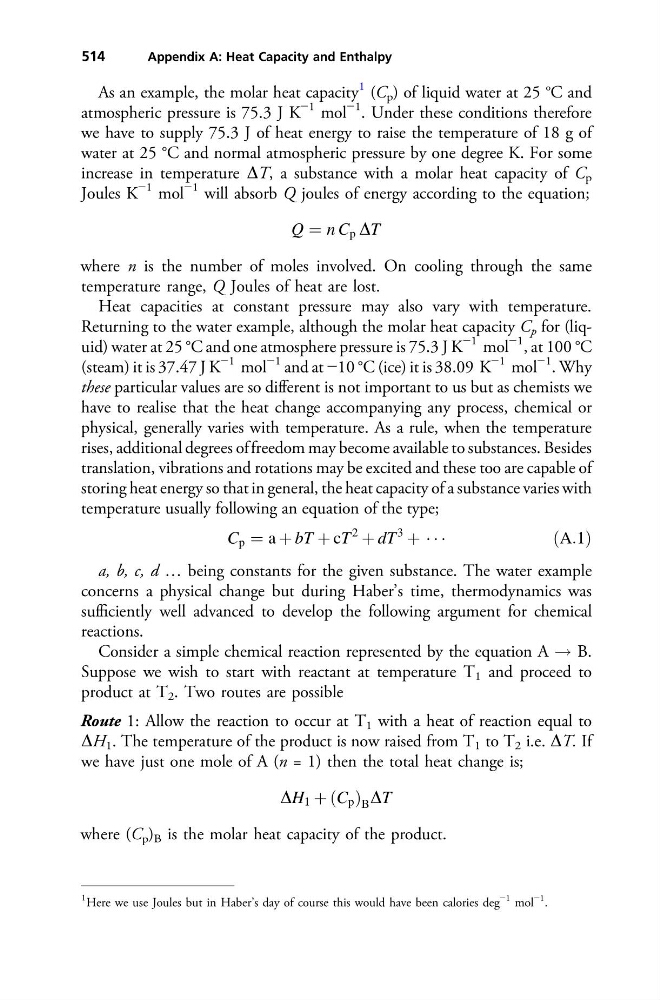
As an example, the molar heat capacity
1 (C p ) of liquid water at 25 °C and
atmospheric pressure is 75.3 J K
−1 mol
−1
. Under these conditions therefore
we have to supply 75.3 J of heat energy to raise the temperature of 18 g of
water at 25 °C and normal atmospheric pressure by one degree K. For some
increase in temperature DT, a substance with a molar heat capacity of C p
Joules K
−1 mol
−1 will absorb Q joules of energy according to the equation;
Q ¼ n C p DT
where n is the number of moles involved. On cooling through the same
temperature range, Q Joules of heat are lost.
Heat capacities at constant pressure may also vary with temperature.
Returning to the water example, although the molar heat capacity C p for (liquid) water at 25 °C and one atmosphere pressure is 75.3 J K
−1 mol
−1
, at 100 °C
(steam) it is 37.47 J K
−1 mol
−1 and at −10 °C (ice) it is 38.09 K
−1 mol
−1
. Why
these particular values are so different is not important to us but as chemists we
have to realise that the heat change accompanying any process, chemical or
physical, generally varies with temperature. As a rule, when the temperature
rises, additional degrees of freedom may become available to substances. Besides
translation, vibrations and rotations may be excited and these too are capable of
storing heat energy so that in general, the heat capacity of a substance varies with
temperature usually following an equation of the type;
C p ¼ a þ bT þ cT
2
þ dT
3
þ Á Á Á
ðA:1Þ
a, b, c, d … being constants for the given substance. The water example
concerns a physical change but during Haber’s time, thermodynamics was
sufficiently well advanced to develop the following argument for chemical
reactions.
Consider a simple chemical reaction represented by the equation A ! B.
Suppose we wish to start with reactant at temperature T 1 and proceed to
product at T 2 . Two routes are possible
Route 1: Allow the reaction to occur at T 1 with a heat of reaction equal to
DH 1 . The temperature of the product is now raised from T 1 to T 2 i.e. DT. If
we have just one mole of A (n = 1) then the total heat change is;
DH 1 þ ðC p Þ B DT
where (C p ) B is the molar heat capacity of the product.
1
Here we use Joules but in Haber’s day of course this would have been calories deg
−1 mol
−1
.
514
Appendix A: Heat Capacity and Enthalpy
1 (C p ) of liquid water at 25 °C and
atmospheric pressure is 75.3 J K
−1 mol
−1
. Under these conditions therefore
we have to supply 75.3 J of heat energy to raise the temperature of 18 g of
water at 25 °C and normal atmospheric pressure by one degree K. For some
increase in temperature DT, a substance with a molar heat capacity of C p
Joules K
−1 mol
−1 will absorb Q joules of energy according to the equation;
Q ¼ n C p DT
where n is the number of moles involved. On cooling through the same
temperature range, Q Joules of heat are lost.
Heat capacities at constant pressure may also vary with temperature.
Returning to the water example, although the molar heat capacity C p for (liquid) water at 25 °C and one atmosphere pressure is 75.3 J K
−1 mol
−1
, at 100 °C
(steam) it is 37.47 J K
−1 mol
−1 and at −10 °C (ice) it is 38.09 K
−1 mol
−1
. Why
these particular values are so different is not important to us but as chemists we
have to realise that the heat change accompanying any process, chemical or
physical, generally varies with temperature. As a rule, when the temperature
rises, additional degrees of freedom may become available to substances. Besides
translation, vibrations and rotations may be excited and these too are capable of
storing heat energy so that in general, the heat capacity of a substance varies with
temperature usually following an equation of the type;
C p ¼ a þ bT þ cT
2
þ dT
3
þ Á Á Á
ðA:1Þ
a, b, c, d … being constants for the given substance. The water example
concerns a physical change but during Haber’s time, thermodynamics was
sufficiently well advanced to develop the following argument for chemical
reactions.
Consider a simple chemical reaction represented by the equation A ! B.
Suppose we wish to start with reactant at temperature T 1 and proceed to
product at T 2 . Two routes are possible
Route 1: Allow the reaction to occur at T 1 with a heat of reaction equal to
DH 1 . The temperature of the product is now raised from T 1 to T 2 i.e. DT. If
we have just one mole of A (n = 1) then the total heat change is;
DH 1 þ ðC p Þ B DT
where (C p ) B is the molar heat capacity of the product.
1
Here we use Joules but in Haber’s day of course this would have been calories deg
−1 mol
−1
.
514
Appendix A: Heat Capacity and Enthalpy