

‘protested’.
23 Having secured some initial ‘seniority’ because of his work
under Woodland Toms, Robert was instead pleased to be allocated a place in
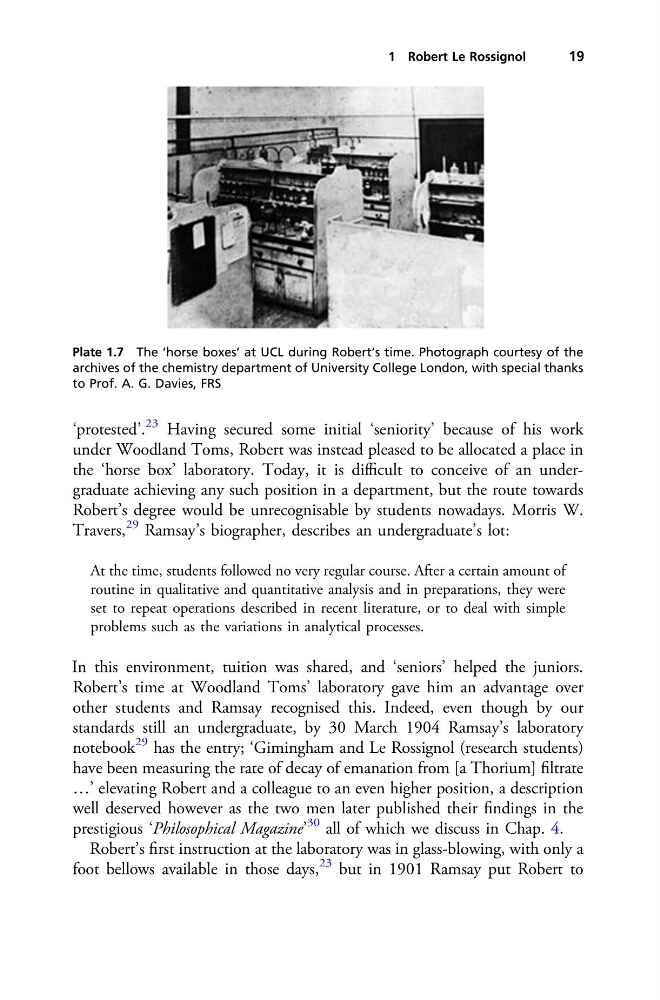
the ‘horse box’ laboratory. Today, it is difficult to conceive of an undergraduate achieving any such position in a department, but the route towards
Robert’s degree would be unrecognisable by students nowadays. Morris W.
Travers,
29 Ramsay’s biographer, describes an undergraduate’s lot:
At the time, students followed no very regular course. After a certain amount of
routine in qualitative and quantitative analysis and in preparations, they were
set to repeat operations described in recent literature, or to deal with simple
problems such as the variations in analytical processes.
In this environment, tuition was shared, and ‘seniors’ helped the juniors.
Robert’s time at Woodland Toms’ laboratory gave him an advantage over
other students and Ramsay recognised this. Indeed, even though by our
standards still an undergraduate, by 30 March 1904 Ramsay’s laboratory
notebook
29 has the entry; ‘Gimingham and Le Rossignol (research students)
have been measuring the rate of decay of emanation from [a Thorium] filtrate
…’ elevating Robert and a colleague to an even higher position, a description
well deserved however as the two men later published their findings in the
prestigious ‘Philosophical Magazine’
30 all of which we discuss in Chap. 4.
Robert’s first instruction at the laboratory was in glass-blowing, with only a
foot bellows available in those days,
23 but in 1901 Ramsay put Robert to
Plate 1.7 The ‘horse boxes’ at UCL during Robert’s time. Photograph courtesy of the
archives of the chemistry department of University College London, with special thanks
to Prof. A. G. Davies, FRS
1 Robert Le Rossignol
19
23 Having secured some initial ‘seniority’ because of his work
under Woodland Toms, Robert was instead pleased to be allocated a place in
the ‘horse box’ laboratory. Today, it is difficult to conceive of an undergraduate achieving any such position in a department, but the route towards
Robert’s degree would be unrecognisable by students nowadays. Morris W.
Travers,
29 Ramsay’s biographer, describes an undergraduate’s lot:
At the time, students followed no very regular course. After a certain amount of
routine in qualitative and quantitative analysis and in preparations, they were
set to repeat operations described in recent literature, or to deal with simple
problems such as the variations in analytical processes.
In this environment, tuition was shared, and ‘seniors’ helped the juniors.
Robert’s time at Woodland Toms’ laboratory gave him an advantage over
other students and Ramsay recognised this. Indeed, even though by our
standards still an undergraduate, by 30 March 1904 Ramsay’s laboratory
notebook
29 has the entry; ‘Gimingham and Le Rossignol (research students)
have been measuring the rate of decay of emanation from [a Thorium] filtrate
…’ elevating Robert and a colleague to an even higher position, a description
well deserved however as the two men later published their findings in the
prestigious ‘Philosophical Magazine’
30 all of which we discuss in Chap. 4.
Robert’s first instruction at the laboratory was in glass-blowing, with only a
foot bellows available in those days,
23 but in 1901 Ramsay put Robert to
Plate 1.7 The ‘horse boxes’ at UCL during Robert’s time. Photograph courtesy of the
archives of the chemistry department of University College London, with special thanks
to Prof. A. G. Davies, FRS
1 Robert Le Rossignol
19