

work on the ‘velocity of reactions’, (reaction kinetics). As a result of ‘some
observations’ he made,
23 he won the UCL Gold Medal at the end of his first
year and was moved into the research laboratory to work with F. G. Donnan
who had joined Ramsay in 1898. Donnan was educated at Queen’s College
Belfast from 1889 to 1893 taking a BA in 1892 and his MA from the Royal
University of Ireland in 1894, after which he left to work in Germany.
Almost all young chemists who intended to follow a career in chemistry after
graduating at a British University spent two years in Germany engaging in
research and often taking a Ph.D. degree. Donnan worked there until 1897
studying under Wislicenus, van’t Hoff and Ostwald, and helped to introduce
the new subject of physical chemistry into Britain. On his return to the UK
he joined Ramsay at UCL where he preached it zealously. Robert therefore
would have been at the forefront of this new discipline although at the time
there was no separate Physical Chemistry Department at UCL and even as
late as 1926 the subject was still widely examined as part of the Inorganic
paper.
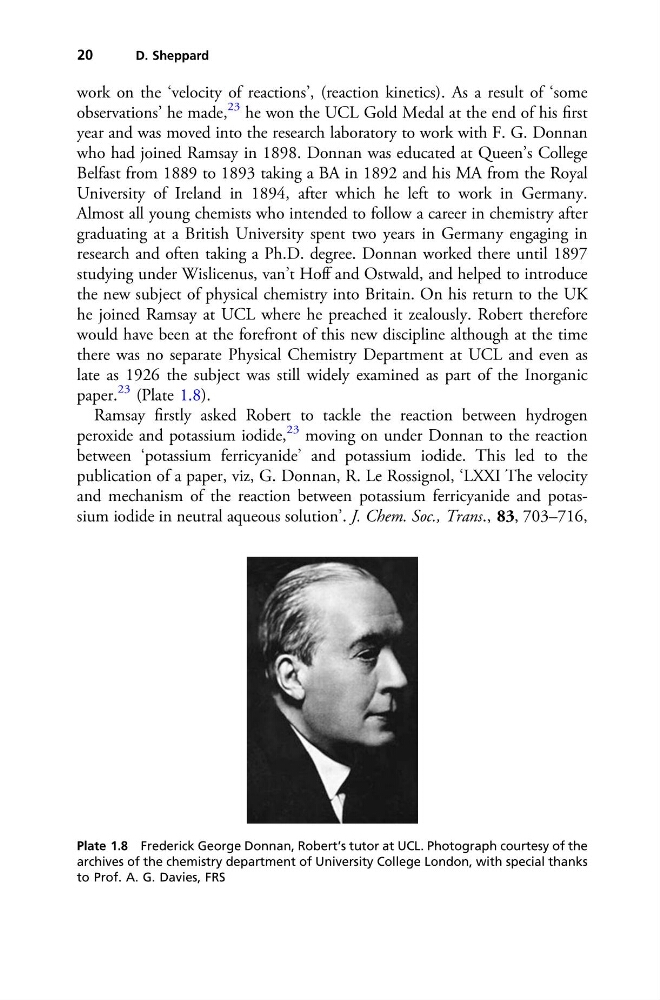
23 (Plate 1.8).
Ramsay firstly asked Robert to tackle the reaction between hydrogen
peroxide and potassium iodide,
23 moving on under Donnan to the reaction
between ‘potassium ferricyanide’ and potassium iodide. This led to the
publication of a paper, viz, G. Donnan, R. Le Rossignol, ‘LXXI The velocity
and mechanism of the reaction between potassium ferricyanide and potassium iodide in neutral aqueous solution’. J. Chem. Soc., Trans., 83, 703–716,
Plate 1.8 Frederick George Donnan, Robert’s tutor at UCL. Photograph courtesy of the
archives of the chemistry department of University College London, with special thanks
to Prof. A. G. Davies, FRS
20
D. Sheppard
observations’ he made,
23 he won the UCL Gold Medal at the end of his first
year and was moved into the research laboratory to work with F. G. Donnan
who had joined Ramsay in 1898. Donnan was educated at Queen’s College
Belfast from 1889 to 1893 taking a BA in 1892 and his MA from the Royal
University of Ireland in 1894, after which he left to work in Germany.
Almost all young chemists who intended to follow a career in chemistry after
graduating at a British University spent two years in Germany engaging in
research and often taking a Ph.D. degree. Donnan worked there until 1897
studying under Wislicenus, van’t Hoff and Ostwald, and helped to introduce
the new subject of physical chemistry into Britain. On his return to the UK
he joined Ramsay at UCL where he preached it zealously. Robert therefore
would have been at the forefront of this new discipline although at the time
there was no separate Physical Chemistry Department at UCL and even as
late as 1926 the subject was still widely examined as part of the Inorganic
paper.
23 (Plate 1.8).
Ramsay firstly asked Robert to tackle the reaction between hydrogen
peroxide and potassium iodide,
23 moving on under Donnan to the reaction
between ‘potassium ferricyanide’ and potassium iodide. This led to the
publication of a paper, viz, G. Donnan, R. Le Rossignol, ‘LXXI The velocity
and mechanism of the reaction between potassium ferricyanide and potassium iodide in neutral aqueous solution’. J. Chem. Soc., Trans., 83, 703–716,
Plate 1.8 Frederick George Donnan, Robert’s tutor at UCL. Photograph courtesy of the
archives of the chemistry department of University College London, with special thanks
to Prof. A. G. Davies, FRS
20
D. Sheppard