

warranted the award of a Nobel Prize, and that the ‘Haber process’ would
ultimately be of great value to the world. But he refused to accept the
‘half-truth’
41 that Germany’s primary reason for the erection of her nitrogen
plants was the production of agricultural fertilizer, believing instead that
ammonia was always meant to be the first step in the production of nitric acid
for munitions. He cited Bernthsen’s talk at the 8th International Congress of
Applied Chemistry in NY City (not ‘Philadelphia’) in 1912 (Chap. 12) where,
contrary to Hammarskjöld’s views, technical detail was scarce and not ‘known
to all nations before the great war …’ but where it became clear that
‘Germany could conduct a war even if the British Navy cut off the Chile
supply’. Alexander’s letter crystallized the Allies bitterness towards Germany
in that it was universally accepted at the time that she had long organized her
industries against the probability of war—a view repeated many times e.g., in
The Times on 22 April 1920, However, history has shown that many of
Hammarskjöld’s statements of ‘fact’ were indeed just that. The ‘Haber process’ was indeed originally conceived as a solution to the world’s need for
cheap nitric fertiliser. The Germans had not prepared for war by building
nitrate factories. An industrial process to convert ammonia to nitric acid was
never part of the initial brief for Oppau, but came later as Germany’s
engagement with the war—initially confident and typically Teutonic—soon
gave way to grave concern as her nitrate deficiency became acute. But what
Hammarskjöld’s ‘facts’ did not reveal was the political maneuverings of the
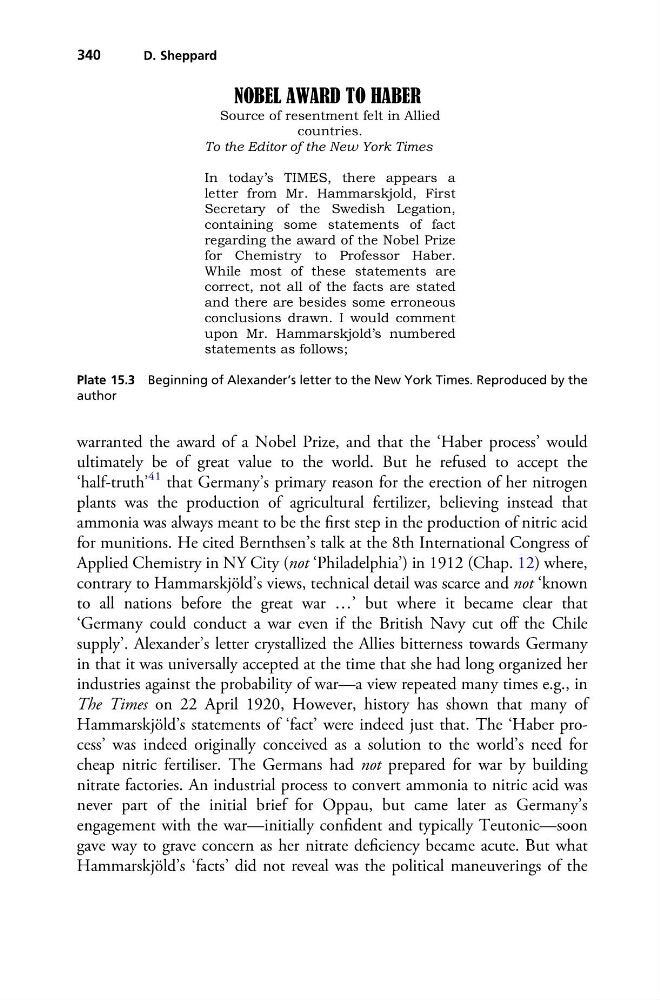
NOBEL AWARD TO HABER
Source of resentment felt in Allied
countries.
To the Editor of the New York Times
In today’s TIMES, there appears a
letter from Mr. Hammarskjold, First
Secretary of the Swedish Legation,
containing some statements of fact
regarding the award of the Nobel Prize
for Chemistry to Professor Haber.
While most of these statements are
correct, not all of the facts are stated
and there are besides some erroneous
conclusions drawn. I would comment
upon Mr. Hammarskjold’s numbered
statements as follows;
Plate 15.3 Beginning of Alexander’s letter to the New York Times. Reproduced by the
author
340
D. Sheppard
ultimately be of great value to the world. But he refused to accept the
‘half-truth’
41 that Germany’s primary reason for the erection of her nitrogen
plants was the production of agricultural fertilizer, believing instead that
ammonia was always meant to be the first step in the production of nitric acid
for munitions. He cited Bernthsen’s talk at the 8th International Congress of
Applied Chemistry in NY City (not ‘Philadelphia’) in 1912 (Chap. 12) where,
contrary to Hammarskjöld’s views, technical detail was scarce and not ‘known
to all nations before the great war …’ but where it became clear that
‘Germany could conduct a war even if the British Navy cut off the Chile
supply’. Alexander’s letter crystallized the Allies bitterness towards Germany
in that it was universally accepted at the time that she had long organized her
industries against the probability of war—a view repeated many times e.g., in
The Times on 22 April 1920, However, history has shown that many of
Hammarskjöld’s statements of ‘fact’ were indeed just that. The ‘Haber process’ was indeed originally conceived as a solution to the world’s need for
cheap nitric fertiliser. The Germans had not prepared for war by building
nitrate factories. An industrial process to convert ammonia to nitric acid was
never part of the initial brief for Oppau, but came later as Germany’s
engagement with the war—initially confident and typically Teutonic—soon
gave way to grave concern as her nitrate deficiency became acute. But what
Hammarskjöld’s ‘facts’ did not reveal was the political maneuverings of the
NOBEL AWARD TO HABER
Source of resentment felt in Allied
countries.
To the Editor of the New York Times
In today’s TIMES, there appears a
letter from Mr. Hammarskjold, First
Secretary of the Swedish Legation,
containing some statements of fact
regarding the award of the Nobel Prize
for Chemistry to Professor Haber.
While most of these statements are
correct, not all of the facts are stated
and there are besides some erroneous
conclusions drawn. I would comment
upon Mr. Hammarskjold’s numbered
statements as follows;
Plate 15.3 Beginning of Alexander’s letter to the New York Times. Reproduced by the
author
340
D. Sheppard