

RSAS. Alexander however, like many in the scientific community realised
that ‘something was up’ and he was not prepared to have his prejudices
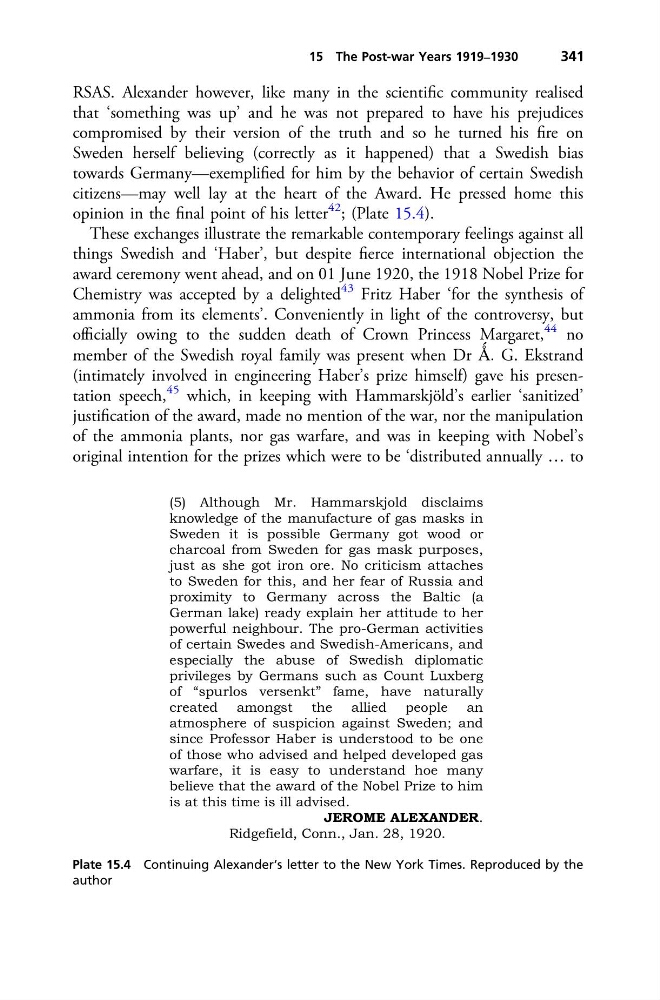
compromised by their version of the truth and so he turned his fire on
Sweden herself believing (correctly as it happened) that a Swedish bias
towards Germany—exemplified for him by the behavior of certain Swedish
citizens—may well lay at the heart of the Award. He pressed home this
opinion in the final point of his letter
42
; (Plate 15.4).
These exchanges illustrate the remarkable contemporary feelings against all
things Swedish and ‘Haber’, but despite fierce international objection the
award ceremony went ahead, and on 01 June 1920, the 1918 Nobel Prize for
Chemistry was accepted by a delighted
43 Fritz Haber ‘for the synthesis of
ammonia from its elements’. Conveniently in light of the controversy, but
officially owing to the sudden death of Crown Princess Margaret,
44 no
member of the Swedish royal family was present when Dr ˚
A
'
: G. Ekstrand
(intimately involved in engineering Haber’s prize himself) gave his presentation speech,
45 which, in keeping with Hammarskjöld’s earlier ‘sanitized’
justification of the award, made no mention of the war, nor the manipulation
of the ammonia plants, nor gas warfare, and was in keeping with Nobel’s
original intention for the prizes which were to be ‘distributed annually … to
(5) Although Mr. Hammarskjold disclaims
knowledge of the manufacture of gas masks in
Sweden it is possible Germany got wood or
charcoal from Sweden for gas mask purposes,
just as she got iron ore. No criticism attaches
to Sweden for this, and her fear of Russia and
proximity to Germany across the Baltic (a
German lake) ready explain her attitude to her
powerful neighbour. The pro-German activities
of certain Swedes and Swedish-Americans, and
especially the abuse of Swedish diplomatic
privileges by Germans such as Count Luxberg
of “spurlos versenkt” fame, have naturally
created amongst the allied people an
atmosphere of suspicion against Sweden; and
since Professor Haber is understood to be one
of those who advised and helped developed gas
warfare, it is easy to understand hoe many
believe that the award of the Nobel Prize to him
is at this time is ill advised.
JEROME ALEXANDER.
Ridgefield, Conn., Jan. 28, 1920.
Plate 15.4 Continuing Alexander’s letter to the New York Times. Reproduced by the
author
15 The Post-war Years 1919–1930
341
that ‘something was up’ and he was not prepared to have his prejudices
compromised by their version of the truth and so he turned his fire on
Sweden herself believing (correctly as it happened) that a Swedish bias
towards Germany—exemplified for him by the behavior of certain Swedish
citizens—may well lay at the heart of the Award. He pressed home this
opinion in the final point of his letter
42
; (Plate 15.4).
These exchanges illustrate the remarkable contemporary feelings against all
things Swedish and ‘Haber’, but despite fierce international objection the
award ceremony went ahead, and on 01 June 1920, the 1918 Nobel Prize for
Chemistry was accepted by a delighted
43 Fritz Haber ‘for the synthesis of
ammonia from its elements’. Conveniently in light of the controversy, but
officially owing to the sudden death of Crown Princess Margaret,
44 no
member of the Swedish royal family was present when Dr ˚
A
'
: G. Ekstrand
(intimately involved in engineering Haber’s prize himself) gave his presentation speech,
45 which, in keeping with Hammarskjöld’s earlier ‘sanitized’
justification of the award, made no mention of the war, nor the manipulation
of the ammonia plants, nor gas warfare, and was in keeping with Nobel’s
original intention for the prizes which were to be ‘distributed annually … to
(5) Although Mr. Hammarskjold disclaims
knowledge of the manufacture of gas masks in
Sweden it is possible Germany got wood or
charcoal from Sweden for gas mask purposes,
just as she got iron ore. No criticism attaches
to Sweden for this, and her fear of Russia and
proximity to Germany across the Baltic (a
German lake) ready explain her attitude to her
powerful neighbour. The pro-German activities
of certain Swedes and Swedish-Americans, and
especially the abuse of Swedish diplomatic
privileges by Germans such as Count Luxberg
of “spurlos versenkt” fame, have naturally
created amongst the allied people an
atmosphere of suspicion against Sweden; and
since Professor Haber is understood to be one
of those who advised and helped developed gas
warfare, it is easy to understand hoe many
believe that the award of the Nobel Prize to him
is at this time is ill advised.
JEROME ALEXANDER.
Ridgefield, Conn., Jan. 28, 1920.
Plate 15.4 Continuing Alexander’s letter to the New York Times. Reproduced by the
author
15 The Post-war Years 1919–1930
341