

6.4 So Thirdly
‘Bestimmung …’ wedded Robert’s precise experimental practice to contemporary theoretical prediction and Haber and Robert extended the arguments
from their Hamburg paper to establish that their calculations applied with a
high degree of accuracy across the pressure and temperature ranges employed.
In this respect, and even though the ammonia synthesis had a fearsome
reputation, they showed that there was nothing unusual about the reaction
and that the equilibrium could be described perfectly well by the standard
thermodynamic equations of the day—without recourse to ‘titivation’. Just as
Nernst had ‘showcased’ his ‘Heat Theorem’ at Hamburg, Haber now confidently referred to his book
21 throughout this part of ‘Bestimmung …’ and in
doing so – just as in Hamburg - Haber demonstrated once again that the kind
of modifications made by Nernst were unnecessary to explain the results.
22
The implication of course was again obvious.
Haber and Robert firstly summarised their results at 30 atm and 1 atm
comparing them to the expected K p values using the same equation they used
in Hamburg viz,
log 10 K p ¼
12; 000
4:57T
À 5:8927
and although not every temperature corresponded to measurements made at
both 30 atm and 1 atm, the consistency of the figures and their agreement
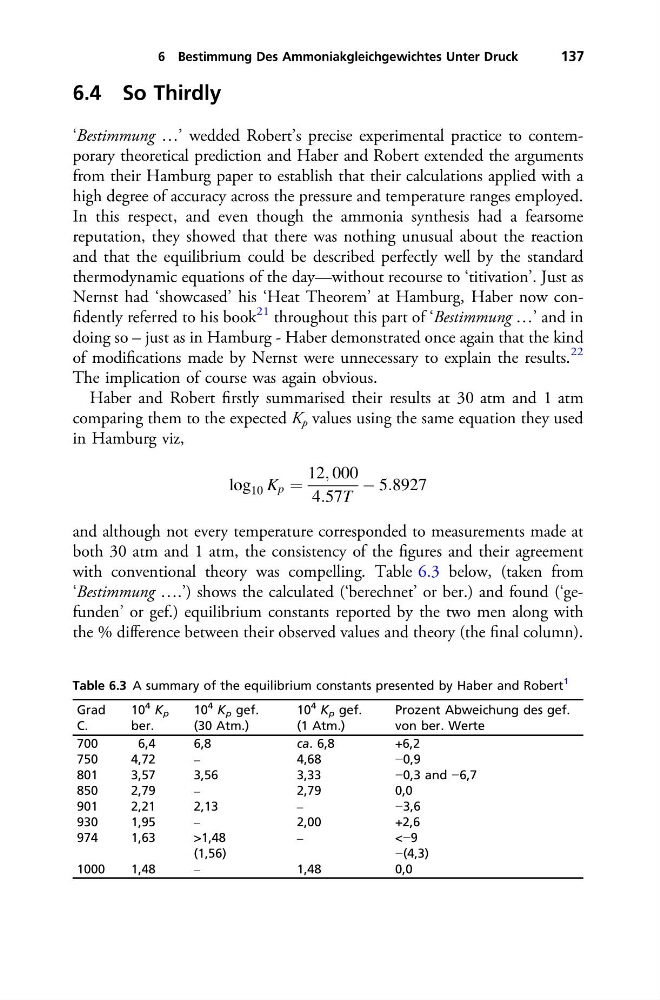
with conventional theory was compelling. Table 6.3 below, (taken from
‘Bestimmung ….’) shows the calculated (‘berechnet’ or ber.) and found (‘gefunden’ or gef.) equilibrium constants reported by the two men along with
the % difference between their observed values and theory (the final column).
Table 6.3 A summary of the equilibrium constants presented by Haber and Robert
1
Grad
C.
10
4 K p
ber.
10
4 K p gef.
(30 Atm.)
10
4 K p gef.
(1 Atm.)
Prozent Abweichung des gef.
von ber. Werte
700
6,4
6,8
ca. 6,8
+6,2
750
4,72
–
4,68
−0,9
801
3,57
3,56
3,33
−0,3 and −6,7
850
2,79
–
2,79
0,0
901
2,21
2,13
–
−3,6
930
1,95
–
2,00
+2,6
974
1,63
>1,48
–
<−9
(1,56)
−(4,3)
1000
1,48
–
1,48
0,0
6 Bestimmung Des Ammoniakgleichgewichtes Unter Druck
137
‘Bestimmung …’ wedded Robert’s precise experimental practice to contemporary theoretical prediction and Haber and Robert extended the arguments
from their Hamburg paper to establish that their calculations applied with a
high degree of accuracy across the pressure and temperature ranges employed.
In this respect, and even though the ammonia synthesis had a fearsome
reputation, they showed that there was nothing unusual about the reaction
and that the equilibrium could be described perfectly well by the standard
thermodynamic equations of the day—without recourse to ‘titivation’. Just as
Nernst had ‘showcased’ his ‘Heat Theorem’ at Hamburg, Haber now confidently referred to his book
21 throughout this part of ‘Bestimmung …’ and in
doing so – just as in Hamburg - Haber demonstrated once again that the kind
of modifications made by Nernst were unnecessary to explain the results.
22
The implication of course was again obvious.
Haber and Robert firstly summarised their results at 30 atm and 1 atm
comparing them to the expected K p values using the same equation they used
in Hamburg viz,
log 10 K p ¼
12; 000
4:57T
À 5:8927
and although not every temperature corresponded to measurements made at
both 30 atm and 1 atm, the consistency of the figures and their agreement
with conventional theory was compelling. Table 6.3 below, (taken from
‘Bestimmung ….’) shows the calculated (‘berechnet’ or ber.) and found (‘gefunden’ or gef.) equilibrium constants reported by the two men along with
the % difference between their observed values and theory (the final column).
Table 6.3 A summary of the equilibrium constants presented by Haber and Robert
1
Grad
C.
10
4 K p
ber.
10
4 K p gef.
(30 Atm.)
10
4 K p gef.
(1 Atm.)
Prozent Abweichung des gef.
von ber. Werte
700
6,4
6,8
ca. 6,8
+6,2
750
4,72
–
4,68
−0,9
801
3,57
3,56
3,33
−0,3 and −6,7
850
2,79
–
2,79
0,0
901
2,21
2,13
–
−3,6
930
1,95
–
2,00
+2,6
974
1,63
>1,48
–
<−9
(1,56)
−(4,3)
1000
1,48
–
1,48
0,0
6 Bestimmung Des Ammoniakgleichgewichtes Unter Druck
137