

denominator in the expression could be regarded as a ‘constant’ equal to
ð25Þ
1
2 Â ð75Þ
3
2 or 3247, so at 30 atm K p was expressed
19 as;
K p Á 30 ¼ 100 Á ðNH 3 Þ=3247
ð1Þ
Therefore, given the average % ammonia at equilibrium from ‘Tabelle 1’ as
0.2071% for example, K p was easily calculated as 2.13 Â 10
−4 atm
−1
. This
calculation was repeated for each temperature group. However, in the last
group of (7) results at ‘974 °C’—the most contentious temperature given the
dispute in Hamburg—and with 20 mg iron as catalyst, Robert varied the
composition of the gas mixtures around the optimal 75% hydrogen to 25%
nitrogen to determine the maximum and minimum values to be expected for
K p . For the first four experiments the ratio was 25.9% nitrogen to 74.1%
hydrogen (const. eqn 1 = 3246.1) and in the remaining three experiments
the ratio was 75.2% hydrogen to 24.8% nitrogen (const. eqn 1 = 3247.7).
Therefore, the average K p for the first group could confidently be expected to
be a maximum value whilst the average K p for the latter was regarded as
minimum. Using the same calculation as before, the range for K p at 974 °C
was determined as 1.48 Â 10
−4 to 1.56 Â 10
−4 atm
−1 and this was expressed
by Haber and Robert in their final table for the equilibrium constants at
30 atm viz, where the middle column provided the % ammonia at
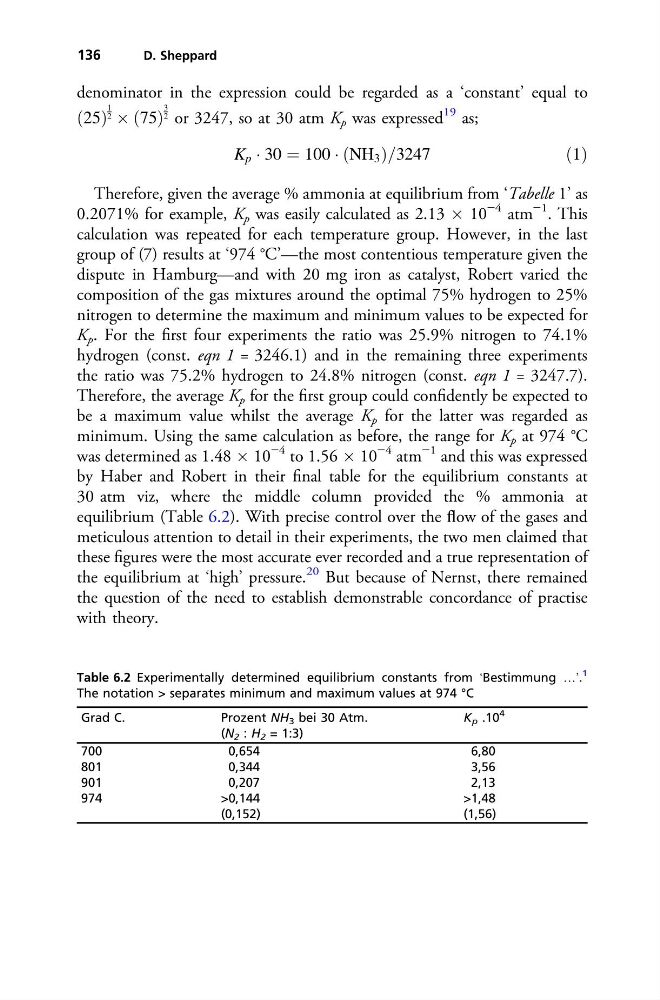
equilibrium (Table 6.2). With precise control over the flow of the gases and
meticulous attention to detail in their experiments, the two men claimed that
these figures were the most accurate ever recorded and a true representation of
the equilibrium at ‘high’ pressure.
20 But because of Nernst, there remained
the question of the need to establish demonstrable concordance of practise
with theory.
Table 6.2 Experimentally determined equilibrium constants from ‘Bestimmung …’.
1
The notation > separates minimum and maximum values at 974 °C
Grad C.
Prozent NH 3 bei 30 Atm.
(N 2 : H 2 = 1:3)
K p .10
4
700
0,654
6,80
801
0,344
3,56
901
0,207
2,13
974
>0,144
(0,152)
>1,48
(1,56)
136
D. Sheppard
ð25Þ
1
2 Â ð75Þ
3
2 or 3247, so at 30 atm K p was expressed
19 as;
K p Á 30 ¼ 100 Á ðNH 3 Þ=3247
ð1Þ
Therefore, given the average % ammonia at equilibrium from ‘Tabelle 1’ as
0.2071% for example, K p was easily calculated as 2.13 Â 10
−4 atm
−1
. This
calculation was repeated for each temperature group. However, in the last
group of (7) results at ‘974 °C’—the most contentious temperature given the
dispute in Hamburg—and with 20 mg iron as catalyst, Robert varied the
composition of the gas mixtures around the optimal 75% hydrogen to 25%
nitrogen to determine the maximum and minimum values to be expected for
K p . For the first four experiments the ratio was 25.9% nitrogen to 74.1%
hydrogen (const. eqn 1 = 3246.1) and in the remaining three experiments
the ratio was 75.2% hydrogen to 24.8% nitrogen (const. eqn 1 = 3247.7).
Therefore, the average K p for the first group could confidently be expected to
be a maximum value whilst the average K p for the latter was regarded as
minimum. Using the same calculation as before, the range for K p at 974 °C
was determined as 1.48 Â 10
−4 to 1.56 Â 10
−4 atm
−1 and this was expressed
by Haber and Robert in their final table for the equilibrium constants at
30 atm viz, where the middle column provided the % ammonia at
equilibrium (Table 6.2). With precise control over the flow of the gases and
meticulous attention to detail in their experiments, the two men claimed that
these figures were the most accurate ever recorded and a true representation of
the equilibrium at ‘high’ pressure.
20 But because of Nernst, there remained
the question of the need to establish demonstrable concordance of practise
with theory.
Table 6.2 Experimentally determined equilibrium constants from ‘Bestimmung …’.
1
The notation > separates minimum and maximum values at 974 °C
Grad C.
Prozent NH 3 bei 30 Atm.
(N 2 : H 2 = 1:3)
K p .10
4
700
0,654
6,80
801
0,344
3,56
901
0,207
2,13
974
>0,144
(0,152)
>1,48
(1,56)
136
D. Sheppard