

credibility. Employing the ‘approximation formula’ as a double check may
have been an appeasement to Nernst, after all who can resist the self satisfaction when one’s ideas are used to confirm another’s work?
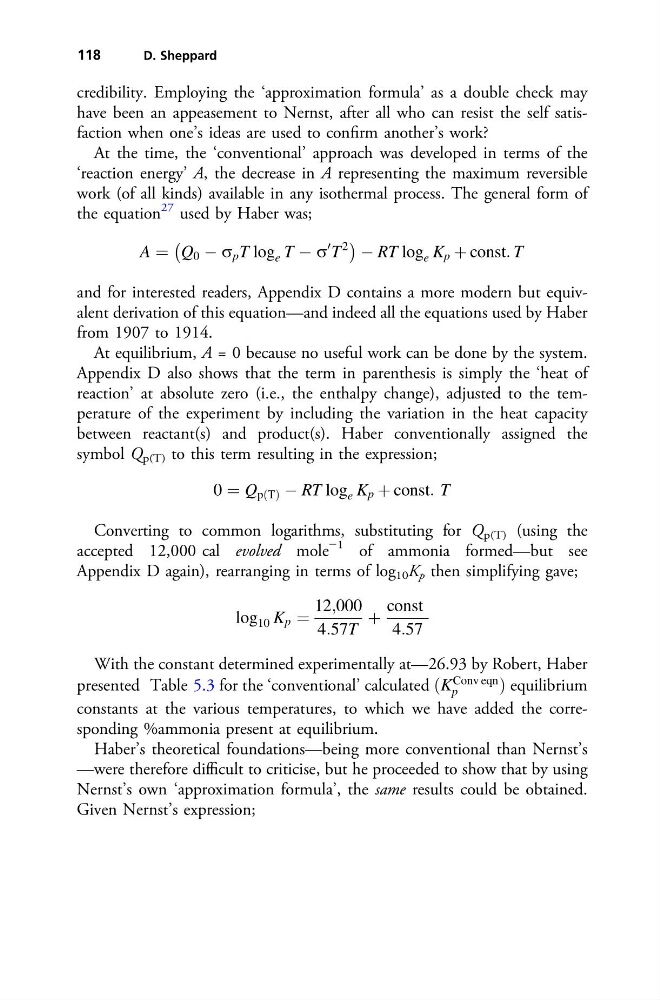
At the time, the ‘conventional’ approach was developed in terms of the
‘reaction energy’ A, the decrease in A representing the maximum reversible
work (of all kinds) available in any isothermal process. The general form of
the equation
27 used by Haber was;
A ¼ Q 0 À r p T log e T À r
0
T
2
À
Á À RT log e K p þ const: T
and for interested readers, Appendix D contains a more modern but equivalent derivation of this equation—and indeed all the equations used by Haber
from 1907 to 1914.
At equilibrium, A = 0 because no useful work can be done by the system.
Appendix D also shows that the term in parenthesis is simply the ‘heat of
reaction’ at absolute zero (i.e., the enthalpy change), adjusted to the temperature of the experiment by including the variation in the heat capacity
between reactant(s) and product(s). Haber conventionally assigned the
symbol Q p(T) to this term resulting in the expression;
0 ¼ Q pðTÞ À RT log e K p þ const: T
Converting to common logarithms, substituting for Q p(T) (using the
accepted 12,000 cal evolved mole
−1 of ammonia formed—but see
Appendix D again), rearranging in terms of log 10 K p then simplifying gave;
log 10 K p ¼
12;000
4:57T
þ
const
4:57
With the constant determined experimentally at—26.93 by Robert, Haber
presented Table 5.3 for the ‘conventional’ calculated ðK
Conv eqn
p
Þ equilibrium
constants at the various temperatures, to which we have added the corresponding %ammonia present at equilibrium.
Haber’s theoretical foundations—being more conventional than Nernst’s
—were therefore difficult to criticise, but he proceeded to show that by using
Nernst’s own ‘approximation formula’, the same results could be obtained.
Given Nernst’s expression;
118
D. Sheppard
have been an appeasement to Nernst, after all who can resist the self satisfaction when one’s ideas are used to confirm another’s work?
At the time, the ‘conventional’ approach was developed in terms of the
‘reaction energy’ A, the decrease in A representing the maximum reversible
work (of all kinds) available in any isothermal process. The general form of
the equation
27 used by Haber was;
A ¼ Q 0 À r p T log e T À r
0
T
2
À
Á À RT log e K p þ const: T
and for interested readers, Appendix D contains a more modern but equivalent derivation of this equation—and indeed all the equations used by Haber
from 1907 to 1914.
At equilibrium, A = 0 because no useful work can be done by the system.
Appendix D also shows that the term in parenthesis is simply the ‘heat of
reaction’ at absolute zero (i.e., the enthalpy change), adjusted to the temperature of the experiment by including the variation in the heat capacity
between reactant(s) and product(s). Haber conventionally assigned the
symbol Q p(T) to this term resulting in the expression;
0 ¼ Q pðTÞ À RT log e K p þ const: T
Converting to common logarithms, substituting for Q p(T) (using the
accepted 12,000 cal evolved mole
−1 of ammonia formed—but see
Appendix D again), rearranging in terms of log 10 K p then simplifying gave;
log 10 K p ¼
12;000
4:57T
þ
const
4:57
With the constant determined experimentally at—26.93 by Robert, Haber
presented Table 5.3 for the ‘conventional’ calculated ðK
Conv eqn
p
Þ equilibrium
constants at the various temperatures, to which we have added the corresponding %ammonia present at equilibrium.
Haber’s theoretical foundations—being more conventional than Nernst’s
—were therefore difficult to criticise, but he proceeded to show that by using
Nernst’s own ‘approximation formula’, the same results could be obtained.
Given Nernst’s expression;
118
D. Sheppard