

flask was to act as a control, absorbing any traces of ammonia not ‘held back’
by the first. Robert noted that no ammonia was ever absorbed in the second
flask. The ammonia determination could therefore proceed with confidence
on the first. The ammonia ‘held back’ in the absorption bottles was determined by titration. The bottles were washed out with distilled water to
provide a final volume of 40 cc. 5 cc of ethers containing 2 mg per litre of
‘Jedeosin’ (Erythrosin B) were then added as indicator. This solution was
titrated with 0.02N aqueous ammonia (according to the established method
of Mylius and Foerster). The titration therefore required 3.4 mg of ammonia
for complete neutralisation of the original acid and Haber and Robert
declared that the end point for the residual acid was sharp enough to
recognise 0.01 mg ammonia (formed or undecomposed), ‘very clearly’.
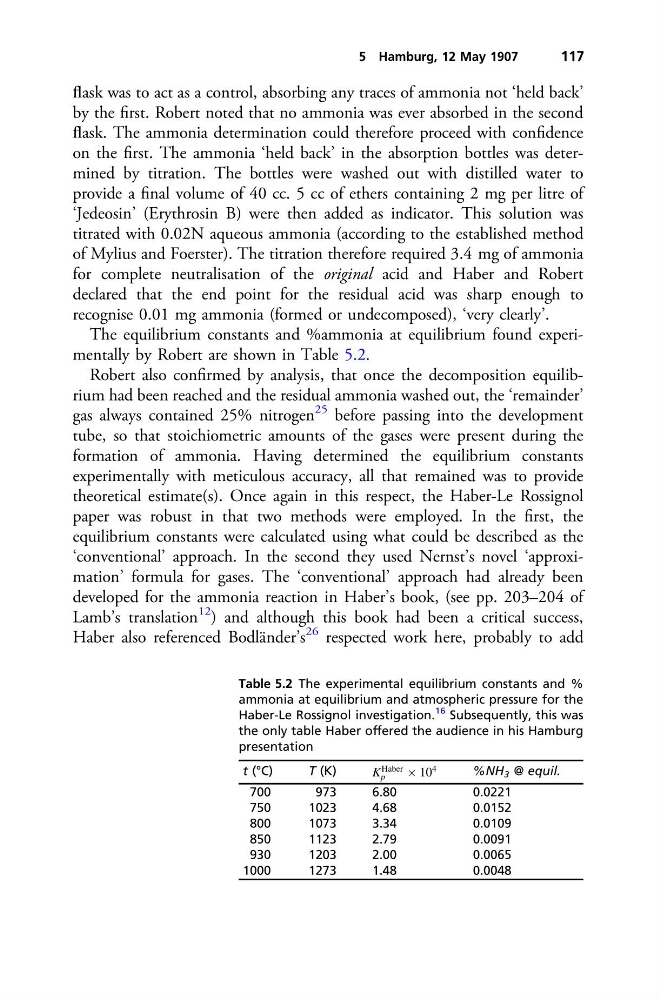
The equilibrium constants and %ammonia at equilibrium found experimentally by Robert are shown in Table 5.2.
Robert also confirmed by analysis, that once the decomposition equilibrium had been reached and the residual ammonia washed out, the ‘remainder’
gas always contained 25% nitrogen
25 before passing into the development
tube, so that stoichiometric amounts of the gases were present during the
formation of ammonia. Having determined the equilibrium constants
experimentally with meticulous accuracy, all that remained was to provide
theoretical estimate(s). Once again in this respect, the Haber-Le Rossignol
paper was robust in that two methods were employed. In the first, the
equilibrium constants were calculated using what could be described as the
‘conventional’ approach. In the second they used Nernst’s novel ‘approximation’ formula for gases. The ‘conventional’ approach had already been
developed for the ammonia reaction in Haber’s book, (see pp. 203–204 of
Lamb’s translation
12 ) and although this book had been a critical success,
Haber also referenced Bodländer’s
26 respected work here, probably to add
Table 5.2 The experimental equilibrium constants and %
ammonia at equilibrium and atmospheric pressure for the
Haber-Le Rossignol investigation.
16 Subsequently, this was
the only table Haber offered the audience in his Hamburg
presentation
t (°C)
T (K)
K
Haber
p
 10
4
%NH 3 @ equil.
700
973
6.80
0.0221
750
1023
4.68
0.0152
800
1073
3.34
0.0109
850
1123
2.79
0.0091
930
1203
2.00
0.0065
1000
1273
1.48
0.0048
5 Hamburg, 12 May 1907
117
by the first. Robert noted that no ammonia was ever absorbed in the second
flask. The ammonia determination could therefore proceed with confidence
on the first. The ammonia ‘held back’ in the absorption bottles was determined by titration. The bottles were washed out with distilled water to
provide a final volume of 40 cc. 5 cc of ethers containing 2 mg per litre of
‘Jedeosin’ (Erythrosin B) were then added as indicator. This solution was
titrated with 0.02N aqueous ammonia (according to the established method
of Mylius and Foerster). The titration therefore required 3.4 mg of ammonia
for complete neutralisation of the original acid and Haber and Robert
declared that the end point for the residual acid was sharp enough to
recognise 0.01 mg ammonia (formed or undecomposed), ‘very clearly’.
The equilibrium constants and %ammonia at equilibrium found experimentally by Robert are shown in Table 5.2.
Robert also confirmed by analysis, that once the decomposition equilibrium had been reached and the residual ammonia washed out, the ‘remainder’
gas always contained 25% nitrogen
25 before passing into the development
tube, so that stoichiometric amounts of the gases were present during the
formation of ammonia. Having determined the equilibrium constants
experimentally with meticulous accuracy, all that remained was to provide
theoretical estimate(s). Once again in this respect, the Haber-Le Rossignol
paper was robust in that two methods were employed. In the first, the
equilibrium constants were calculated using what could be described as the
‘conventional’ approach. In the second they used Nernst’s novel ‘approximation’ formula for gases. The ‘conventional’ approach had already been
developed for the ammonia reaction in Haber’s book, (see pp. 203–204 of
Lamb’s translation
12 ) and although this book had been a critical success,
Haber also referenced Bodländer’s
26 respected work here, probably to add
Table 5.2 The experimental equilibrium constants and %
ammonia at equilibrium and atmospheric pressure for the
Haber-Le Rossignol investigation.
16 Subsequently, this was
the only table Haber offered the audience in his Hamburg
presentation
t (°C)
T (K)
K
Haber
p
 10
4
%NH 3 @ equil.
700
973
6.80
0.0221
750
1023
4.68
0.0152
800
1073
3.34
0.0109
850
1123
2.79
0.0091
930
1203
2.00
0.0065
1000
1273
1.48
0.0048
5 Hamburg, 12 May 1907
117