

with the assumption that the partial pressure of the remaining ammonia (x) at
equilibrium was so small that the sum of the partial pressures of the product
gases constituted the total pressure. The observed (beobachtung or ‘beob.’)
%ammonia at equilibrium was then simply 100x.
Having determined the %ammonia experimentally at various temperatures, all that remained was to provide a theoretical estimate based on the
‘Heat Theorem’. Nernst used his ‘approximation’ formula for gases to achieve
this viz.,
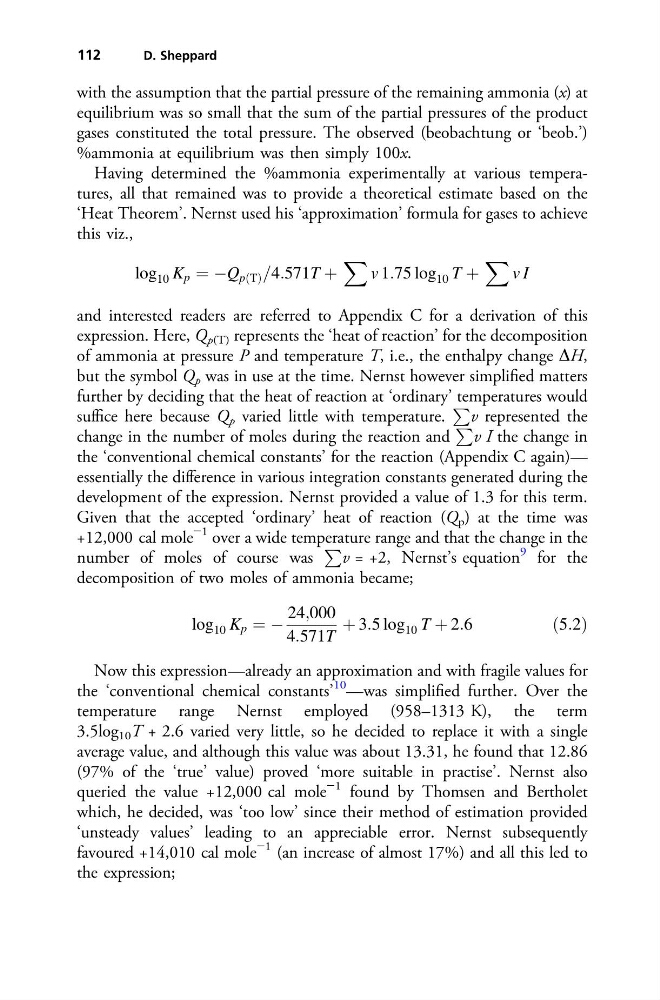
log 10 K p ¼ ÀQ pðTÞ =4:571T þ
X v 1:75 log 10 T þ
X v I
and interested readers are referred to Appendix C for a derivation of this
expression. Here, Q p(T) represents the ‘heat of reaction’ for the decomposition
of ammonia at pressure P and temperature T, i.e., the enthalpy change DH,
but the symbol Q p was in use at the time. Nernst however simplified matters
further by deciding that the heat of reaction at ‘ordinary’ temperatures would
suffice here because Q p varied little with temperature.
P
v represented the
change in the number of moles during the reaction and
P
v I the change in
the ‘conventional chemical constants’ for the reaction (Appendix C again)—
essentially the difference in various integration constants generated during the
development of the expression. Nernst provided a value of 1.3 for this term.
Given that the accepted ‘ordinary’ heat of reaction (Q p ) at the time was
+12,000 cal mole
−1 over a wide temperature range and that the change in the
number of moles of course was
P
v = +2, Nernst’s equation
9 for the
decomposition of two moles of ammonia became;
log 10 K p ¼ À
24;000
4:571T
þ 3:5 log 10 T þ 2:6
ð5:2Þ
Now this expression—already an approximation and with fragile values for
the ‘conventional chemical constants’
10
—was simplified further. Over the
temperature range Nernst employed (958–1313 K), the term
3.5log 10 T + 2.6 varied very little, so he decided to replace it with a single
average value, and although this value was about 13.31, he found that 12.86
(97% of the ‘true’ value) proved ‘more suitable in practise’. Nernst also
queried the value +12,000 cal mole
−1 found by Thomsen and Bertholet
which, he decided, was ‘too low’ since their method of estimation provided
‘unsteady values’ leading to an appreciable error. Nernst subsequently
favoured +14,010 cal mole
−1 (an increase of almost 17%) and all this led to
the expression;
112
D. Sheppard
equilibrium was so small that the sum of the partial pressures of the product
gases constituted the total pressure. The observed (beobachtung or ‘beob.’)
%ammonia at equilibrium was then simply 100x.
Having determined the %ammonia experimentally at various temperatures, all that remained was to provide a theoretical estimate based on the
‘Heat Theorem’. Nernst used his ‘approximation’ formula for gases to achieve
this viz.,
log 10 K p ¼ ÀQ pðTÞ =4:571T þ
X v 1:75 log 10 T þ
X v I
and interested readers are referred to Appendix C for a derivation of this
expression. Here, Q p(T) represents the ‘heat of reaction’ for the decomposition
of ammonia at pressure P and temperature T, i.e., the enthalpy change DH,
but the symbol Q p was in use at the time. Nernst however simplified matters
further by deciding that the heat of reaction at ‘ordinary’ temperatures would
suffice here because Q p varied little with temperature.
P
v represented the
change in the number of moles during the reaction and
P
v I the change in
the ‘conventional chemical constants’ for the reaction (Appendix C again)—
essentially the difference in various integration constants generated during the
development of the expression. Nernst provided a value of 1.3 for this term.
Given that the accepted ‘ordinary’ heat of reaction (Q p ) at the time was
+12,000 cal mole
−1 over a wide temperature range and that the change in the
number of moles of course was
P
v = +2, Nernst’s equation
9 for the
decomposition of two moles of ammonia became;
log 10 K p ¼ À
24;000
4:571T
þ 3:5 log 10 T þ 2:6
ð5:2Þ
Now this expression—already an approximation and with fragile values for
the ‘conventional chemical constants’
10
—was simplified further. Over the
temperature range Nernst employed (958–1313 K), the term
3.5log 10 T + 2.6 varied very little, so he decided to replace it with a single
average value, and although this value was about 13.31, he found that 12.86
(97% of the ‘true’ value) proved ‘more suitable in practise’. Nernst also
queried the value +12,000 cal mole
−1 found by Thomsen and Bertholet
which, he decided, was ‘too low’ since their method of estimation provided
‘unsteady values’ leading to an appreciable error. Nernst subsequently
favoured +14,010 cal mole
−1 (an increase of almost 17%) and all this led to
the expression;
112
D. Sheppard