

in the quantitative determination(s). To this end, experiments were performed at 50–70 atmospheres by moving a mixture of hydrogen and nitrogen
into the oven using the ‘streaming method’
4 where the gas mixture was
funnelled through a long tube. The gases were held in the tube and the
temperature kept constant until equilibrium was reached. On release of the
mixture, the temperature was rapidly reduced so that the reaction was
immediately halted (‘quenched’) at the equilibrium position. Quite rightly
then, Nernst has to be recognised as the first to synthesise ammonia at ‘high’
pressure
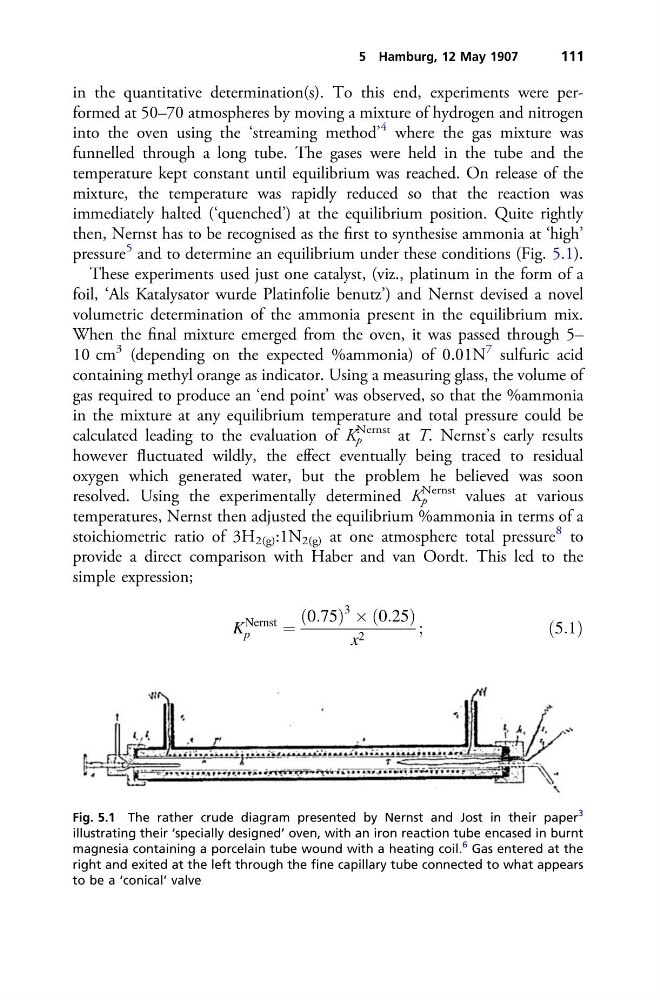
5 and to determine an equilibrium under these conditions (Fig. 5.1).
These experiments used just one catalyst, (viz., platinum in the form of a
foil, ‘Als Katalysator wurde Platinfolie benutz’) and Nernst devised a novel
volumetric determination of the ammonia present in the equilibrium mix.
When the final mixture emerged from the oven, it was passed through 5–
10 cm
3 (depending on the expected %ammonia) of 0.01N
7 sulfuric acid
containing methyl orange as indicator. Using a measuring glass, the volume of
gas required to produce an ‘end point’ was observed, so that the %ammonia
in the mixture at any equilibrium temperature and total pressure could be
calculated leading to the evaluation of K p
Nernst at T. Nernst’s early results
however fluctuated wildly, the effect eventually being traced to residual
oxygen which generated water, but the problem he believed was soon
resolved. Using the experimentally determined K p
Nernst values at various
temperatures, Nernst then adjusted the equilibrium %ammonia in terms of a
stoichiometric ratio of 3H 2(g) :1N 2(g) at one atmosphere total pressure
8 to
provide a direct comparison with Haber and van Oordt. This led to the
simple expression;
K
Nernst
p
¼
ð0:75Þ
3
 ð0:25Þ
x 2
;
ð5:1Þ
Fig. 5.1 The rather crude diagram presented by Nernst and Jost in their paper
3
illustrating their ‘specially designed’ oven, with an iron reaction tube encased in burnt
magnesia containing a porcelain tube wound with a heating coil.
6 Gas entered at the
right and exited at the left through the fine capillary tube connected to what appears
to be a ‘conical’ valve
5 Hamburg, 12 May 1907
111
into the oven using the ‘streaming method’
4 where the gas mixture was
funnelled through a long tube. The gases were held in the tube and the
temperature kept constant until equilibrium was reached. On release of the
mixture, the temperature was rapidly reduced so that the reaction was
immediately halted (‘quenched’) at the equilibrium position. Quite rightly
then, Nernst has to be recognised as the first to synthesise ammonia at ‘high’
pressure
5 and to determine an equilibrium under these conditions (Fig. 5.1).
These experiments used just one catalyst, (viz., platinum in the form of a
foil, ‘Als Katalysator wurde Platinfolie benutz’) and Nernst devised a novel
volumetric determination of the ammonia present in the equilibrium mix.
When the final mixture emerged from the oven, it was passed through 5–
10 cm
3 (depending on the expected %ammonia) of 0.01N
7 sulfuric acid
containing methyl orange as indicator. Using a measuring glass, the volume of
gas required to produce an ‘end point’ was observed, so that the %ammonia
in the mixture at any equilibrium temperature and total pressure could be
calculated leading to the evaluation of K p
Nernst at T. Nernst’s early results
however fluctuated wildly, the effect eventually being traced to residual
oxygen which generated water, but the problem he believed was soon
resolved. Using the experimentally determined K p
Nernst values at various
temperatures, Nernst then adjusted the equilibrium %ammonia in terms of a
stoichiometric ratio of 3H 2(g) :1N 2(g) at one atmosphere total pressure
8 to
provide a direct comparison with Haber and van Oordt. This led to the
simple expression;
K
Nernst
p
¼
ð0:75Þ
3
 ð0:25Þ
x 2
;
ð5:1Þ
Fig. 5.1 The rather crude diagram presented by Nernst and Jost in their paper
3
illustrating their ‘specially designed’ oven, with an iron reaction tube encased in burnt
magnesia containing a porcelain tube wound with a heating coil.
6 Gas entered at the
right and exited at the left through the fine capillary tube connected to what appears
to be a ‘conical’ valve
5 Hamburg, 12 May 1907
111