

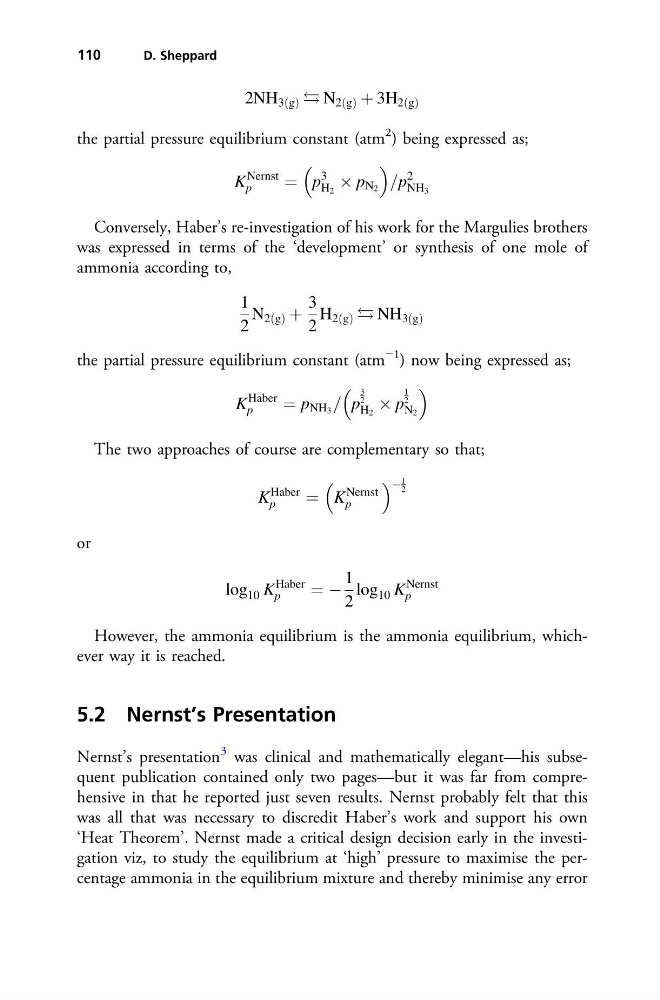
2NH 3ðgÞ N 2ðgÞ þ 3H 2ðgÞ
the partial pressure equilibrium constant (atm
2 ) being expressed as;
K
Nernst
p
¼ p
3
H 2
 p N 2
=p
2
NH 3
Conversely, Haber’s re-investigation of his work for the Margulies brothers
was expressed in terms of the ‘development’ or synthesis of one mole of
ammonia according to,
1
2
N 2ðgÞ þ
3
2
H 2ðgÞ NH 3ðgÞ
the partial pressure equilibrium constant (atm
−1
) now being expressed as;
K
Haber
p
¼ p NH 3 = p
3
2
H 2
 p
1
2
N 2
The two approaches of course are complementary so that;
K
Haber
p
¼ K
Nernst
p
À
1
2
or
log 10 K
Haber
p
¼ À
1
2
log 10 K
Nernst
p
However, the ammonia equilibrium is the ammonia equilibrium, whichever way it is reached.
5.2 Nernst’s Presentation
Nernst’s presentation
3 was clinical and mathematically elegant—his subsequent publication contained only two pages—but it was far from comprehensive in that he reported just seven results. Nernst probably felt that this
was all that was necessary to discredit Haber’s work and support his own
‘Heat Theorem’. Nernst made a critical design decision early in the investigation viz, to study the equilibrium at ‘high’ pressure to maximise the percentage ammonia in the equilibrium mixture and thereby minimise any error
110
D. Sheppard
the partial pressure equilibrium constant (atm
2 ) being expressed as;
K
Nernst
p
¼ p
3
H 2
 p N 2
=p
2
NH 3
Conversely, Haber’s re-investigation of his work for the Margulies brothers
was expressed in terms of the ‘development’ or synthesis of one mole of
ammonia according to,
1
2
N 2ðgÞ þ
3
2
H 2ðgÞ NH 3ðgÞ
the partial pressure equilibrium constant (atm
−1
) now being expressed as;
K
Haber
p
¼ p NH 3 = p
3
2
H 2
 p
1
2
N 2
The two approaches of course are complementary so that;
K
Haber
p
¼ K
Nernst
p
À
1
2
or
log 10 K
Haber
p
¼ À
1
2
log 10 K
Nernst
p
However, the ammonia equilibrium is the ammonia equilibrium, whichever way it is reached.
5.2 Nernst’s Presentation
Nernst’s presentation
3 was clinical and mathematically elegant—his subsequent publication contained only two pages—but it was far from comprehensive in that he reported just seven results. Nernst probably felt that this
was all that was necessary to discredit Haber’s work and support his own
‘Heat Theorem’. Nernst made a critical design decision early in the investigation viz, to study the equilibrium at ‘high’ pressure to maximise the percentage ammonia in the equilibrium mixture and thereby minimise any error
110
D. Sheppard