

log 10 K p ¼ À
28;020
4:571T
þ 12:86 ¼ À
6130
T
þ 12:86
Now any physical chemist reading these lines today would regard Nernst’s
modification of these values as, frankly, ‘over-accommodating’—a point we
return to later—but substituting for K p from Eq. 5.1, Nernst finally arrived at
an equation of imperious mathematical austerity;
log 10 x ¼ 3065=T À 6:918
ð5:3Þ
which gave the partial pressure of ammonia (x) at equilibrium and one
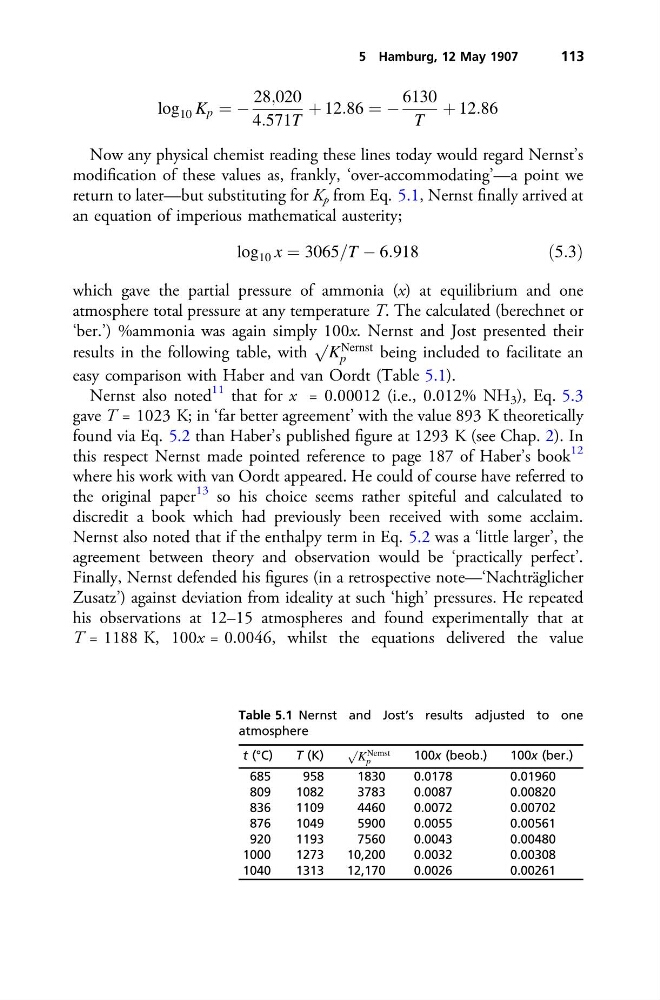
atmosphere total pressure at any temperature T. The calculated (berechnet or
‘ber.’) %ammonia was again simply 100x. Nernst and Jost presented their
results in the following table, with
p K
Nernst
p
being included to facilitate an
easy comparison with Haber and van Oordt (Table 5.1).
Nernst also noted
11 that for x = 0.00012 (i.e., 0.012% NH 3 ), Eq. 5.3
gave T = 1023 K; in ‘far better agreement’ with the value 893 K theoretically
found via Eq. 5.2 than Haber’s published figure at 1293 K (see Chap. 2). In
this respect Nernst made pointed reference to page 187 of Haber’s book
12
where his work with van Oordt appeared. He could of course have referred to
the original paper
13 so his choice seems rather spiteful and calculated to
discredit a book which had previously been received with some acclaim.
Nernst also noted that if the enthalpy term in Eq. 5.2 was a ‘little larger’, the
agreement between theory and observation would be ‘practically perfect’.
Finally, Nernst defended his figures (in a retrospective note—‘Nachträglicher
Zusatz’) against deviation from ideality at such ‘high’ pressures. He repeated
his observations at 12–15 atmospheres and found experimentally that at
T = 1188 K, 100x = 0.0046, whilst the equations delivered the value
Table 5.1 Nernst and Jost’s results adjusted to one
atmosphere
t (°C)
T (K)
p K
Nemst
p
100x (beob.)
100x (ber.)
685
958
1830
0.0178
0.01960
809
1082
3783
0.0087
0.00820
836
1109
4460
0.0072
0.00702
876
1049
5900
0.0055
0.00561
920
1193
7560
0.0043
0.00480
1000
1273
10,200
0.0032
0.00308
1040
1313
12,170
0.0026
0.00261
5 Hamburg, 12 May 1907
113
28;020
4:571T
þ 12:86 ¼ À
6130
T
þ 12:86
Now any physical chemist reading these lines today would regard Nernst’s
modification of these values as, frankly, ‘over-accommodating’—a point we
return to later—but substituting for K p from Eq. 5.1, Nernst finally arrived at
an equation of imperious mathematical austerity;
log 10 x ¼ 3065=T À 6:918
ð5:3Þ
which gave the partial pressure of ammonia (x) at equilibrium and one
atmosphere total pressure at any temperature T. The calculated (berechnet or
‘ber.’) %ammonia was again simply 100x. Nernst and Jost presented their
results in the following table, with
p K
Nernst
p
being included to facilitate an
easy comparison with Haber and van Oordt (Table 5.1).
Nernst also noted
11 that for x = 0.00012 (i.e., 0.012% NH 3 ), Eq. 5.3
gave T = 1023 K; in ‘far better agreement’ with the value 893 K theoretically
found via Eq. 5.2 than Haber’s published figure at 1293 K (see Chap. 2). In
this respect Nernst made pointed reference to page 187 of Haber’s book
12
where his work with van Oordt appeared. He could of course have referred to
the original paper
13 so his choice seems rather spiteful and calculated to
discredit a book which had previously been received with some acclaim.
Nernst also noted that if the enthalpy term in Eq. 5.2 was a ‘little larger’, the
agreement between theory and observation would be ‘practically perfect’.
Finally, Nernst defended his figures (in a retrospective note—‘Nachträglicher
Zusatz’) against deviation from ideality at such ‘high’ pressures. He repeated
his observations at 12–15 atmospheres and found experimentally that at
T = 1188 K, 100x = 0.0046, whilst the equations delivered the value
Table 5.1 Nernst and Jost’s results adjusted to one
atmosphere
t (°C)
T (K)
p K
Nemst
p
100x (beob.)
100x (ber.)
685
958
1830
0.0178
0.01960
809
1082
3783
0.0087
0.00820
836
1109
4460
0.0072
0.00702
876
1049
5900
0.0055
0.00561
920
1193
7560
0.0043
0.00480
1000
1273
10,200
0.0032
0.00308
1040
1313
12,170
0.0026
0.00261
5 Hamburg, 12 May 1907
113