

188
5 Modeling of Mechanical Oscillatory Systems …
r 1
r 2
=
n 1
n 2
= n
The angular displacement is related to the radii as follows:
r 1 θ 1 = r 2 θ 2
from where θ 2 = nθ 1 .
We examined the geometrical characteristics of the gear train. However, the gear
ratio is the main kinematic and dynamic characteristic of the gear transmission. This
is the ratio of the angular velocity of the first wheel to the angular velocity of the
second wheel.
d θ 2
dt
/
d θ 1
dt
= n
The gear ratio shows how many times the angular speed has decreased, and the
torque has increased by the same amount (without taking into account losses). Indeed,
equating the power transmitted by the gear transmission, we obtain:
T 1
d θ 1
dt
= T 2
d θ 2
dt
from where
T 1
T 2
= n
If the diameter of the drive wheel is smaller, then the torque of the driven wheel
increases due to a proportional decrease in rotation speed. In accordance with the gear
ratio (this is the ratio of the rotational speed of the leading element of a mechanical
transmission to the rotational speed of the driven one), an increase in torque will
cause a proportional decrease in the angular speed of rotation of the driven wheel,
and their product—mechanical power—will remain unchanged. Simply put, if small
gears drive large gears, the torque increases, and vice versa, if large gears drive small
gears, the torque decreases.
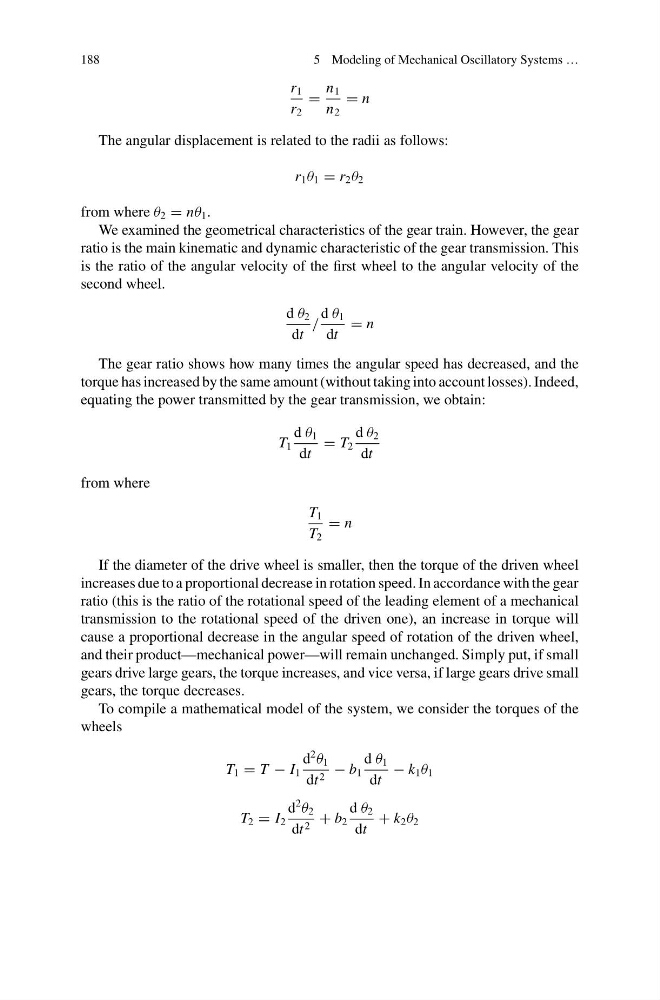
To compile a mathematical model of the system, we consider the torques of the
wheels
T 1 = T − I 1
d
2
θ 1
dt 2 − b 1
d θ 1
dt
− k 1 θ 1
T 2 = I 2
d
2
θ 2
dt 2 + b 2
d θ 2
dt
+ k 2 θ 2
5 Modeling of Mechanical Oscillatory Systems …
r 1
r 2
=
n 1
n 2
= n
The angular displacement is related to the radii as follows:
r 1 θ 1 = r 2 θ 2
from where θ 2 = nθ 1 .
We examined the geometrical characteristics of the gear train. However, the gear
ratio is the main kinematic and dynamic characteristic of the gear transmission. This
is the ratio of the angular velocity of the first wheel to the angular velocity of the
second wheel.
d θ 2
dt
/
d θ 1
dt
= n
The gear ratio shows how many times the angular speed has decreased, and the
torque has increased by the same amount (without taking into account losses). Indeed,
equating the power transmitted by the gear transmission, we obtain:
T 1
d θ 1
dt
= T 2
d θ 2
dt
from where
T 1
T 2
= n
If the diameter of the drive wheel is smaller, then the torque of the driven wheel
increases due to a proportional decrease in rotation speed. In accordance with the gear
ratio (this is the ratio of the rotational speed of the leading element of a mechanical
transmission to the rotational speed of the driven one), an increase in torque will
cause a proportional decrease in the angular speed of rotation of the driven wheel,
and their product—mechanical power—will remain unchanged. Simply put, if small
gears drive large gears, the torque increases, and vice versa, if large gears drive small
gears, the torque decreases.
To compile a mathematical model of the system, we consider the torques of the
wheels
T 1 = T − I 1
d
2
θ 1
dt 2 − b 1
d θ 1
dt
− k 1 θ 1
T 2 = I 2
d
2
θ 2
dt 2 + b 2
d θ 2
dt
+ k 2 θ 2