

5.6 Dual Torsion Oscillator
181
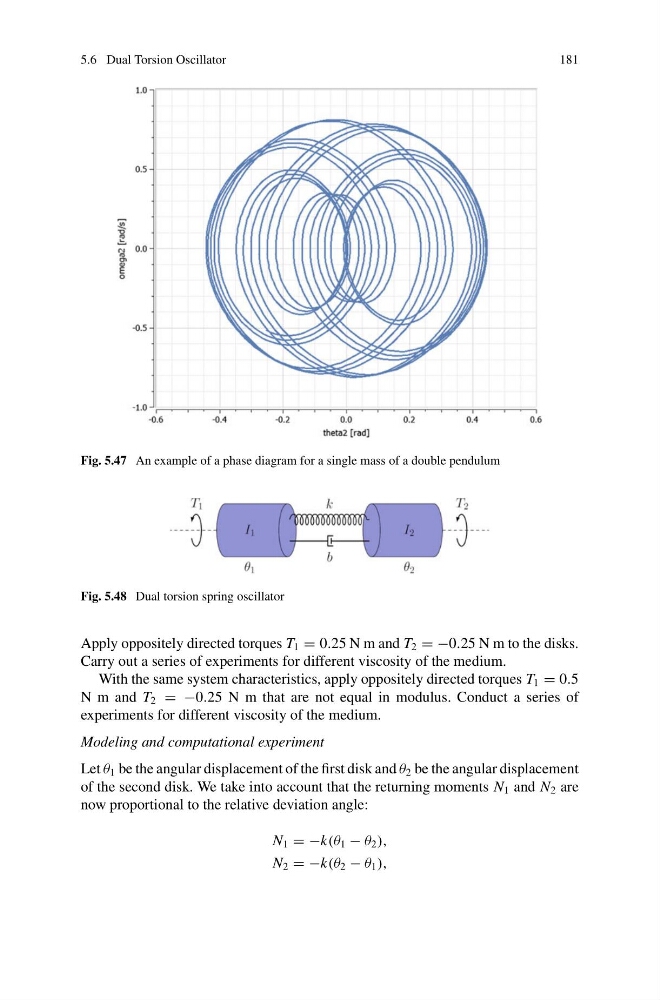
Fig. 5.47 An example of a phase diagram for a single mass of a double pendulum
Fig. 5.48 Dual torsion spring oscillator
Apply oppositely directed torques T 1 = 0.25 N m and T 2 = −0.25 N m to the disks.
Carry out a series of experiments for different viscosity of the medium.
With the same system characteristics, apply oppositely directed torques T 1 = 0.5
N m and T 2 = −0.25 N m that are not equal in modulus. Conduct a series of
experiments for different viscosity of the medium.
Modeling and computational experiment
Let θ 1 be the angular displacement of the first disk and θ 2 be the angular displacement
of the second disk. We take into account that the returning moments N 1 and N 2 are
now proportional to the relative deviation angle:
N 1 = −k(θ 1 − θ 2 ),
N 2 = −k(θ 2 − θ 1 ),
181
Fig. 5.47 An example of a phase diagram for a single mass of a double pendulum
Fig. 5.48 Dual torsion spring oscillator
Apply oppositely directed torques T 1 = 0.25 N m and T 2 = −0.25 N m to the disks.
Carry out a series of experiments for different viscosity of the medium.
With the same system characteristics, apply oppositely directed torques T 1 = 0.5
N m and T 2 = −0.25 N m that are not equal in modulus. Conduct a series of
experiments for different viscosity of the medium.
Modeling and computational experiment
Let θ 1 be the angular displacement of the first disk and θ 2 be the angular displacement
of the second disk. We take into account that the returning moments N 1 and N 2 are
now proportional to the relative deviation angle:
N 1 = −k(θ 1 − θ 2 ),
N 2 = −k(θ 2 − θ 1 ),