

180
5 Modeling of Mechanical Oscillatory Systems …
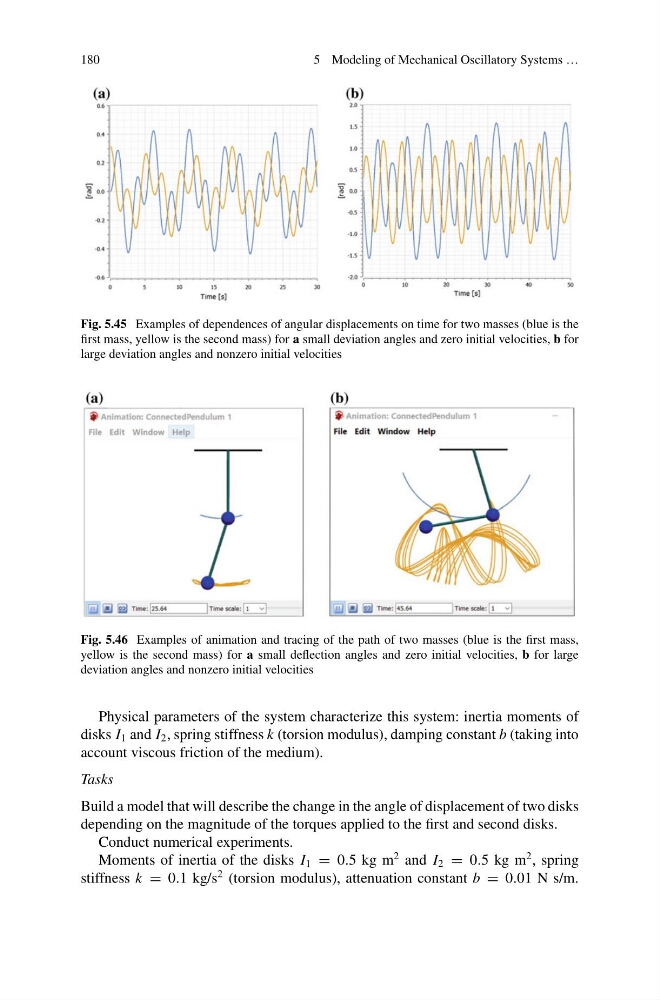
Fig. 5.45 Examples of dependences of angular displacements on time for two masses (blue is the
first mass, yellow is the second mass) for a small deviation angles and zero initial velocities, b for
large deviation angles and nonzero initial velocities
Fig. 5.46 Examples of animation and tracing of the path of two masses (blue is the first mass,
yellow is the second mass) for a small deflection angles and zero initial velocities, b for large
deviation angles and nonzero initial velocities
Physical parameters of the system characterize this system: inertia moments of
disks I 1 and I 2 , spring stiffness k (torsion modulus), damping constant b (taking into
account viscous friction of the medium).
Tasks
Build a model that will describe the change in the angle of displacement of two disks
depending on the magnitude of the torques applied to the first and second disks.
Conduct numerical experiments.
Moments of inertia of the disks I 1 = 0.5 kg m
2 and I 2 = 0.5 kg m
2 , spring
stiffness k = 0.1 kg/s
2 (torsion modulus), attenuation constant b = 0.01 N s/m.
5 Modeling of Mechanical Oscillatory Systems …
Fig. 5.45 Examples of dependences of angular displacements on time for two masses (blue is the
first mass, yellow is the second mass) for a small deviation angles and zero initial velocities, b for
large deviation angles and nonzero initial velocities
Fig. 5.46 Examples of animation and tracing of the path of two masses (blue is the first mass,
yellow is the second mass) for a small deflection angles and zero initial velocities, b for large
deviation angles and nonzero initial velocities
Physical parameters of the system characterize this system: inertia moments of
disks I 1 and I 2 , spring stiffness k (torsion modulus), damping constant b (taking into
account viscous friction of the medium).
Tasks
Build a model that will describe the change in the angle of displacement of two disks
depending on the magnitude of the torques applied to the first and second disks.
Conduct numerical experiments.
Moments of inertia of the disks I 1 = 0.5 kg m
2 and I 2 = 0.5 kg m
2 , spring
stiffness k = 0.1 kg/s
2 (torsion modulus), attenuation constant b = 0.01 N s/m.