

5.5 Double Pendulum
179
∂
∂t
∂ L
∂ ˙
θ 1
−
∂ L
∂θ 1
= 0
∂
∂t
∂ L
∂ ˙
θ 2
−
∂ L
∂θ 2
= 0
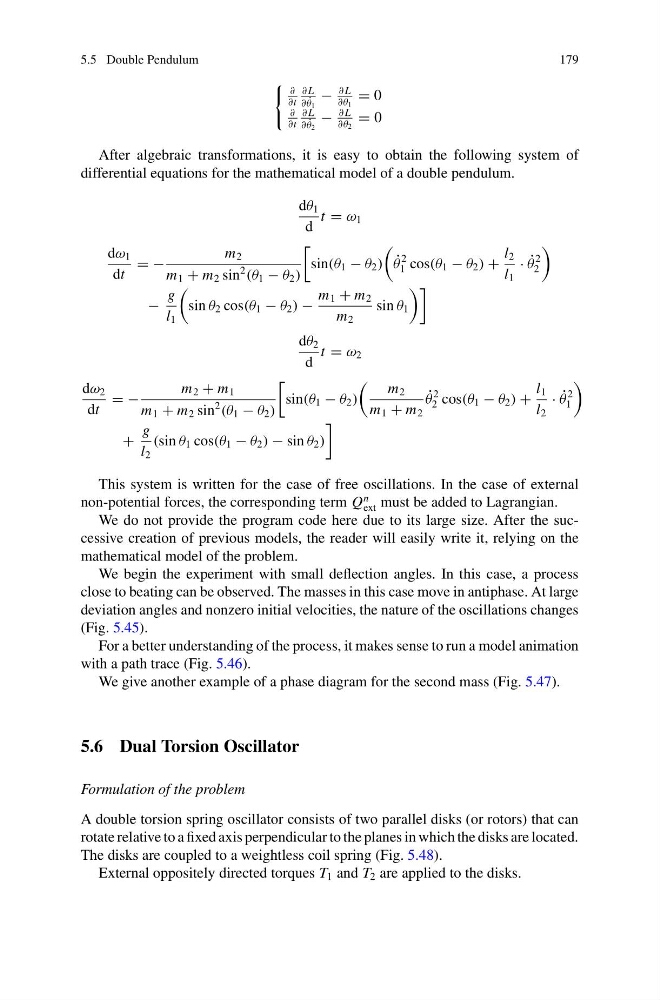
After algebraic transformations, it is easy to obtain the following system of
differential equations for the mathematical model of a double pendulum.
dθ 1
d
t = ω 1
dω 1
dt
= −
m 2
m 1 + m 2 sin
2
(θ 1 − θ 2 )
sin(θ 1 − θ 2 )
˙
θ
2
1 cos(θ 1 − θ 2 ) +
l 2
l 1
· ˙
θ
2
2
−
g
l 1
sin θ 2 cos(θ 1 − θ 2 ) −
m 1 + m 2
m 2
sin θ 1
dθ 2
d
t = ω 2
dω 2
dt
= −
m 2 + m 1
m 1 + m 2 sin
2
(θ 1 − θ 2 )
sin(θ 1 − θ 2 )
m 2
m 1 + m 2
˙
θ
2
2 cos(θ 1 − θ 2 ) +
l 1
l 2
· ˙
θ
2
1
+
g
l 2
(sin θ 1 cos(θ 1 − θ 2 ) − sin θ 2 )
This system is written for the case of free oscillations. In the case of external
non-potential forces, the corresponding term Q
n
ext must be added to Lagrangian.
We do not provide the program code here due to its large size. After the successive creation of previous models, the reader will easily write it, relying on the
mathematical model of the problem.
We begin the experiment with small deflection angles. In this case, a process
close to beating can be observed. The masses in this case move in antiphase. At large
deviation angles and nonzero initial velocities, the nature of the oscillations changes
(Fig. 5.45).
For a better understanding of the process, it makes sense to run a model animation
with a path trace (Fig. 5.46).
We give another example of a phase diagram for the second mass (Fig. 5.47).
5.6 Dual Torsion Oscillator
Formulation of the problem
A double torsion spring oscillator consists of two parallel disks (or rotors) that can
rotate relative to a fixed axis perpendicular to the planes in which the disks are located.
The disks are coupled to a weightless coil spring (Fig. 5.48).
External oppositely directed torques T 1 and T 2 are applied to the disks.
179
∂
∂t
∂ L
∂ ˙
θ 1
−
∂ L
∂θ 1
= 0
∂
∂t
∂ L
∂ ˙
θ 2
−
∂ L
∂θ 2
= 0
After algebraic transformations, it is easy to obtain the following system of
differential equations for the mathematical model of a double pendulum.
dθ 1
d
t = ω 1
dω 1
dt
= −
m 2
m 1 + m 2 sin
2
(θ 1 − θ 2 )
sin(θ 1 − θ 2 )
˙
θ
2
1 cos(θ 1 − θ 2 ) +
l 2
l 1
· ˙
θ
2
2
−
g
l 1
sin θ 2 cos(θ 1 − θ 2 ) −
m 1 + m 2
m 2
sin θ 1
dθ 2
d
t = ω 2
dω 2
dt
= −
m 2 + m 1
m 1 + m 2 sin
2
(θ 1 − θ 2 )
sin(θ 1 − θ 2 )
m 2
m 1 + m 2
˙
θ
2
2 cos(θ 1 − θ 2 ) +
l 1
l 2
· ˙
θ
2
1
+
g
l 2
(sin θ 1 cos(θ 1 − θ 2 ) − sin θ 2 )
This system is written for the case of free oscillations. In the case of external
non-potential forces, the corresponding term Q
n
ext must be added to Lagrangian.
We do not provide the program code here due to its large size. After the successive creation of previous models, the reader will easily write it, relying on the
mathematical model of the problem.
We begin the experiment with small deflection angles. In this case, a process
close to beating can be observed. The masses in this case move in antiphase. At large
deviation angles and nonzero initial velocities, the nature of the oscillations changes
(Fig. 5.45).
For a better understanding of the process, it makes sense to run a model animation
with a path trace (Fig. 5.46).
We give another example of a phase diagram for the second mass (Fig. 5.47).
5.6 Dual Torsion Oscillator
Formulation of the problem
A double torsion spring oscillator consists of two parallel disks (or rotors) that can
rotate relative to a fixed axis perpendicular to the planes in which the disks are located.
The disks are coupled to a weightless coil spring (Fig. 5.48).
External oppositely directed torques T 1 and T 2 are applied to the disks.