

182
5 Modeling of Mechanical Oscillatory Systems …
The braking torque of viscous friction forces is proportional to the relative angular
velocity of each disk
˙
θ 1 − ˙
θ 2
or
˙
θ 2 − ˙
θ 1
.
Given this, we obtain the system of equations:
T 1 − b
d θ 1
dt
−
d θ 2
dt
− k(θ 1 − θ 2 ) = I 1
d
2
θ 1
dt 2
T 2 − b
d θ 2
dt
−
d θ 1
dt
− k(θ 2 − θ 1 ) = I 2
d
2
θ 2
dt 2
or
I 1 ¨
θ 1 + b( ˙
θ 1 − ˙
θ 2 ) + k(θ 1 − θ 2 ) = T 1
I 2 ¨
θ 2 + b( ˙
θ 2 − ˙
θ 1 ) + k(θ 2 − θ 1 ) = T 2
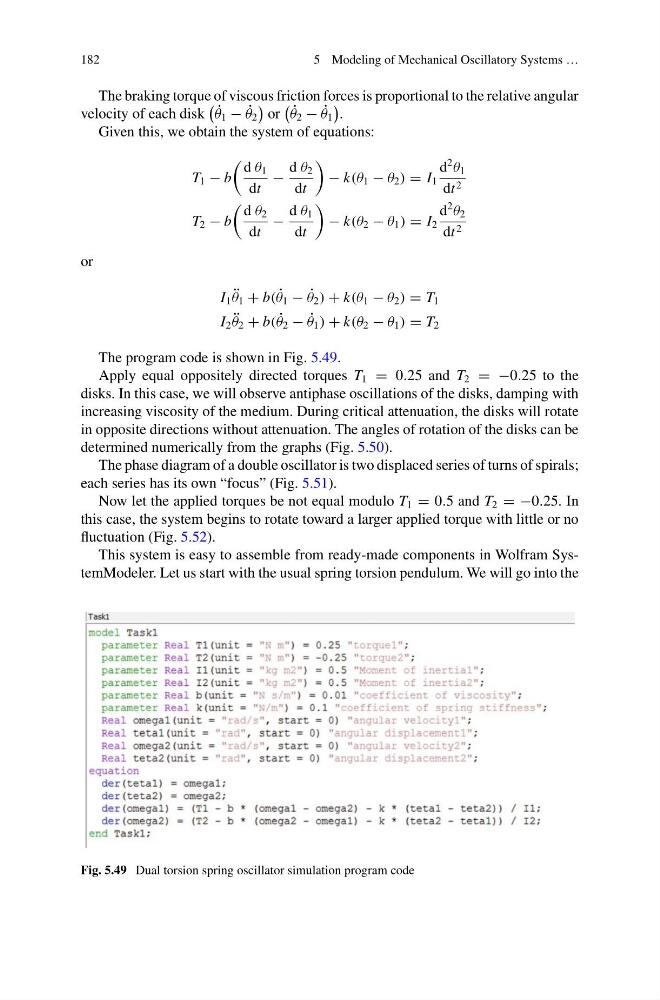
The program code is shown in Fig. 5.49.
Apply equal oppositely directed torques T 1 = 0.25 and T 2 = −0.25 to the
disks. In this case, we will observe antiphase oscillations of the disks, damping with
increasing viscosity of the medium. During critical attenuation, the disks will rotate
in opposite directions without attenuation. The angles of rotation of the disks can be
determined numerically from the graphs (Fig. 5.50).
The phase diagram of a double oscillator is two displaced series of turns of spirals;
each series has its own “focus” (Fig. 5.51).
Now let the applied torques be not equal modulo T 1 = 0.5 and T 2 = −0.25. In
this case, the system begins to rotate toward a larger applied torque with little or no
fluctuation (Fig. 5.52).
This system is easy to assemble from ready-made components in Wolfram SystemModeler. Let us start with the usual spring torsion pendulum. We will go into the
Fig. 5.49 Dual torsion spring oscillator simulation program code
5 Modeling of Mechanical Oscillatory Systems …
The braking torque of viscous friction forces is proportional to the relative angular
velocity of each disk
˙
θ 1 − ˙
θ 2
or
˙
θ 2 − ˙
θ 1
.
Given this, we obtain the system of equations:
T 1 − b
d θ 1
dt
−
d θ 2
dt
− k(θ 1 − θ 2 ) = I 1
d
2
θ 1
dt 2
T 2 − b
d θ 2
dt
−
d θ 1
dt
− k(θ 2 − θ 1 ) = I 2
d
2
θ 2
dt 2
or
I 1 ¨
θ 1 + b( ˙
θ 1 − ˙
θ 2 ) + k(θ 1 − θ 2 ) = T 1
I 2 ¨
θ 2 + b( ˙
θ 2 − ˙
θ 1 ) + k(θ 2 − θ 1 ) = T 2
The program code is shown in Fig. 5.49.
Apply equal oppositely directed torques T 1 = 0.25 and T 2 = −0.25 to the
disks. In this case, we will observe antiphase oscillations of the disks, damping with
increasing viscosity of the medium. During critical attenuation, the disks will rotate
in opposite directions without attenuation. The angles of rotation of the disks can be
determined numerically from the graphs (Fig. 5.50).
The phase diagram of a double oscillator is two displaced series of turns of spirals;
each series has its own “focus” (Fig. 5.51).
Now let the applied torques be not equal modulo T 1 = 0.5 and T 2 = −0.25. In
this case, the system begins to rotate toward a larger applied torque with little or no
fluctuation (Fig. 5.52).
This system is easy to assemble from ready-made components in Wolfram SystemModeler. Let us start with the usual spring torsion pendulum. We will go into the
Fig. 5.49 Dual torsion spring oscillator simulation program code