

5.4 Connected Pendulums
167
We take l 1 = l 2 = 1 m, m 1 = m 2 = 0.2 kg. The value of the distance d at which
we fix the spring, we take equal to 0.21. The initial values of the angles of deviation
of the pendulums: θ 10 = 0 (within 5°–6°) and θ 20 = 0.
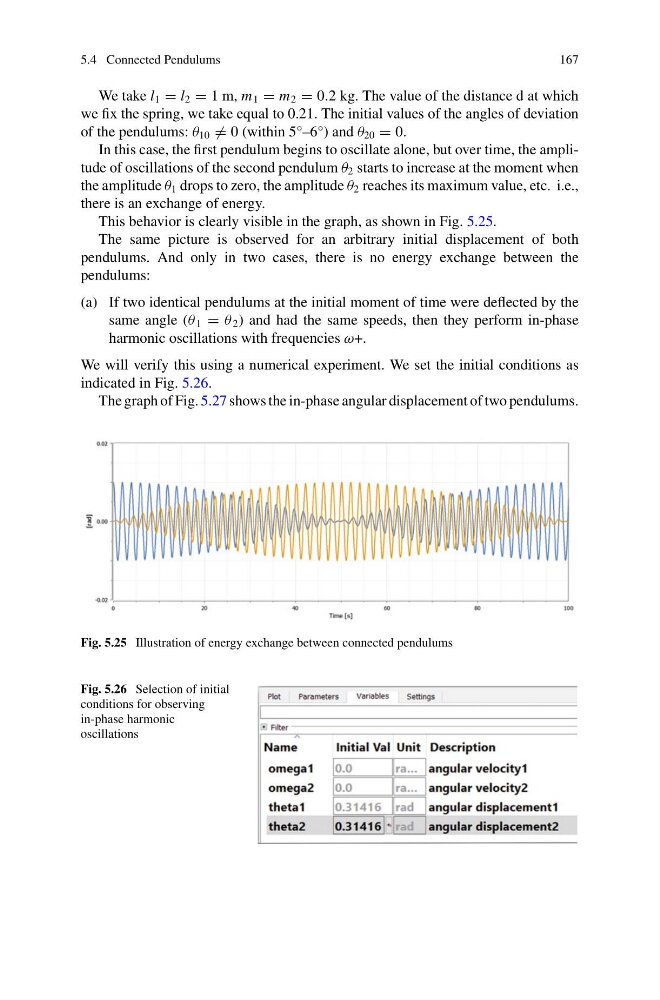
In this case, the first pendulum begins to oscillate alone, but over time, the amplitude of oscillations of the second pendulum θ 2 starts to increase at the moment when
the amplitude θ 1 drops to zero, the amplitude θ 2 reaches its maximum value, etc. i.e.,
there is an exchange of energy.
This behavior is clearly visible in the graph, as shown in Fig. 5.25.
The same picture is observed for an arbitrary initial displacement of both
pendulums. And only in two cases, there is no energy exchange between the
pendulums:
(a) If two identical pendulums at the initial moment of time were deflected by the
same angle (θ 1 = θ 2 ) and had the same speeds, then they perform in-phase
harmonic oscillations with frequencies ω+.
We will verify this using a numerical experiment. We set the initial conditions as
indicated in Fig. 5.26.
The graph of Fig. 5.27 shows the in-phase angular displacement of two pendulums.
Fig. 5.25 Illustration of energy exchange between connected pendulums
Fig. 5.26 Selection of initial
conditions for observing
in-phase harmonic
oscillations
167
We take l 1 = l 2 = 1 m, m 1 = m 2 = 0.2 kg. The value of the distance d at which
we fix the spring, we take equal to 0.21. The initial values of the angles of deviation
of the pendulums: θ 10 = 0 (within 5°–6°) and θ 20 = 0.
In this case, the first pendulum begins to oscillate alone, but over time, the amplitude of oscillations of the second pendulum θ 2 starts to increase at the moment when
the amplitude θ 1 drops to zero, the amplitude θ 2 reaches its maximum value, etc. i.e.,
there is an exchange of energy.
This behavior is clearly visible in the graph, as shown in Fig. 5.25.
The same picture is observed for an arbitrary initial displacement of both
pendulums. And only in two cases, there is no energy exchange between the
pendulums:
(a) If two identical pendulums at the initial moment of time were deflected by the
same angle (θ 1 = θ 2 ) and had the same speeds, then they perform in-phase
harmonic oscillations with frequencies ω+.
We will verify this using a numerical experiment. We set the initial conditions as
indicated in Fig. 5.26.
The graph of Fig. 5.27 shows the in-phase angular displacement of two pendulums.
Fig. 5.25 Illustration of energy exchange between connected pendulums
Fig. 5.26 Selection of initial
conditions for observing
in-phase harmonic
oscillations