

160
5 Modeling of Mechanical Oscillatory Systems …
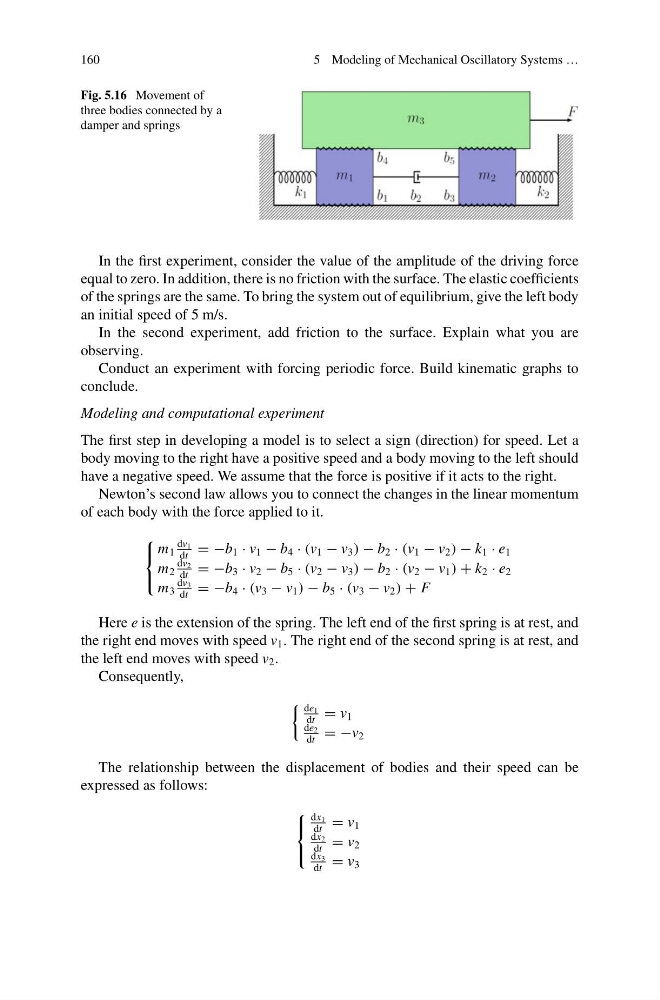
Fig. 5.16 Movement of
three bodies connected by a
damper and springs
In the first experiment, consider the value of the amplitude of the driving force
equal to zero. In addition, there is no friction with the surface. The elastic coefficients
of the springs are the same. To bring the system out of equilibrium, give the left body
an initial speed of 5 m/s.
In the second experiment, add friction to the surface. Explain what you are
observing.
Conduct an experiment with forcing periodic force. Build kinematic graphs to
conclude.
Modeling and computational experiment
The first step in developing a model is to select a sign (direction) for speed. Let a
body moving to the right have a positive speed and a body moving to the left should
have a negative speed. We assume that the force is positive if it acts to the right.
Newton’s second law allows you to connect the changes in the linear momentum
of each body with the force applied to it.
⎧
⎨
⎩
m 1
dv 1
dt
= −b 1 · v 1 − b 4 · (v 1 − v 3 ) − b 2 · (v 1 − v 2 ) − k 1 · e 1
m 2
dv 2
dt
= −b 3 · v 2 − b 5 · (v 2 − v 3 ) − b 2 · (v 2 − v 1 ) + k 2 · e 2
m 3
dv 3
dt
= −b 4 · (v 3 − v 1 ) − b 5 · (v 3 − v 2 ) + F
Here e is the extension of the spring. The left end of the first spring is at rest, and
the right end moves with speed v 1 . The right end of the second spring is at rest, and
the left end moves with speed v 2 .
Consequently,
de 1
dt
= v 1
de 2
dt
= −v 2
The relationship between the displacement of bodies and their speed can be
expressed as follows:
⎧
⎨
⎩
dx 1
dt
= v 1
dx 2
dt
= v 2
dx 3
dt
= v 3
5 Modeling of Mechanical Oscillatory Systems …
Fig. 5.16 Movement of
three bodies connected by a
damper and springs
In the first experiment, consider the value of the amplitude of the driving force
equal to zero. In addition, there is no friction with the surface. The elastic coefficients
of the springs are the same. To bring the system out of equilibrium, give the left body
an initial speed of 5 m/s.
In the second experiment, add friction to the surface. Explain what you are
observing.
Conduct an experiment with forcing periodic force. Build kinematic graphs to
conclude.
Modeling and computational experiment
The first step in developing a model is to select a sign (direction) for speed. Let a
body moving to the right have a positive speed and a body moving to the left should
have a negative speed. We assume that the force is positive if it acts to the right.
Newton’s second law allows you to connect the changes in the linear momentum
of each body with the force applied to it.
⎧
⎨
⎩
m 1
dv 1
dt
= −b 1 · v 1 − b 4 · (v 1 − v 3 ) − b 2 · (v 1 − v 2 ) − k 1 · e 1
m 2
dv 2
dt
= −b 3 · v 2 − b 5 · (v 2 − v 3 ) − b 2 · (v 2 − v 1 ) + k 2 · e 2
m 3
dv 3
dt
= −b 4 · (v 3 − v 1 ) − b 5 · (v 3 − v 2 ) + F
Here e is the extension of the spring. The left end of the first spring is at rest, and
the right end moves with speed v 1 . The right end of the second spring is at rest, and
the left end moves with speed v 2 .
Consequently,
de 1
dt
= v 1
de 2
dt
= −v 2
The relationship between the displacement of bodies and their speed can be
expressed as follows:
⎧
⎨
⎩
dx 1
dt
= v 1
dx 2
dt
= v 2
dx 3
dt
= v 3