

5.3 The Movement of Three Bodies Connected by a Damper ...
161
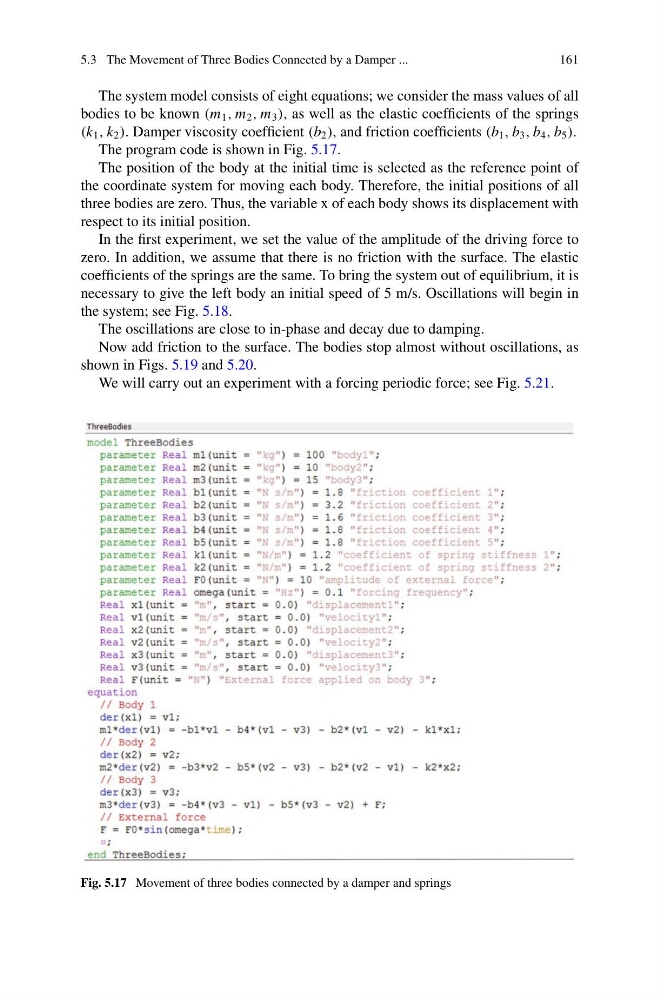
The system model consists of eight equations; we consider the mass values of all
bodies to be known (m 1 , m 2 , m 3 ), as well as the elastic coefficients of the springs
(k 1 , k 2 ). Damper viscosity coefficient (b 2 ), and friction coefficients (b 1 , b 3 , b 4 , b 5 ).
The program code is shown in Fig. 5.17.
The position of the body at the initial time is selected as the reference point of
the coordinate system for moving each body. Therefore, the initial positions of all
three bodies are zero. Thus, the variable x of each body shows its displacement with
respect to its initial position.
In the first experiment, we set the value of the amplitude of the driving force to
zero. In addition, we assume that there is no friction with the surface. The elastic
coefficients of the springs are the same. To bring the system out of equilibrium, it is
necessary to give the left body an initial speed of 5 m/s. Oscillations will begin in
the system; see Fig. 5.18.
The oscillations are close to in-phase and decay due to damping.
Now add friction to the surface. The bodies stop almost without oscillations, as
shown in Figs. 5.19 and 5.20.
We will carry out an experiment with a forcing periodic force; see Fig. 5.21.
Fig. 5.17 Movement of three bodies connected by a damper and springs
161
The system model consists of eight equations; we consider the mass values of all
bodies to be known (m 1 , m 2 , m 3 ), as well as the elastic coefficients of the springs
(k 1 , k 2 ). Damper viscosity coefficient (b 2 ), and friction coefficients (b 1 , b 3 , b 4 , b 5 ).
The program code is shown in Fig. 5.17.
The position of the body at the initial time is selected as the reference point of
the coordinate system for moving each body. Therefore, the initial positions of all
three bodies are zero. Thus, the variable x of each body shows its displacement with
respect to its initial position.
In the first experiment, we set the value of the amplitude of the driving force to
zero. In addition, we assume that there is no friction with the surface. The elastic
coefficients of the springs are the same. To bring the system out of equilibrium, it is
necessary to give the left body an initial speed of 5 m/s. Oscillations will begin in
the system; see Fig. 5.18.
The oscillations are close to in-phase and decay due to damping.
Now add friction to the surface. The bodies stop almost without oscillations, as
shown in Figs. 5.19 and 5.20.
We will carry out an experiment with a forcing periodic force; see Fig. 5.21.
Fig. 5.17 Movement of three bodies connected by a damper and springs