

158
5 Modeling of Mechanical Oscillatory Systems …
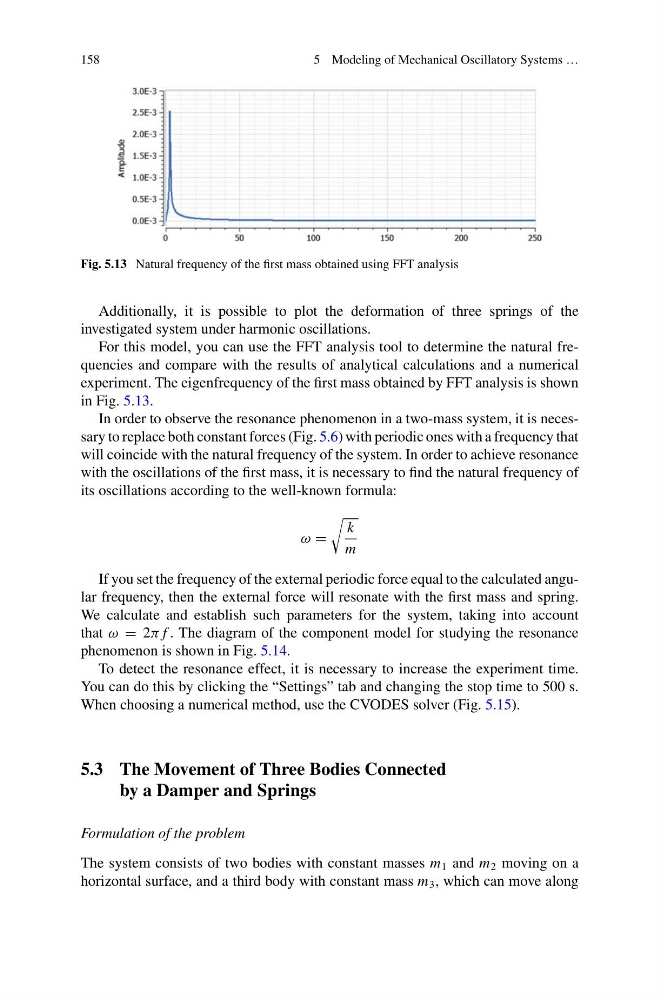
Fig. 5.13 Natural frequency of the first mass obtained using FFT analysis
Additionally, it is possible to plot the deformation of three springs of the
investigated system under harmonic oscillations.
For this model, you can use the FFT analysis tool to determine the natural frequencies and compare with the results of analytical calculations and a numerical
experiment. The eigenfrequency of the first mass obtained by FFT analysis is shown
in Fig. 5.13.
In order to observe the resonance phenomenon in a two-mass system, it is necessary to replace both constant forces (Fig. 5.6) with periodic ones with a frequency that
will coincide with the natural frequency of the system. In order to achieve resonance
with the oscillations of the first mass, it is necessary to find the natural frequency of
its oscillations according to the well-known formula:
ω =
k
m
If you set the frequency of the external periodic force equal to the calculated angular frequency, then the external force will resonate with the first mass and spring.
We calculate and establish such parameters for the system, taking into account
that ω = 2π f . The diagram of the component model for studying the resonance
phenomenon is shown in Fig. 5.14.
To detect the resonance effect, it is necessary to increase the experiment time.
You can do this by clicking the “Settings” tab and changing the stop time to 500 s.
When choosing a numerical method, use the CVODES solver (Fig. 5.15).
5.3 The Movement of Three Bodies Connected
by a Damper and Springs
Formulation of the problem
The system consists of two bodies with constant masses m 1 and m 2 moving on a
horizontal surface, and a third body with constant mass m 3 , which can move along
5 Modeling of Mechanical Oscillatory Systems …
Fig. 5.13 Natural frequency of the first mass obtained using FFT analysis
Additionally, it is possible to plot the deformation of three springs of the
investigated system under harmonic oscillations.
For this model, you can use the FFT analysis tool to determine the natural frequencies and compare with the results of analytical calculations and a numerical
experiment. The eigenfrequency of the first mass obtained by FFT analysis is shown
in Fig. 5.13.
In order to observe the resonance phenomenon in a two-mass system, it is necessary to replace both constant forces (Fig. 5.6) with periodic ones with a frequency that
will coincide with the natural frequency of the system. In order to achieve resonance
with the oscillations of the first mass, it is necessary to find the natural frequency of
its oscillations according to the well-known formula:
ω =
k
m
If you set the frequency of the external periodic force equal to the calculated angular frequency, then the external force will resonate with the first mass and spring.
We calculate and establish such parameters for the system, taking into account
that ω = 2π f . The diagram of the component model for studying the resonance
phenomenon is shown in Fig. 5.14.
To detect the resonance effect, it is necessary to increase the experiment time.
You can do this by clicking the “Settings” tab and changing the stop time to 500 s.
When choosing a numerical method, use the CVODES solver (Fig. 5.15).
5.3 The Movement of Three Bodies Connected
by a Damper and Springs
Formulation of the problem
The system consists of two bodies with constant masses m 1 and m 2 moving on a
horizontal surface, and a third body with constant mass m 3 , which can move along