

108
3 Computer Simulation of Dynamic Systems
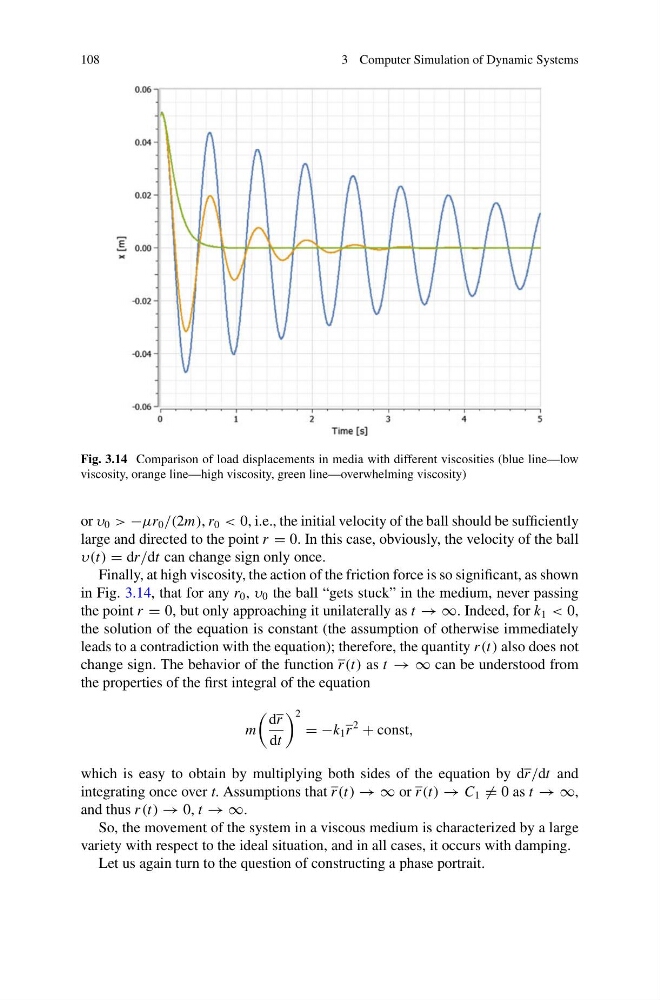
Fig. 3.14 Comparison of load displacements in media with different viscosities (blue line—low
viscosity, orange line—high viscosity, green line—overwhelming viscosity)
or υ 0 > −μr 0 /(2m), r 0 < 0, i.e., the initial velocity of the ball should be sufficiently
large and directed to the point r = 0. In this case, obviously, the velocity of the ball
υ(t) = dr/dt can change sign only once.
Finally, at high viscosity, the action of the friction force is so significant, as shown
in Fig. 3.14, that for any r 0 , υ 0 the ball “gets stuck” in the medium, never passing
the point r = 0, but only approaching it unilaterally as t → ∞. Indeed, for k 1 < 0,
the solution of the equation is constant (the assumption of otherwise immediately
leads to a contradiction with the equation); therefore, the quantity r (t) also does not
change sign. The behavior of the function r (t) as t → ∞ can be understood from
the properties of the first integral of the equation
m
dr
dt
2
= −k 1 r
2
+ const,
which is easy to obtain by multiplying both sides of the equation by dr /dt and
integrating once over t. Assumptions that r (t) → ∞ or r (t) → C 1 = 0 as t → ∞,
and thus r (t) → 0, t → ∞.
So, the movement of the system in a viscous medium is characterized by a large
variety with respect to the ideal situation, and in all cases, it occurs with damping.
Let us again turn to the question of constructing a phase portrait.
3 Computer Simulation of Dynamic Systems
Fig. 3.14 Comparison of load displacements in media with different viscosities (blue line—low
viscosity, orange line—high viscosity, green line—overwhelming viscosity)
or υ 0 > −μr 0 /(2m), r 0 < 0, i.e., the initial velocity of the ball should be sufficiently
large and directed to the point r = 0. In this case, obviously, the velocity of the ball
υ(t) = dr/dt can change sign only once.
Finally, at high viscosity, the action of the friction force is so significant, as shown
in Fig. 3.14, that for any r 0 , υ 0 the ball “gets stuck” in the medium, never passing
the point r = 0, but only approaching it unilaterally as t → ∞. Indeed, for k 1 < 0,
the solution of the equation is constant (the assumption of otherwise immediately
leads to a contradiction with the equation); therefore, the quantity r (t) also does not
change sign. The behavior of the function r (t) as t → ∞ can be understood from
the properties of the first integral of the equation
m
dr
dt
2
= −k 1 r
2
+ const,
which is easy to obtain by multiplying both sides of the equation by dr /dt and
integrating once over t. Assumptions that r (t) → ∞ or r (t) → C 1 = 0 as t → ∞,
and thus r (t) → 0, t → ∞.
So, the movement of the system in a viscous medium is characterized by a large
variety with respect to the ideal situation, and in all cases, it occurs with damping.
Let us again turn to the question of constructing a phase portrait.