

3.3 Hierarchical Principles of Model Building
107
At low viscosity, i.e., for k − μ
2
/(4m) = k 1 > 0, the solution r is given by the
formula r = A sin(ωt) + B cos(ωt), and for r (t), we have
r = r e
αt
= e
−tμ/(2m)
(A sin(ωt) + B cos(ωt))
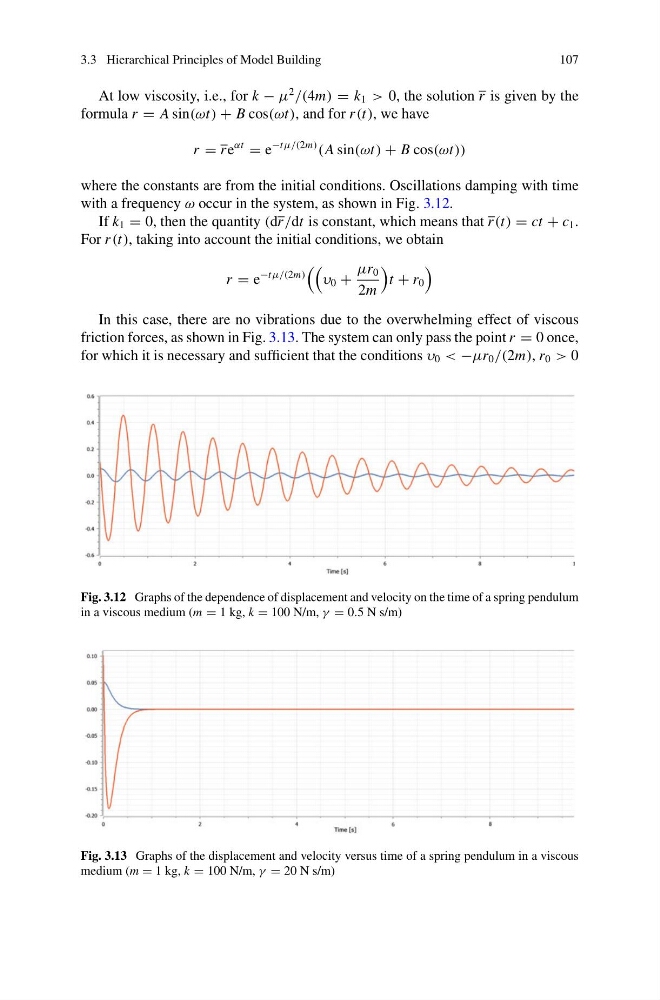
where the constants are from the initial conditions. Oscillations damping with time
with a frequency ω occur in the system, as shown in Fig. 3.12.
If k 1 = 0, then the quantity (dr /dt is constant, which means that r (t) = ct + c 1 .
For r (t), taking into account the initial conditions, we obtain
r = e
−tμ/(2m)
υ 0 +
μr 0
2m
t + r 0
In this case, there are no vibrations due to the overwhelming effect of viscous
friction forces, as shown in Fig. 3.13. The system can only pass the point r = 0 once,
for which it is necessary and sufficient that the conditions υ 0 < −μr 0 /(2m), r 0 > 0
Fig. 3.12 Graphs of the dependence of displacement and velocity on the time of a spring pendulum
in a viscous medium (m = 1 kg, k = 100 N/m, γ = 0.5 N s/m)
Fig. 3.13 Graphs of the displacement and velocity versus time of a spring pendulum in a viscous
medium (m = 1 kg, k = 100 N/m, γ = 20 N s/m)
107
At low viscosity, i.e., for k − μ
2
/(4m) = k 1 > 0, the solution r is given by the
formula r = A sin(ωt) + B cos(ωt), and for r (t), we have
r = r e
αt
= e
−tμ/(2m)
(A sin(ωt) + B cos(ωt))
where the constants are from the initial conditions. Oscillations damping with time
with a frequency ω occur in the system, as shown in Fig. 3.12.
If k 1 = 0, then the quantity (dr /dt is constant, which means that r (t) = ct + c 1 .
For r (t), taking into account the initial conditions, we obtain
r = e
−tμ/(2m)
υ 0 +
μr 0
2m
t + r 0
In this case, there are no vibrations due to the overwhelming effect of viscous
friction forces, as shown in Fig. 3.13. The system can only pass the point r = 0 once,
for which it is necessary and sufficient that the conditions υ 0 < −μr 0 /(2m), r 0 > 0
Fig. 3.12 Graphs of the dependence of displacement and velocity on the time of a spring pendulum
in a viscous medium (m = 1 kg, k = 100 N/m, γ = 0.5 N s/m)
Fig. 3.13 Graphs of the displacement and velocity versus time of a spring pendulum in a viscous
medium (m = 1 kg, k = 100 N/m, γ = 20 N s/m)