

3.3 Hierarchical Principles of Model Building
109
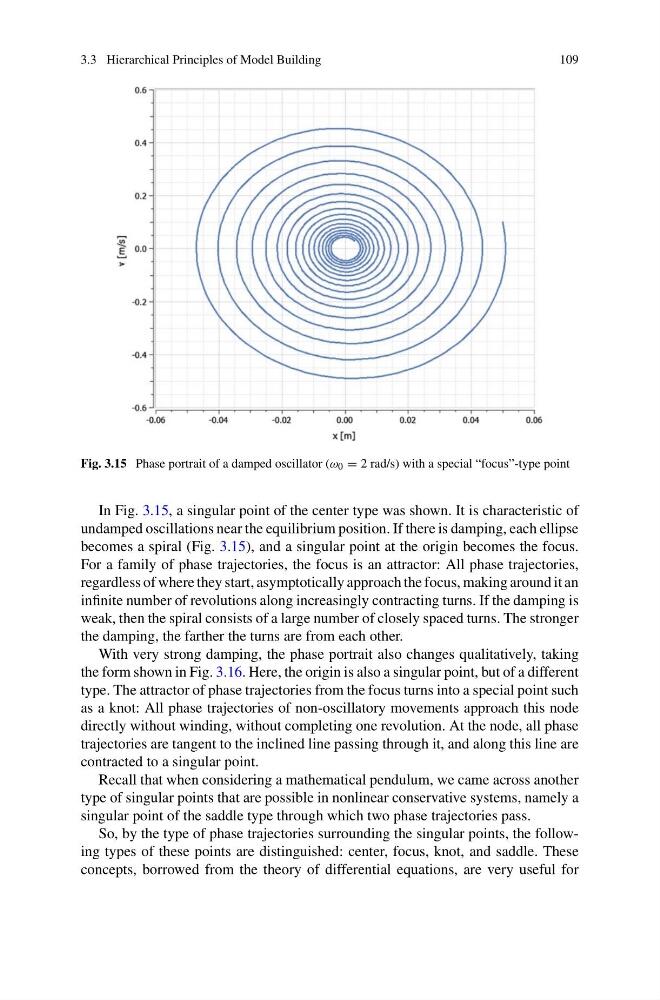
Fig. 3.15 Phase portrait of a damped oscillator (ω 0 = 2 rad/s) with a special “focus”-type point
In Fig. 3.15, a singular point of the center type was shown. It is characteristic of
undamped oscillations near the equilibrium position. If there is damping, each ellipse
becomes a spiral (Fig. 3.15), and a singular point at the origin becomes the focus.
For a family of phase trajectories, the focus is an attractor: All phase trajectories,
regardless of where they start, asymptotically approach the focus, making around it an
infinite number of revolutions along increasingly contracting turns. If the damping is
weak, then the spiral consists of a large number of closely spaced turns. The stronger
the damping, the farther the turns are from each other.
With very strong damping, the phase portrait also changes qualitatively, taking
the form shown in Fig. 3.16. Here, the origin is also a singular point, but of a different
type. The attractor of phase trajectories from the focus turns into a special point such
as a knot: All phase trajectories of non-oscillatory movements approach this node
directly without winding, without completing one revolution. At the node, all phase
trajectories are tangent to the inclined line passing through it, and along this line are
contracted to a singular point.
Recall that when considering a mathematical pendulum, we came across another
type of singular points that are possible in nonlinear conservative systems, namely a
singular point of the saddle type through which two phase trajectories pass.
So, by the type of phase trajectories surrounding the singular points, the following types of these points are distinguished: center, focus, knot, and saddle. These
concepts, borrowed from the theory of differential equations, are very useful for
109
Fig. 3.15 Phase portrait of a damped oscillator (ω 0 = 2 rad/s) with a special “focus”-type point
In Fig. 3.15, a singular point of the center type was shown. It is characteristic of
undamped oscillations near the equilibrium position. If there is damping, each ellipse
becomes a spiral (Fig. 3.15), and a singular point at the origin becomes the focus.
For a family of phase trajectories, the focus is an attractor: All phase trajectories,
regardless of where they start, asymptotically approach the focus, making around it an
infinite number of revolutions along increasingly contracting turns. If the damping is
weak, then the spiral consists of a large number of closely spaced turns. The stronger
the damping, the farther the turns are from each other.
With very strong damping, the phase portrait also changes qualitatively, taking
the form shown in Fig. 3.16. Here, the origin is also a singular point, but of a different
type. The attractor of phase trajectories from the focus turns into a special point such
as a knot: All phase trajectories of non-oscillatory movements approach this node
directly without winding, without completing one revolution. At the node, all phase
trajectories are tangent to the inclined line passing through it, and along this line are
contracted to a singular point.
Recall that when considering a mathematical pendulum, we came across another
type of singular points that are possible in nonlinear conservative systems, namely a
singular point of the saddle type through which two phase trajectories pass.
So, by the type of phase trajectories surrounding the singular points, the following types of these points are distinguished: center, focus, knot, and saddle. These
concepts, borrowed from the theory of differential equations, are very useful for