

3.2 Fundamental Principles for Mathematical Models Development
103
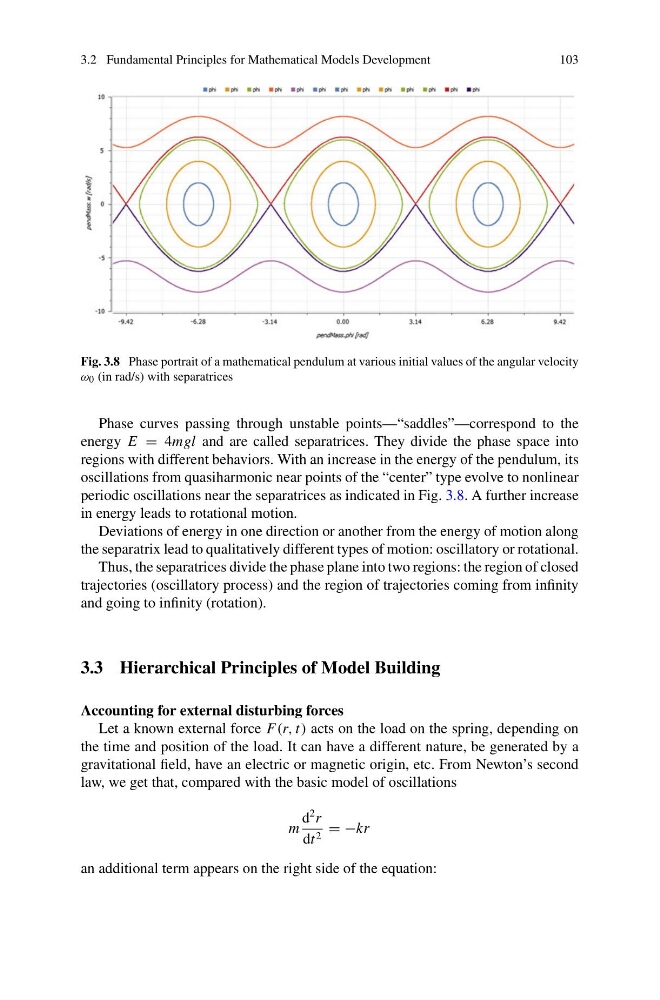
Fig. 3.8 Phase portrait of a mathematical pendulum at various initial values of the angular velocity
ω 0 (in rad/s) with separatrices
Phase curves passing through unstable points—“saddles”—correspond to the
energy E = 4mgl and are called separatrices. They divide the phase space into
regions with different behaviors. With an increase in the energy of the pendulum, its
oscillations from quasiharmonic near points of the “center” type evolve to nonlinear
periodic oscillations near the separatrices as indicated in Fig. 3.8. A further increase
in energy leads to rotational motion.
Deviations of energy in one direction or another from the energy of motion along
the separatrix lead to qualitatively different types of motion: oscillatory or rotational.
Thus, the separatrices divide the phase plane into two regions: the region of closed
trajectories (oscillatory process) and the region of trajectories coming from infinity
and going to infinity (rotation).
3.3 Hierarchical Principles of Model Building
Accounting for external disturbing forces
Let a known external force F(r, t) acts on the load on the spring, depending on
the time and position of the load. It can have a different nature, be generated by a
gravitational field, have an electric or magnetic origin, etc. From Newton’s second
law, we get that, compared with the basic model of oscillations
m
d
2 r
dt 2 = −kr
an additional term appears on the right side of the equation:
103
Fig. 3.8 Phase portrait of a mathematical pendulum at various initial values of the angular velocity
ω 0 (in rad/s) with separatrices
Phase curves passing through unstable points—“saddles”—correspond to the
energy E = 4mgl and are called separatrices. They divide the phase space into
regions with different behaviors. With an increase in the energy of the pendulum, its
oscillations from quasiharmonic near points of the “center” type evolve to nonlinear
periodic oscillations near the separatrices as indicated in Fig. 3.8. A further increase
in energy leads to rotational motion.
Deviations of energy in one direction or another from the energy of motion along
the separatrix lead to qualitatively different types of motion: oscillatory or rotational.
Thus, the separatrices divide the phase plane into two regions: the region of closed
trajectories (oscillatory process) and the region of trajectories coming from infinity
and going to infinity (rotation).
3.3 Hierarchical Principles of Model Building
Accounting for external disturbing forces
Let a known external force F(r, t) acts on the load on the spring, depending on
the time and position of the load. It can have a different nature, be generated by a
gravitational field, have an electric or magnetic origin, etc. From Newton’s second
law, we get that, compared with the basic model of oscillations
m
d
2 r
dt 2 = −kr
an additional term appears on the right side of the equation: