

7.4 Hybrid Capacitors
215
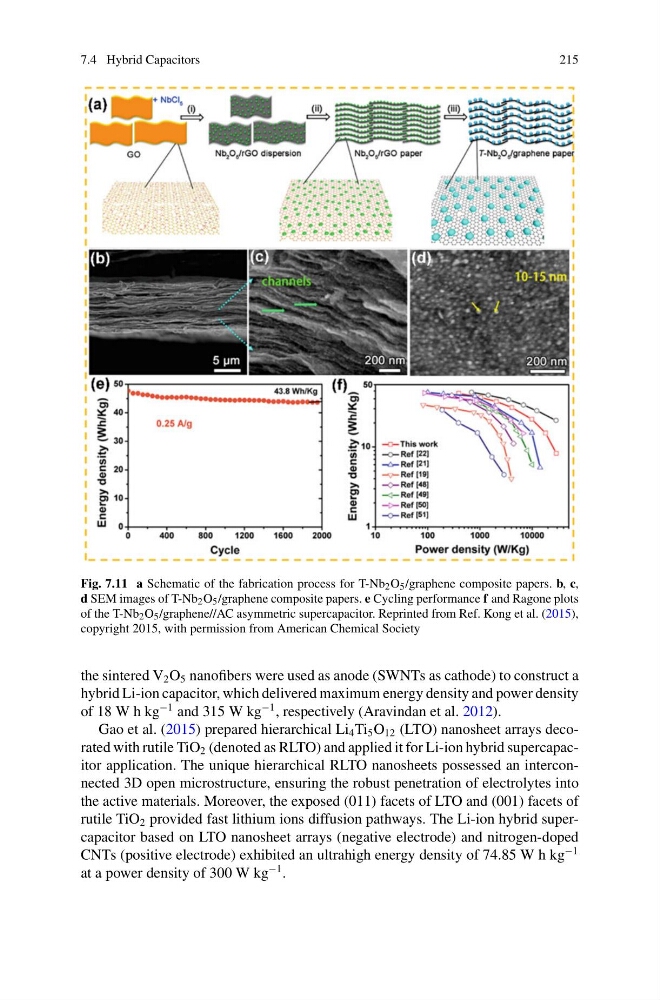
Fig. 7.11 a Schematic of the fabrication process for T-Nb 2 O 5 /graphene composite papers. b, c,
d SEM images of T-Nb 2 O 5 /graphene composite papers. e Cycling performance f and Ragone plots
of the T-Nb 2 O 5 /graphene//AC asymmetric supercapacitor. Reprinted from Ref. Kong et al. (2015),
copyright 2015, with permission from American Chemical Society
the sintered V 2 O 5 nanofibers were used as anode (SWNTs as cathode) to construct a
hybrid Li-ion capacitor, which delivered maximum energy density and power density
of 18 W h kg
−1 and 315 W kg
−1 , respectively (Aravindan et al. 2012).
Gao et al. (2015) prepared hierarchical Li 4 Ti 5 O 12 (LTO) nanosheet arrays decorated with rutile TiO 2 (denoted as RLTO) and applied it for Li-ion hybrid supercapacitor application. The unique hierarchical RLTO nanosheets possessed an interconnected 3D open microstructure, ensuring the robust penetration of electrolytes into
the active materials. Moreover, the exposed (011) facets of LTO and (001) facets of
rutile TiO 2 provided fast lithium ions diffusion pathways. The Li-ion hybrid supercapacitor based on LTO nanosheet arrays (negative electrode) and nitrogen-doped
CNTs (positive electrode) exhibited an ultrahigh energy density of 74.85 W h kg
−1
at a power density of 300 W kg
−1 .
215
Fig. 7.11 a Schematic of the fabrication process for T-Nb 2 O 5 /graphene composite papers. b, c,
d SEM images of T-Nb 2 O 5 /graphene composite papers. e Cycling performance f and Ragone plots
of the T-Nb 2 O 5 /graphene//AC asymmetric supercapacitor. Reprinted from Ref. Kong et al. (2015),
copyright 2015, with permission from American Chemical Society
the sintered V 2 O 5 nanofibers were used as anode (SWNTs as cathode) to construct a
hybrid Li-ion capacitor, which delivered maximum energy density and power density
of 18 W h kg
−1 and 315 W kg
−1 , respectively (Aravindan et al. 2012).
Gao et al. (2015) prepared hierarchical Li 4 Ti 5 O 12 (LTO) nanosheet arrays decorated with rutile TiO 2 (denoted as RLTO) and applied it for Li-ion hybrid supercapacitor application. The unique hierarchical RLTO nanosheets possessed an interconnected 3D open microstructure, ensuring the robust penetration of electrolytes into
the active materials. Moreover, the exposed (011) facets of LTO and (001) facets of
rutile TiO 2 provided fast lithium ions diffusion pathways. The Li-ion hybrid supercapacitor based on LTO nanosheet arrays (negative electrode) and nitrogen-doped
CNTs (positive electrode) exhibited an ultrahigh energy density of 74.85 W h kg
−1
at a power density of 300 W kg
−1 .