

170
6 Nanomaterials for Batteries
the Li 2 S as the final discharge product. Due to the very poor conductivity of sulfur
element, sulfur composites as the positive electrodes usually consist of sulfur element,
conductive agents, porous carbon, and binders (Manthiram et al. 2013).
During the discharge process, the sulfur on the positive electrodes is gradually
reduced to form an intermediate product of lithium polysulfide, which finally is
completely reduced to lithium sulfide; on the negative electrode, lithium loses electrons and is oxidized into lithium ions to enter the electrolyte. During the charging
process, lithium sulfide is re-oxidized to sulfur at the positive electrode, and liberated lithium ions migrate back to the negative electrode. In addition, lithium ions
are reduced and deposited as lithium metal on the surface of the negative electrode.
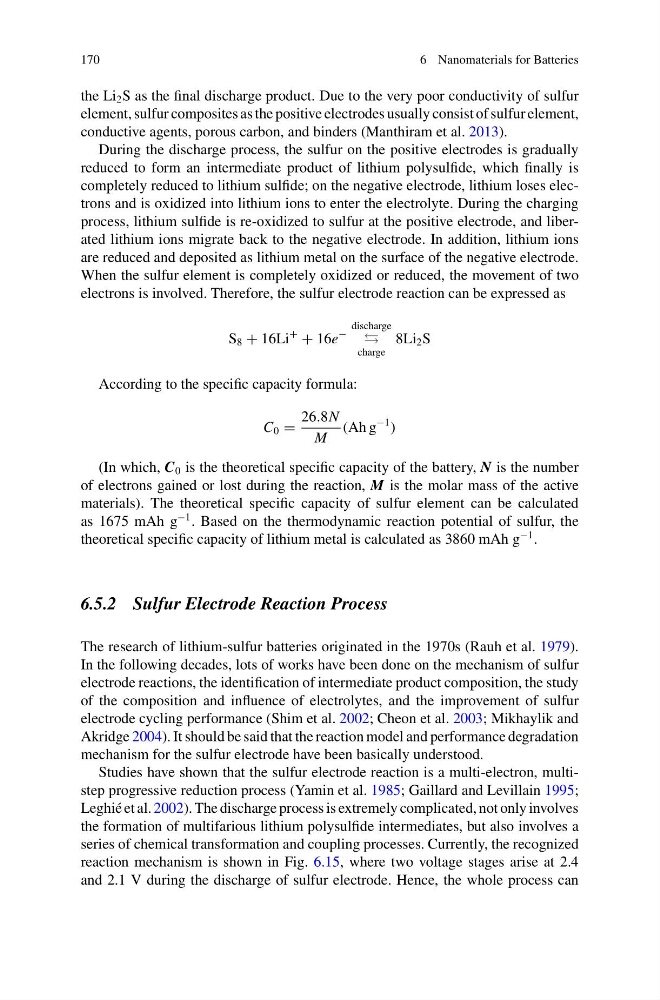
When the sulfur element is completely oxidized or reduced, the movement of two
electrons is involved. Therefore, the sulfur electrode reaction can be expressed as
S 8 + 16Li
+
+ 16e
−
discharge
charge
8Li 2 S
According to the specific capacity formula:
C 0 =
26.8N
M
(Ah g
−1
)
(In which, C 0 is the theoretical specific capacity of the battery, N is the number
of electrons gained or lost during the reaction, M is the molar mass of the active
materials). The theoretical specific capacity of sulfur element can be calculated
as 1675 mAh g
−1 . Based on the thermodynamic reaction potential of sulfur, the
theoretical specific capacity of lithium metal is calculated as 3860 mAh g
−1 .
6.5.2 Sulfur Electrode Reaction Process
The research of lithium-sulfur batteries originated in the 1970s (Rauh et al. 1979).
In the following decades, lots of works have been done on the mechanism of sulfur
electrode reactions, the identification of intermediate product composition, the study
of the composition and influence of electrolytes, and the improvement of sulfur
electrode cycling performance (Shim et al. 2002; Cheon et al. 2003; Mikhaylik and
Akridge 2004). It should be said that the reaction model and performance degradation
mechanism for the sulfur electrode have been basically understood.
Studies have shown that the sulfur electrode reaction is a multi-electron, multistep progressive reduction process (Yamin et al. 1985; Gaillard and Levillain 1995;
Leghié et al. 2002). The discharge process is extremely complicated, not only involves
the formation of multifarious lithium polysulfide intermediates, but also involves a
series of chemical transformation and coupling processes. Currently, the recognized
reaction mechanism is shown in Fig. 6.15, where two voltage stages arise at 2.4
and 2.1 V during the discharge of sulfur electrode. Hence, the whole process can
6 Nanomaterials for Batteries
the Li 2 S as the final discharge product. Due to the very poor conductivity of sulfur
element, sulfur composites as the positive electrodes usually consist of sulfur element,
conductive agents, porous carbon, and binders (Manthiram et al. 2013).
During the discharge process, the sulfur on the positive electrodes is gradually
reduced to form an intermediate product of lithium polysulfide, which finally is
completely reduced to lithium sulfide; on the negative electrode, lithium loses electrons and is oxidized into lithium ions to enter the electrolyte. During the charging
process, lithium sulfide is re-oxidized to sulfur at the positive electrode, and liberated lithium ions migrate back to the negative electrode. In addition, lithium ions
are reduced and deposited as lithium metal on the surface of the negative electrode.
When the sulfur element is completely oxidized or reduced, the movement of two
electrons is involved. Therefore, the sulfur electrode reaction can be expressed as
S 8 + 16Li
+
+ 16e
−
discharge
charge
8Li 2 S
According to the specific capacity formula:
C 0 =
26.8N
M
(Ah g
−1
)
(In which, C 0 is the theoretical specific capacity of the battery, N is the number
of electrons gained or lost during the reaction, M is the molar mass of the active
materials). The theoretical specific capacity of sulfur element can be calculated
as 1675 mAh g
−1 . Based on the thermodynamic reaction potential of sulfur, the
theoretical specific capacity of lithium metal is calculated as 3860 mAh g
−1 .
6.5.2 Sulfur Electrode Reaction Process
The research of lithium-sulfur batteries originated in the 1970s (Rauh et al. 1979).
In the following decades, lots of works have been done on the mechanism of sulfur
electrode reactions, the identification of intermediate product composition, the study
of the composition and influence of electrolytes, and the improvement of sulfur
electrode cycling performance (Shim et al. 2002; Cheon et al. 2003; Mikhaylik and
Akridge 2004). It should be said that the reaction model and performance degradation
mechanism for the sulfur electrode have been basically understood.
Studies have shown that the sulfur electrode reaction is a multi-electron, multistep progressive reduction process (Yamin et al. 1985; Gaillard and Levillain 1995;
Leghié et al. 2002). The discharge process is extremely complicated, not only involves
the formation of multifarious lithium polysulfide intermediates, but also involves a
series of chemical transformation and coupling processes. Currently, the recognized
reaction mechanism is shown in Fig. 6.15, where two voltage stages arise at 2.4
and 2.1 V during the discharge of sulfur electrode. Hence, the whole process can