

6.5 Lithium-Sulfur Battery
169
Table 6.6 Electrochemical reaction and energy density of several energy storage devices
Battery system
Chemical reaction
Voltage (V)
Theoretical
density
(Wh kg −1 )
Actual density
(Wh kg −1 )
Lithium-ion
battery
0.5LiC 6 +
Li 0.5 CoO 2 ↔
3C + LiCoO 2
3.8
387
200
Lithium-sulfur
battery
2Li + S ↔ Li 2 S
2.2
2600
350
the most important, the sulfur element on the earth is abundant, low cost, environmentally friendly, and other characteristics, which is very useful for the application
of lithium batteries.
As early as 1962, Herbet and Ulam proposed the assumption of using sulfur
element as electrode materials (Herbert and Ulam 1962). Subsequently, all kinds of
alkali-sulfur battery systems were researched and reported, and most of according
works are concentrated on the high temperature sodium-sulfur batteries and the
room-temperature lithium-sulfur batteries (Abraham et al. 1978).
6.5.1 Working Principle
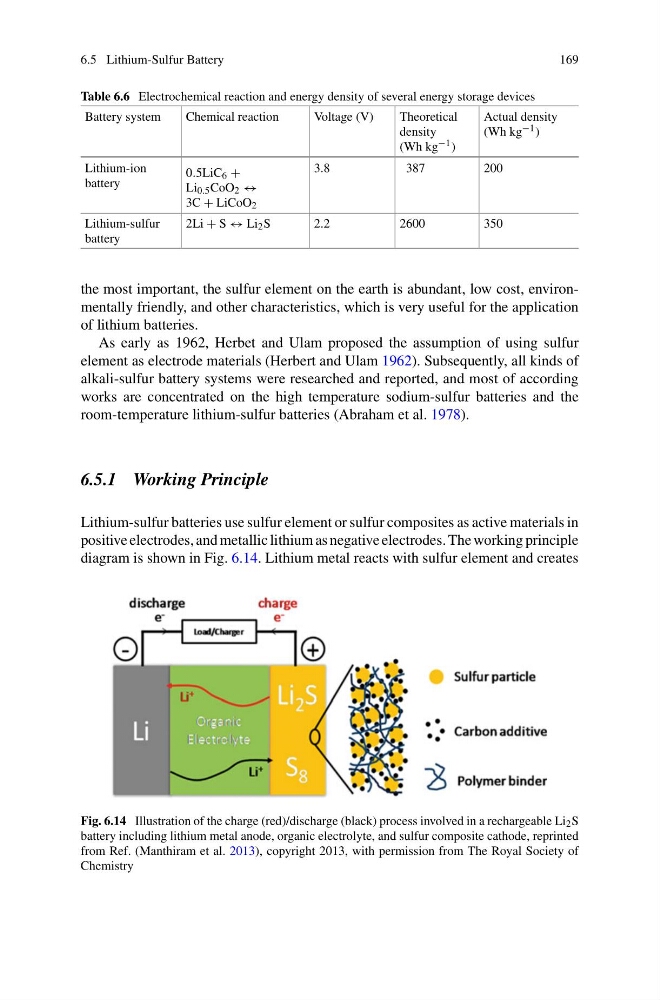
Lithium-sulfur batteries use sulfur element or sulfur composites as active materials in
positive electrodes, and metallic lithium as negative electrodes. The working principle
diagram is shown in Fig. 6.14. Lithium metal reacts with sulfur element and creates
Fig. 6.14 Illustration of the charge (red)/discharge (black) process involved in a rechargeable Li 2 S
battery including lithium metal anode, organic electrolyte, and sulfur composite cathode, reprinted
from Ref. (Manthiram et al. 2013), copyright 2013, with permission from The Royal Society of
Chemistry
169
Table 6.6 Electrochemical reaction and energy density of several energy storage devices
Battery system
Chemical reaction
Voltage (V)
Theoretical
density
(Wh kg −1 )
Actual density
(Wh kg −1 )
Lithium-ion
battery
0.5LiC 6 +
Li 0.5 CoO 2 ↔
3C + LiCoO 2
3.8
387
200
Lithium-sulfur
battery
2Li + S ↔ Li 2 S
2.2
2600
350
the most important, the sulfur element on the earth is abundant, low cost, environmentally friendly, and other characteristics, which is very useful for the application
of lithium batteries.
As early as 1962, Herbet and Ulam proposed the assumption of using sulfur
element as electrode materials (Herbert and Ulam 1962). Subsequently, all kinds of
alkali-sulfur battery systems were researched and reported, and most of according
works are concentrated on the high temperature sodium-sulfur batteries and the
room-temperature lithium-sulfur batteries (Abraham et al. 1978).
6.5.1 Working Principle
Lithium-sulfur batteries use sulfur element or sulfur composites as active materials in
positive electrodes, and metallic lithium as negative electrodes. The working principle
diagram is shown in Fig. 6.14. Lithium metal reacts with sulfur element and creates
Fig. 6.14 Illustration of the charge (red)/discharge (black) process involved in a rechargeable Li 2 S
battery including lithium metal anode, organic electrolyte, and sulfur composite cathode, reprinted
from Ref. (Manthiram et al. 2013), copyright 2013, with permission from The Royal Society of
Chemistry