

6.5 Lithium-Sulfur Battery
171
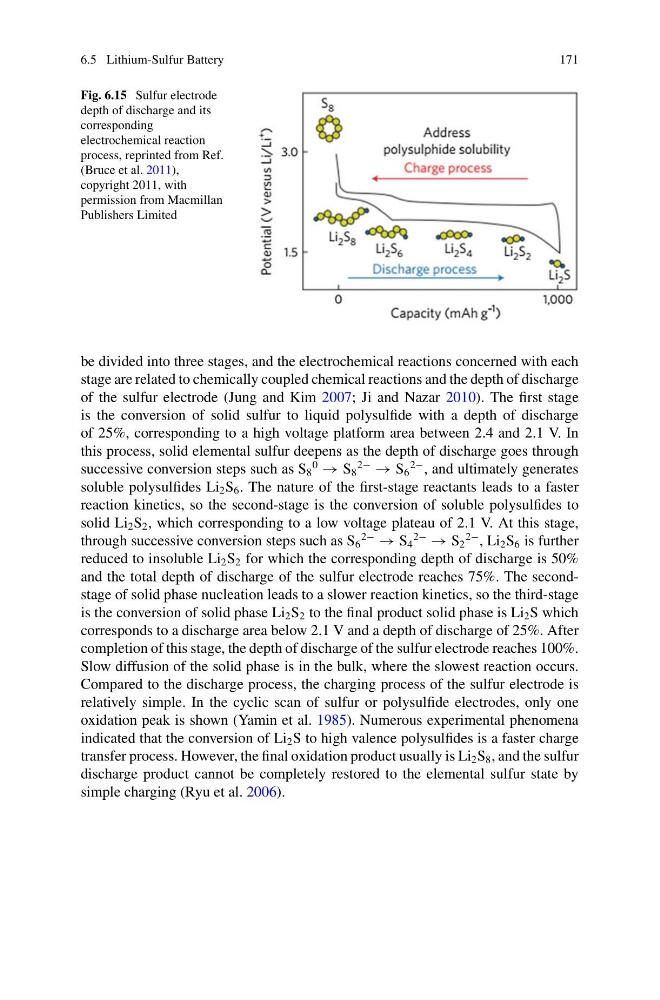
Fig. 6.15 Sulfur electrode
depth of discharge and its
corresponding
electrochemical reaction
process, reprinted from Ref.
(Bruce et al. 2011),
copyright 2011, with
permission from Macmillan
Publishers Limited
be divided into three stages, and the electrochemical reactions concerned with each
stage are related to chemically coupled chemical reactions and the depth of discharge
of the sulfur electrode (Jung and Kim 2007; Ji and Nazar 2010). The first stage
is the conversion of solid sulfur to liquid polysulfide with a depth of discharge
of 25%, corresponding to a high voltage platform area between 2.4 and 2.1 V. In
this process, solid elemental sulfur deepens as the depth of discharge goes through
successive conversion steps such as S 8
0
→ S 8
2−
→ S 6
2− , and ultimately generates
soluble polysulfides Li 2 S 6 . The nature of the first-stage reactants leads to a faster
reaction kinetics, so the second-stage is the conversion of soluble polysulfides to
solid Li 2 S 2 , which corresponding to a low voltage plateau of 2.1 V. At this stage,
through successive conversion steps such as S 6
2−
→ S 4
2−
→ S 2
2− , Li 2 S 6 is further
reduced to insoluble Li 2 S 2 for which the corresponding depth of discharge is 50%
and the total depth of discharge of the sulfur electrode reaches 75%. The secondstage of solid phase nucleation leads to a slower reaction kinetics, so the third-stage
is the conversion of solid phase Li 2 S 2 to the final product solid phase is Li 2 S which
corresponds to a discharge area below 2.1 V and a depth of discharge of 25%. After
completion of this stage, the depth of discharge of the sulfur electrode reaches 100%.
Slow diffusion of the solid phase is in the bulk, where the slowest reaction occurs.
Compared to the discharge process, the charging process of the sulfur electrode is
relatively simple. In the cyclic scan of sulfur or polysulfide electrodes, only one
oxidation peak is shown (Yamin et al. 1985). Numerous experimental phenomena
indicated that the conversion of Li 2 S to high valence polysulfides is a faster charge
transfer process. However, the final oxidation product usually is Li 2 S 8 , and the sulfur
discharge product cannot be completely restored to the elemental sulfur state by
simple charging (Ryu et al. 2006).
171
Fig. 6.15 Sulfur electrode
depth of discharge and its
corresponding
electrochemical reaction
process, reprinted from Ref.
(Bruce et al. 2011),
copyright 2011, with
permission from Macmillan
Publishers Limited
be divided into three stages, and the electrochemical reactions concerned with each
stage are related to chemically coupled chemical reactions and the depth of discharge
of the sulfur electrode (Jung and Kim 2007; Ji and Nazar 2010). The first stage
is the conversion of solid sulfur to liquid polysulfide with a depth of discharge
of 25%, corresponding to a high voltage platform area between 2.4 and 2.1 V. In
this process, solid elemental sulfur deepens as the depth of discharge goes through
successive conversion steps such as S 8
0
→ S 8
2−
→ S 6
2− , and ultimately generates
soluble polysulfides Li 2 S 6 . The nature of the first-stage reactants leads to a faster
reaction kinetics, so the second-stage is the conversion of soluble polysulfides to
solid Li 2 S 2 , which corresponding to a low voltage plateau of 2.1 V. At this stage,
through successive conversion steps such as S 6
2−
→ S 4
2−
→ S 2
2− , Li 2 S 6 is further
reduced to insoluble Li 2 S 2 for which the corresponding depth of discharge is 50%
and the total depth of discharge of the sulfur electrode reaches 75%. The secondstage of solid phase nucleation leads to a slower reaction kinetics, so the third-stage
is the conversion of solid phase Li 2 S 2 to the final product solid phase is Li 2 S which
corresponds to a discharge area below 2.1 V and a depth of discharge of 25%. After
completion of this stage, the depth of discharge of the sulfur electrode reaches 100%.
Slow diffusion of the solid phase is in the bulk, where the slowest reaction occurs.
Compared to the discharge process, the charging process of the sulfur electrode is
relatively simple. In the cyclic scan of sulfur or polysulfide electrodes, only one
oxidation peak is shown (Yamin et al. 1985). Numerous experimental phenomena
indicated that the conversion of Li 2 S to high valence polysulfides is a faster charge
transfer process. However, the final oxidation product usually is Li 2 S 8 , and the sulfur
discharge product cannot be completely restored to the elemental sulfur state by
simple charging (Ryu et al. 2006).