

164
6 Nanomaterials for Batteries
time spent on charging. As for medium-sized lightweight submarine power system,
its energy density can reach 500 Wh/L and the power can up to 2.3 kW at 60 V. What’s
more, it can continuously discharge for 50 h at 2 kW, which ensures the underwater
vehicles travel 50–300 km. Although a portable battery that is used directly in military
communications devices weighs less than 4.5 kg, it can produce 300 W of power.
Compared with current lithium batteries, the cycle consumption is lower and the
energy density is greater; it has higher energy efficiency than internal combustion
engines and ordinary batteries.
6.4.5.3 Lithium-Air Batteries
In the same volume or mass, battery capacity of lithium-air is 30% larger than the
capacity of lithium-ion battery (Lee et al. 2011). The cost of lithium-air battery
is lower in the production process without chemical processing and chemical
processing. In particular, because of standardized 3 V voltage platform, lithium-air
battery is not only easy to combine batteries suitable for various electrical appliances, but also is the best supporting battery for large-scale commercialization of
2 V semiconductor chips. Therefore, lithium-air batteries have become a research
hotspot in recent years.
Lithium-air batteries currently have four configurations. Three configurations use
liquid electrolytes, including inert organic electrolytes, aqueous electrolytes, and
hybrids. The other configuration uses solid-state electrolytes. Currently, the studies
are directed at polar aprotic electrolyte systems, lithium ions are transported between
the anode electrode and the cathode electrode of the porous carbon structure and
combined with oxygen, and the resulting Li 2 O 2 stays on the positive electrode.
Oxygen is provided by the external environment, so the theoretical energy density
reaches 13 kWh/kg. For inert electrolyte systems (organic, ionic liquids) and all-solid
electrolyte systems, the battery response is
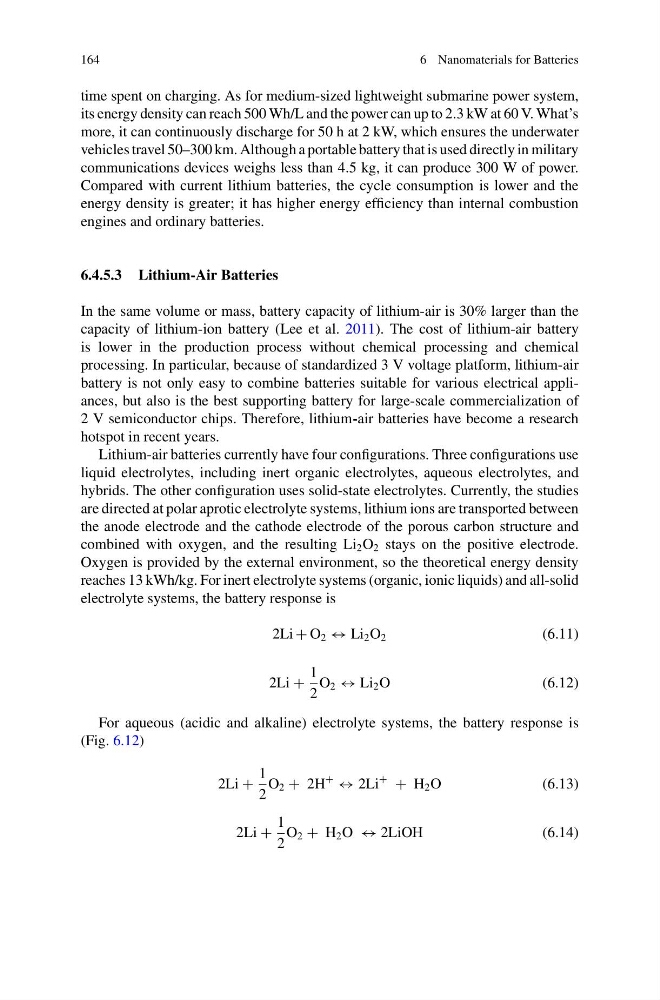
2Li + O 2 ↔ Li 2 O 2
(6.11)
2Li +
1
2
O 2 ↔ Li 2 O
(6.12)
For aqueous (acidic and alkaline) electrolyte systems, the battery response is
(Fig. 6.12)
2Li +
1
2
O 2 + 2H
+
↔ 2Li
+
+ H 2 O
(6.13)
2Li +
1
2
O 2 + H 2 O ↔ 2LiOH
(6.14)
6 Nanomaterials for Batteries
time spent on charging. As for medium-sized lightweight submarine power system,
its energy density can reach 500 Wh/L and the power can up to 2.3 kW at 60 V. What’s
more, it can continuously discharge for 50 h at 2 kW, which ensures the underwater
vehicles travel 50–300 km. Although a portable battery that is used directly in military
communications devices weighs less than 4.5 kg, it can produce 300 W of power.
Compared with current lithium batteries, the cycle consumption is lower and the
energy density is greater; it has higher energy efficiency than internal combustion
engines and ordinary batteries.
6.4.5.3 Lithium-Air Batteries
In the same volume or mass, battery capacity of lithium-air is 30% larger than the
capacity of lithium-ion battery (Lee et al. 2011). The cost of lithium-air battery
is lower in the production process without chemical processing and chemical
processing. In particular, because of standardized 3 V voltage platform, lithium-air
battery is not only easy to combine batteries suitable for various electrical appliances, but also is the best supporting battery for large-scale commercialization of
2 V semiconductor chips. Therefore, lithium-air batteries have become a research
hotspot in recent years.
Lithium-air batteries currently have four configurations. Three configurations use
liquid electrolytes, including inert organic electrolytes, aqueous electrolytes, and
hybrids. The other configuration uses solid-state electrolytes. Currently, the studies
are directed at polar aprotic electrolyte systems, lithium ions are transported between
the anode electrode and the cathode electrode of the porous carbon structure and
combined with oxygen, and the resulting Li 2 O 2 stays on the positive electrode.
Oxygen is provided by the external environment, so the theoretical energy density
reaches 13 kWh/kg. For inert electrolyte systems (organic, ionic liquids) and all-solid
electrolyte systems, the battery response is
2Li + O 2 ↔ Li 2 O 2
(6.11)
2Li +
1
2
O 2 ↔ Li 2 O
(6.12)
For aqueous (acidic and alkaline) electrolyte systems, the battery response is
(Fig. 6.12)
2Li +
1
2
O 2 + 2H
+
↔ 2Li
+
+ H 2 O
(6.13)
2Li +
1
2
O 2 + H 2 O ↔ 2LiOH
(6.14)